

7 – Primary Production, Nutrient Recycling and Energy Flow through Coral Reef Ecosystems
69
surfaces. Particle feeders are part of an important energy and nutrient loop (see next section). Particle
feeders range from the largest (whale sharks) to the
smallest organisms (copepods) of reef associated species. They include sponges, which use special cells
called choanocytes to drive water through small channels and trap particles. Many simple (hydroids, anemones) and advanced invertebrates (polychaetes, bivalve
molluscs, ascidians) use cilia to drive water past their
feeding structures and use sticky mucous to trap them
prior to ingesting them. Other organisms such as crinoids use tube feet to pick particles out of the water
while orienting feeding structures into the currents.
Polychaete worms and sea cucumbers have specialised
feeding structures that allow them to feed on particles
deposited on sediment surfaces. Some fish actively pick
particles out of the water column, while others sift
sediments using their gill rakers to find small pieces of
detritus for ingesting.
The assemblage of particle feeders along the reef
crest has been termed the ‘wall of mouths’. The ‘wall’
plays a crucial role in the accumulation of energy and
nutrients on coral reefs. Few large zooplankton from
the open ocean survive contact when they float by the
cloud of particle feeding fishes at the edges of coral
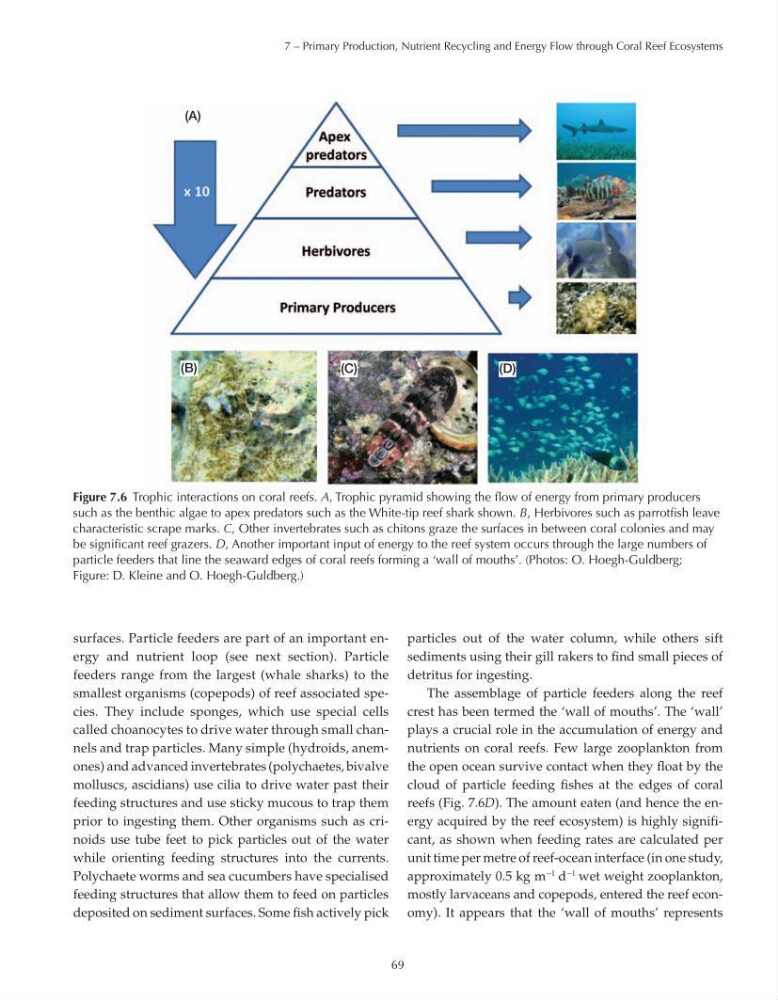
reefs (Fig. 7.6D). The amount eaten (and hence the energy acquired by the reef ecosystem) is highly significant, as shown when feeding rates are calculated per
unit time per metre of reef-ocean interface (in one study,
approximately 0.5 kg m
l d
l wet weight zooplankton,
mostly larvaceans and copepods, entered the reef economy). It appears that the ‘wall of mouths’ represents
(A)
(B)
(C)
(D)
Figure 7.6 Trophic interactions on coral reefs. A, Trophic pyramid showing the flow of energy from primary producers
such as the benthic algae to apex predators such as the White-tip reef shark shown. B, Herbivores such as parrotfish leave
characteristic scrape marks. C, Other invertebrates such as chitons graze the surfaces in between coral colonies and may
be significant reef grazers. D, Another important input of energy to the reef system occurs through the large numbers of
particle feeders that line the seaward edges of coral reefs forming a ‘wall of mouths’. (Photos: O. Hoegh-Guldberg;
Figure: D. Kleine and O. Hoegh-Guldberg.)
69
surfaces. Particle feeders are part of an important energy and nutrient loop (see next section). Particle
feeders range from the largest (whale sharks) to the
smallest organisms (copepods) of reef associated species. They include sponges, which use special cells
called choanocytes to drive water through small channels and trap particles. Many simple (hydroids, anemones) and advanced invertebrates (polychaetes, bivalve
molluscs, ascidians) use cilia to drive water past their
feeding structures and use sticky mucous to trap them
prior to ingesting them. Other organisms such as crinoids use tube feet to pick particles out of the water
while orienting feeding structures into the currents.
Polychaete worms and sea cucumbers have specialised
feeding structures that allow them to feed on particles
deposited on sediment surfaces. Some fish actively pick
particles out of the water column, while others sift
sediments using their gill rakers to find small pieces of
detritus for ingesting.
The assemblage of particle feeders along the reef
crest has been termed the ‘wall of mouths’. The ‘wall’
plays a crucial role in the accumulation of energy and
nutrients on coral reefs. Few large zooplankton from
the open ocean survive contact when they float by the
cloud of particle feeding fishes at the edges of coral
reefs (Fig. 7.6D). The amount eaten (and hence the energy acquired by the reef ecosystem) is highly significant, as shown when feeding rates are calculated per
unit time per metre of reef-ocean interface (in one study,
approximately 0.5 kg m
l d
l wet weight zooplankton,
mostly larvaceans and copepods, entered the reef economy). It appears that the ‘wall of mouths’ represents
(A)
(B)
(C)
(D)
Figure 7.6 Trophic interactions on coral reefs. A, Trophic pyramid showing the flow of energy from primary producers
such as the benthic algae to apex predators such as the White-tip reef shark shown. B, Herbivores such as parrotfish leave
characteristic scrape marks. C, Other invertebrates such as chitons graze the surfaces in between coral colonies and may
be significant reef grazers. D, Another important input of energy to the reef system occurs through the large numbers of
particle feeders that line the seaward edges of coral reefs forming a ‘wall of mouths’. (Photos: O. Hoegh-Guldberg;
Figure: D. Kleine and O. Hoegh-Guldberg.)