

7 – Primary Production, Nutrient Recycling and Energy Flow through Coral Reef Ecosystems
61
with the amount reflected decreasing as the height of
the waves increases. The light that enters the ocean is
absorbed by water molecules, or is scattered and absorbed by dissolved compounds, plankton, and suspended sediments. These interactions are wavelength
dependent such that its spectral breadth and intensity
decrease with depth. In a uniform water column, the
intensity of light decreases exponentially as described
by Beer’s Law (Fig. 7.1).
Different water columns vary with respect to the
amounts of dissolved substances and particles they
contain. Inshore sea waters, that receive fresh waters
from rivers and land runoff, often have large quantities
of sediments, tannins and phytoplankton (often referred
to as ‘Gelbstoff’ or yellow substances). These waters
have spectra that are green-yellow shifted and light attenuation coefficients (k, Fig. 7.1) that may range up to
0.5 m
1
, which means that it gets very dim at quite shallow depths. Waters that are offshore or are located
away from rivers, have far less scattering and absorption. These waters may have light attenuation coefficients as low 0.01 m
1 . The effect of these differences in
light at depth is substantial, causing the depth limits of
corals in typical inshore regions to be around 5 m as
compared with offshore sites where the depth limits
may be in excess of 50 m. Light at depth in offshore
sites is blue shifted due to a relatively small influence
of Gelbstoff substances and the greater relative influence of the water itself as a source of scattering and absorption. One of the key reasons why coral reefs are not
found near major rivers is because the light environment deteriorates due to heavy sediments blocking
light transmission through the water column, in addition to the problems of the low availability of stable
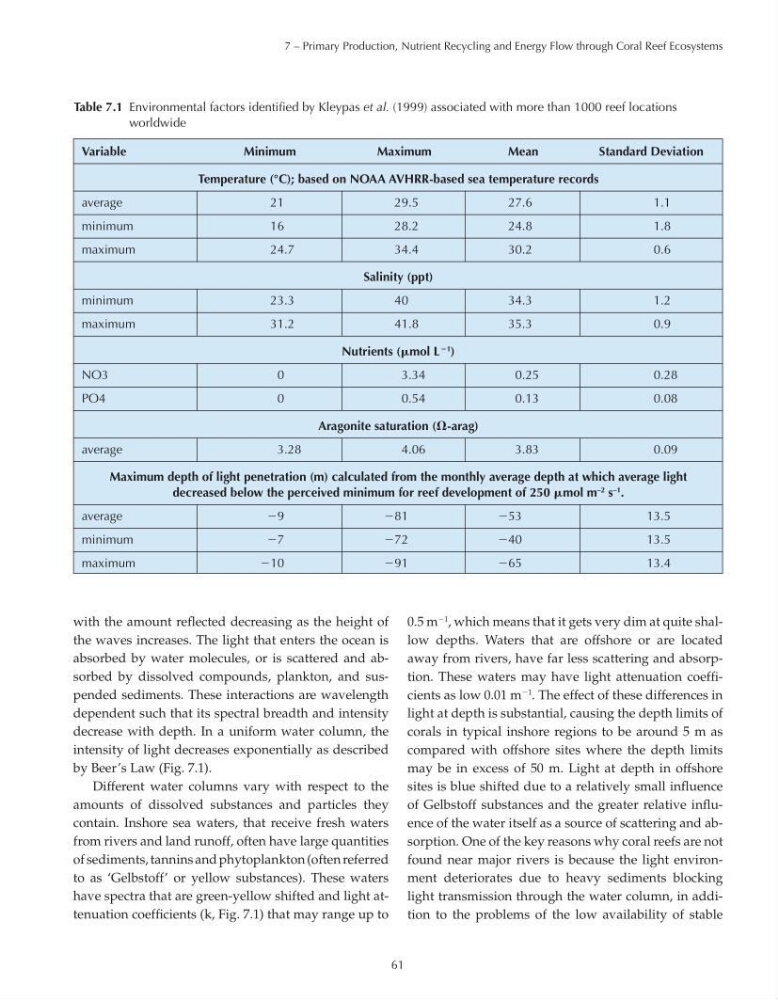
Table 7.1 Environmental factors identified by Kleypas et al. (1999) associated with more than 1000 reef locations
worldwide
Variable
Minimum
Maximum
Mean
Standard Deviation
Temperature (°C); based on NOAA AVHRR-based sea temperature records
average
21
29.5
27.6
1.1
minimum
16
28.2
24.8
1.8
maximum
24.7
34.4
30.2
0.6
Salinity (ppt)
minimum
23.3
40
34.3
1.2
maximum
31.2
41.8
35.3
0.9
Nutrients (Mmol L
)
NO3
0
3.34
0.25
0.28
PO4
0
0.54
0.13
0.08
Aragonite saturation (6-arag)
average
3.28
4.06
3.83
0.09
Maximum depth of light penetration (m) calculated from the monthly average depth at which average light
decreased below the perceived minimum for reef development of 250 Mmol m
–2 s
–1 .
average
9
81
53
13.5
minimum
7
72
40
13.5
maximum
10
91
65
13.4
61
with the amount reflected decreasing as the height of
the waves increases. The light that enters the ocean is
absorbed by water molecules, or is scattered and absorbed by dissolved compounds, plankton, and suspended sediments. These interactions are wavelength
dependent such that its spectral breadth and intensity
decrease with depth. In a uniform water column, the
intensity of light decreases exponentially as described
by Beer’s Law (Fig. 7.1).
Different water columns vary with respect to the
amounts of dissolved substances and particles they
contain. Inshore sea waters, that receive fresh waters
from rivers and land runoff, often have large quantities
of sediments, tannins and phytoplankton (often referred
to as ‘Gelbstoff’ or yellow substances). These waters
have spectra that are green-yellow shifted and light attenuation coefficients (k, Fig. 7.1) that may range up to
0.5 m
1
, which means that it gets very dim at quite shallow depths. Waters that are offshore or are located
away from rivers, have far less scattering and absorption. These waters may have light attenuation coefficients as low 0.01 m
1 . The effect of these differences in
light at depth is substantial, causing the depth limits of
corals in typical inshore regions to be around 5 m as
compared with offshore sites where the depth limits
may be in excess of 50 m. Light at depth in offshore
sites is blue shifted due to a relatively small influence
of Gelbstoff substances and the greater relative influence of the water itself as a source of scattering and absorption. One of the key reasons why coral reefs are not
found near major rivers is because the light environment deteriorates due to heavy sediments blocking
light transmission through the water column, in addition to the problems of the low availability of stable
Table 7.1 Environmental factors identified by Kleypas et al. (1999) associated with more than 1000 reef locations
worldwide
Variable
Minimum
Maximum
Mean
Standard Deviation
Temperature (°C); based on NOAA AVHRR-based sea temperature records
average
21
29.5
27.6
1.1
minimum
16
28.2
24.8
1.8
maximum
24.7
34.4
30.2
0.6
Salinity (ppt)
minimum
23.3
40
34.3
1.2
maximum
31.2
41.8
35.3
0.9
Nutrients (Mmol L
)
NO3
0
3.34
0.25
0.28
PO4
0
0.54
0.13
0.08
Aragonite saturation (6-arag)
average
3.28
4.06
3.83
0.09
Maximum depth of light penetration (m) calculated from the monthly average depth at which average light
decreased below the perceived minimum for reef development of 250 Mmol m
–2 s
–1 .
average
9
81
53
13.5
minimum
7
72
40
13.5
maximum
10
91
65
13.4