

The Great Barrier Reef
46
scale current patterns (see Chapter 4), and smaller scale
currents, which in turn interact with the profile and
relative positions of the individual reefs along the continental shelf. These have important consequences for
larval transport, and ultimately biological connectivity
between the organisms on different reefs. The GBR
crosses a large latitudinal range of approximately
14°52, which means that temperature tolerances of
many species may exert large effects on the assemblage
composition of southern v. northern reefs, just as the
large width of the continental shelf exerts effects due to
sedimentation and exposure regimes. This wide range
of spatial variability in habitat availability has profound effects on the habitat formers, determiners, and
responders that live on the reefs. The ‘typical’ zonation
patterns described previously may not occur on all
GBR reefs, so there is also an additional level of heterogeneity at the reef level.
N TEMPORAL CHANGES IN CORAL
REEF HABITATS
Coral reefs, as with most habitats, change through
time. Coral reefs are subject to a wide range of natural
and anthropogenic perturbations, which can alter their
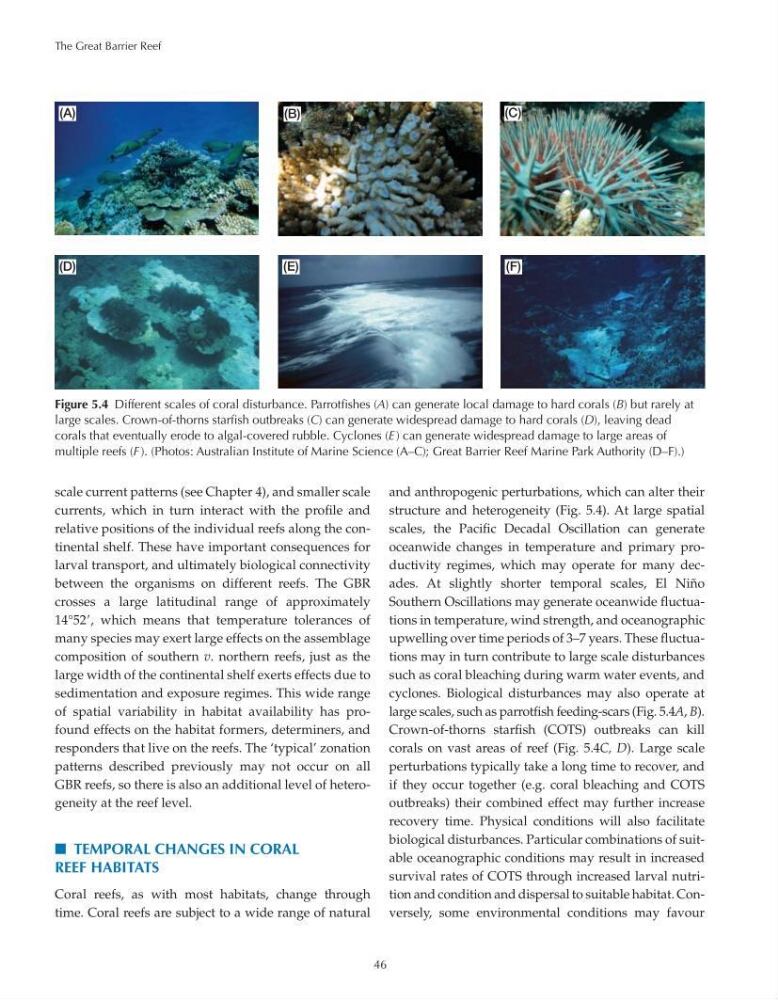
structure and heterogeneity (Fig. 5.4). At large spatial
scales, the Pacific Decadal Oscillation can generate
oceanwide changes in temperature and primary productivity regimes, which may operate for many decades. At slightly shorter temporal scales, El Niño
Southern Oscillations may generate oceanwide fluctuations in temperature, wind strength, and oceanographic
upwelling over time periods of 3–7 years. These fluctuations may in turn contribute to large scale disturbances
such as coral bleaching during warm water events, and
cyclones. Biological disturbances may also operate at
large scales, such as parrotfish feeding-scars (Fig. 5.4A, B).
Crown-of-thorns starfish (COTS) outbreaks can kill
corals on vast areas of reef (Fig. 5.4C, D). Large scale
perturbations typically take a long time to recover, and
if they occur together (e.g. coral bleaching and COTS
outbreaks) their combined effect may further increase
recovery time. Physical conditions will also facilitate
biological disturbances. Particular combinations of suitable oceanographic conditions may result in increased
survival rates of COTS through increased larval nutrition and condition and dispersal to suitable habitat. Conversely, some environmental conditions may favour
(F)
(E)
(D)
(C)
(B)
(A)
Figure 5.4 Different scales of coral disturbance. Parrotfishes (A) can generate local damage to hard corals (B) but rarely at
large scales. Crown-of-thorns starfish outbreaks (C) can generate widespread damage to hard corals (D), leaving dead
corals that eventually erode to algal-covered rubble. Cyclones (E ) can generate widespread damage to large areas of
multiple reefs (F ). (Photos: Australian Institute of Marine Science (A–C); Great Barrier Reef Marine Park Authority (D–F).)
46
scale current patterns (see Chapter 4), and smaller scale
currents, which in turn interact with the profile and
relative positions of the individual reefs along the continental shelf. These have important consequences for
larval transport, and ultimately biological connectivity
between the organisms on different reefs. The GBR
crosses a large latitudinal range of approximately
14°52, which means that temperature tolerances of
many species may exert large effects on the assemblage
composition of southern v. northern reefs, just as the
large width of the continental shelf exerts effects due to
sedimentation and exposure regimes. This wide range
of spatial variability in habitat availability has profound effects on the habitat formers, determiners, and
responders that live on the reefs. The ‘typical’ zonation
patterns described previously may not occur on all
GBR reefs, so there is also an additional level of heterogeneity at the reef level.
N TEMPORAL CHANGES IN CORAL
REEF HABITATS
Coral reefs, as with most habitats, change through
time. Coral reefs are subject to a wide range of natural
and anthropogenic perturbations, which can alter their
structure and heterogeneity (Fig. 5.4). At large spatial
scales, the Pacific Decadal Oscillation can generate
oceanwide changes in temperature and primary productivity regimes, which may operate for many decades. At slightly shorter temporal scales, El Niño
Southern Oscillations may generate oceanwide fluctuations in temperature, wind strength, and oceanographic
upwelling over time periods of 3–7 years. These fluctuations may in turn contribute to large scale disturbances
such as coral bleaching during warm water events, and
cyclones. Biological disturbances may also operate at
large scales, such as parrotfish feeding-scars (Fig. 5.4A, B).
Crown-of-thorns starfish (COTS) outbreaks can kill
corals on vast areas of reef (Fig. 5.4C, D). Large scale
perturbations typically take a long time to recover, and
if they occur together (e.g. coral bleaching and COTS
outbreaks) their combined effect may further increase
recovery time. Physical conditions will also facilitate
biological disturbances. Particular combinations of suitable oceanographic conditions may result in increased
survival rates of COTS through increased larval nutrition and condition and dispersal to suitable habitat. Conversely, some environmental conditions may favour
(F)
(E)
(D)
(C)
(B)
(A)
Figure 5.4 Different scales of coral disturbance. Parrotfishes (A) can generate local damage to hard corals (B) but rarely at
large scales. Crown-of-thorns starfish outbreaks (C) can generate widespread damage to hard corals (D), leaving dead
corals that eventually erode to algal-covered rubble. Cyclones (E ) can generate widespread damage to large areas of
multiple reefs (F ). (Photos: Australian Institute of Marine Science (A–C); Great Barrier Reef Marine Park Authority (D–F).)