

5 – Coral Reef Habitats and Assemblages
45
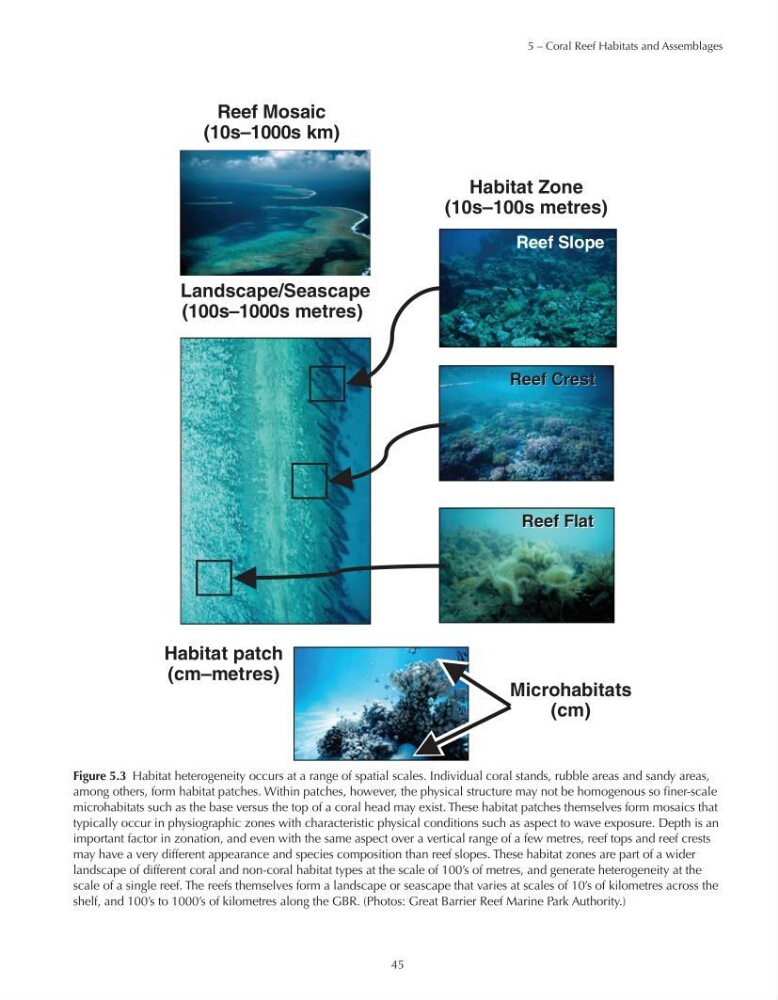
Figure 5.3 Habitat heterogeneity occurs at a range of spatial scales. Individual coral stands, rubble areas and sandy areas,
among others, form habitat patches. Within patches, however, the physical structure may not be homogenous so finer-scale
microhabitats such as the base versus the top of a coral head may exist. These habitat patches themselves form mosaics that
typically occur in physiographic zones with characteristic physical conditions such as aspect to wave exposure. Depth is an
important factor in zonation, and even with the same aspect over a vertical range of a few metres, reef tops and reef crests
may have a very different appearance and species composition than reef slopes. These habitat zones are part of a wider
landscape of different coral and non-coral habitat types at the scale of 100’s of metres, and generate heterogeneity at the
scale of a single reef. The reefs themselves form a landscape or seascape that varies at scales of 10’s of kilometres across the
shelf, and 100’s to 1000’s of kilometres along the GBR. (Photos: Great Barrier Reef Marine Park Authority.)
Habitat patch
(cm–metres)
Microhabitats
(cm)
Landscape/Seascape
(100s–1000s metres)
Reef Mosaic
(10s–1000s km)
Habitat Zone
(10s–100s metres)
Reef Slope
Reef Crest
Reef Crest
Reef Flat
Reef Flat
45
Figure 5.3 Habitat heterogeneity occurs at a range of spatial scales. Individual coral stands, rubble areas and sandy areas,
among others, form habitat patches. Within patches, however, the physical structure may not be homogenous so finer-scale
microhabitats such as the base versus the top of a coral head may exist. These habitat patches themselves form mosaics that
typically occur in physiographic zones with characteristic physical conditions such as aspect to wave exposure. Depth is an
important factor in zonation, and even with the same aspect over a vertical range of a few metres, reef tops and reef crests
may have a very different appearance and species composition than reef slopes. These habitat zones are part of a wider
landscape of different coral and non-coral habitat types at the scale of 100’s of metres, and generate heterogeneity at the
scale of a single reef. The reefs themselves form a landscape or seascape that varies at scales of 10’s of kilometres across the
shelf, and 100’s to 1000’s of kilometres along the GBR. (Photos: Great Barrier Reef Marine Park Authority.)
Habitat patch
(cm–metres)
Microhabitats
(cm)
Landscape/Seascape
(100s–1000s metres)
Reef Mosaic
(10s–1000s km)
Habitat Zone
(10s–100s metres)
Reef Slope
Reef Crest
Reef Crest
Reef Flat
Reef Flat