

5 – Coral Reef Habitats and Assemblages
43
attracted to habitats of a certain type, but then alter that
habitat type and may move on. Habitat determiners,
however, need not necessarily be destructive. For example, urchins, such as Diadema, graze algae, and surgeonfishes, such as Ctenochaetus striatus, remove detritus from
the reef top and by doing so both species help maintain
space that is suitable for coral recruitment.
Coral reefs are important because of the organisms
or habitat responders that live on them. Although fishes
are the most obvious occupants of coral reefs, a vast
array of organisms from a wide range of phyla including molluscs, worms and so forth make up tropical reef
biodiversity. Associations between organisms and the
coral reef habitat are complex. Some organisms, such as
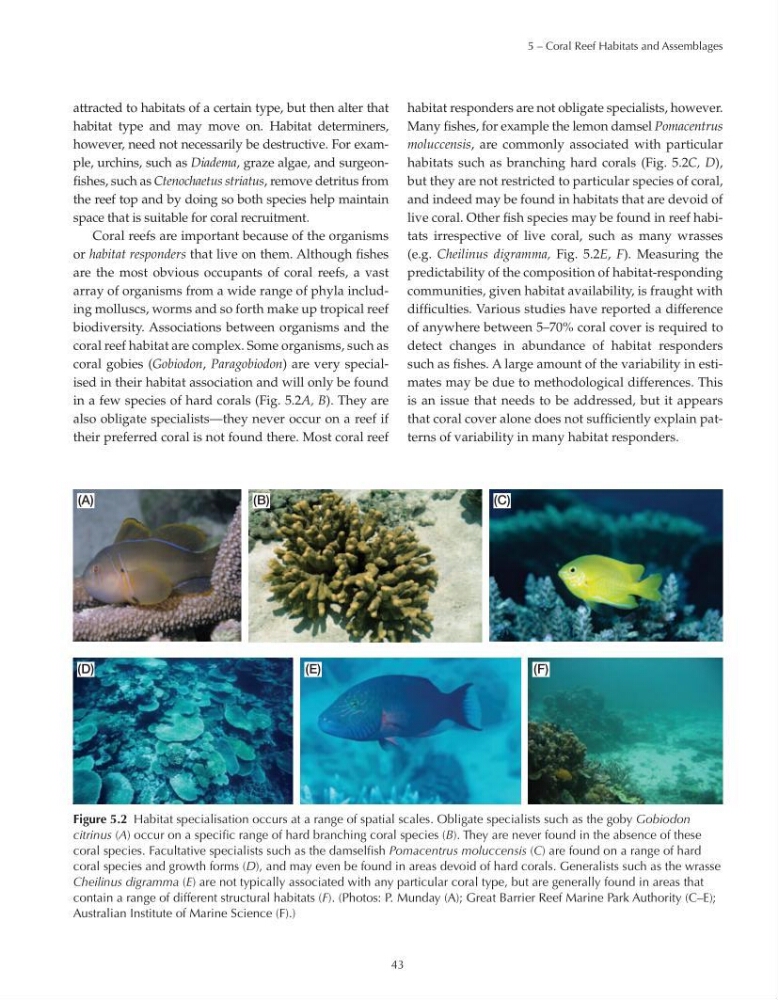
coral gobies (Gobiodon, Paragobiodon) are very specialised in their habitat association and will only be found
in a few species of hard corals (Fig. 5.2A, B). They are
also obligate specialists—they never occur on a reef if
their preferred coral is not found there. Most coral reef
habitat responders are not obligate specialists, however.
Many fishes, for example the lemon damsel Pomacentrus
moluccensis, are commonly associated with particular
habitats such as branching hard corals (Fig. 5.2C, D),
but they are not restricted to particular species of coral,
and indeed may be found in habitats that are devoid of
live coral. Other fish species may be found in reef habitats irrespective of live coral, such as many wrasses
(e.g. Cheilinus digramma, Fig. 5.2E, F). Measuring the
predictability of the composition of habitat-responding
communities, given habitat availability, is fraught with
difficulties. Various studies have reported a difference
of anywhere between 5–70% coral cover is required to
detect changes in abundance of habitat responders
such as fishes. A large amount of the variability in estimates may be due to methodological differences. This
is an issue that needs to be addressed, but it appears
that coral cover alone does not sufficiently explain patterns of variability in many habitat responders.
(F)
(E)
(D)
(C)
(B)
(A)
Figure 5.2 Habitat specialisation occurs at a range of spatial scales. Obligate specialists such as the goby Gobiodon
citrinus (A) occur on a specific range of hard branching coral species (B). They are never found in the absence of these
coral species. Facultative specialists such as the damselfish Pomacentrus moluccensis (C) are found on a range of hard
coral species and growth forms (D), and may even be found in areas devoid of hard corals. Generalists such as the wrasse
Cheilinus digramma (E) are not typically associated with any particular coral type, but are generally found in areas that
contain a range of different structural habitats (F). (Photos: P. Munday (A); Great Barrier Reef Marine Park Authority (C–E);
Australian Institute of Marine Science (F).)
43
attracted to habitats of a certain type, but then alter that
habitat type and may move on. Habitat determiners,
however, need not necessarily be destructive. For example, urchins, such as Diadema, graze algae, and surgeonfishes, such as Ctenochaetus striatus, remove detritus from
the reef top and by doing so both species help maintain
space that is suitable for coral recruitment.
Coral reefs are important because of the organisms
or habitat responders that live on them. Although fishes
are the most obvious occupants of coral reefs, a vast
array of organisms from a wide range of phyla including molluscs, worms and so forth make up tropical reef
biodiversity. Associations between organisms and the
coral reef habitat are complex. Some organisms, such as
coral gobies (Gobiodon, Paragobiodon) are very specialised in their habitat association and will only be found
in a few species of hard corals (Fig. 5.2A, B). They are
also obligate specialists—they never occur on a reef if
their preferred coral is not found there. Most coral reef
habitat responders are not obligate specialists, however.
Many fishes, for example the lemon damsel Pomacentrus
moluccensis, are commonly associated with particular
habitats such as branching hard corals (Fig. 5.2C, D),
but they are not restricted to particular species of coral,
and indeed may be found in habitats that are devoid of
live coral. Other fish species may be found in reef habitats irrespective of live coral, such as many wrasses
(e.g. Cheilinus digramma, Fig. 5.2E, F). Measuring the
predictability of the composition of habitat-responding
communities, given habitat availability, is fraught with
difficulties. Various studies have reported a difference
of anywhere between 5–70% coral cover is required to
detect changes in abundance of habitat responders
such as fishes. A large amount of the variability in estimates may be due to methodological differences. This
is an issue that needs to be addressed, but it appears
that coral cover alone does not sufficiently explain patterns of variability in many habitat responders.
(F)
(E)
(D)
(C)
(B)
(A)
Figure 5.2 Habitat specialisation occurs at a range of spatial scales. Obligate specialists such as the goby Gobiodon
citrinus (A) occur on a specific range of hard branching coral species (B). They are never found in the absence of these
coral species. Facultative specialists such as the damselfish Pomacentrus moluccensis (C) are found on a range of hard
coral species and growth forms (D), and may even be found in areas devoid of hard corals. Generalists such as the wrasse
Cheilinus digramma (E) are not typically associated with any particular coral type, but are generally found in areas that
contain a range of different structural habitats (F). (Photos: P. Munday (A); Great Barrier Reef Marine Park Authority (C–E);
Australian Institute of Marine Science (F).)