

The Great Barrier Reef
42
being what an organism perceives within its range of
movement and response. We will start by considering
organisms in the context of their interactions with their
habitat then introduce the concepts of temporal and
spatial variability in generating habitat heterogeneity.
Then we shall consider how defining habitat independently of a particular organism or set of organisms is
rather challenging, and conclude with some general
comments on the importance of habitat heterogeneity
in maintaining biodiversity on the GBR.
N HABITAT FORMERS, DETERMINERS, AND
RESPONDERS
An important distinction between temperate rocky
reefs and coral reefs is that living organisms (e.g. hermatypic corals, and octocorals) generate the primary
hard superficial benthic structure in coral reefs. While
temperate macroalgae such as giant kelps, like Macrocystis pyrifera, also generate habitat structure by extending physical complexity into the water column, corals
contribute to complexity whether dead or alive. Corals
can be considered as habitat formers. This biological
structuring has several important consequences for the
ecology of coral reefs. Coral growth forms vary greatly
from one species to another, and even within the same
species under different environmental conditions.
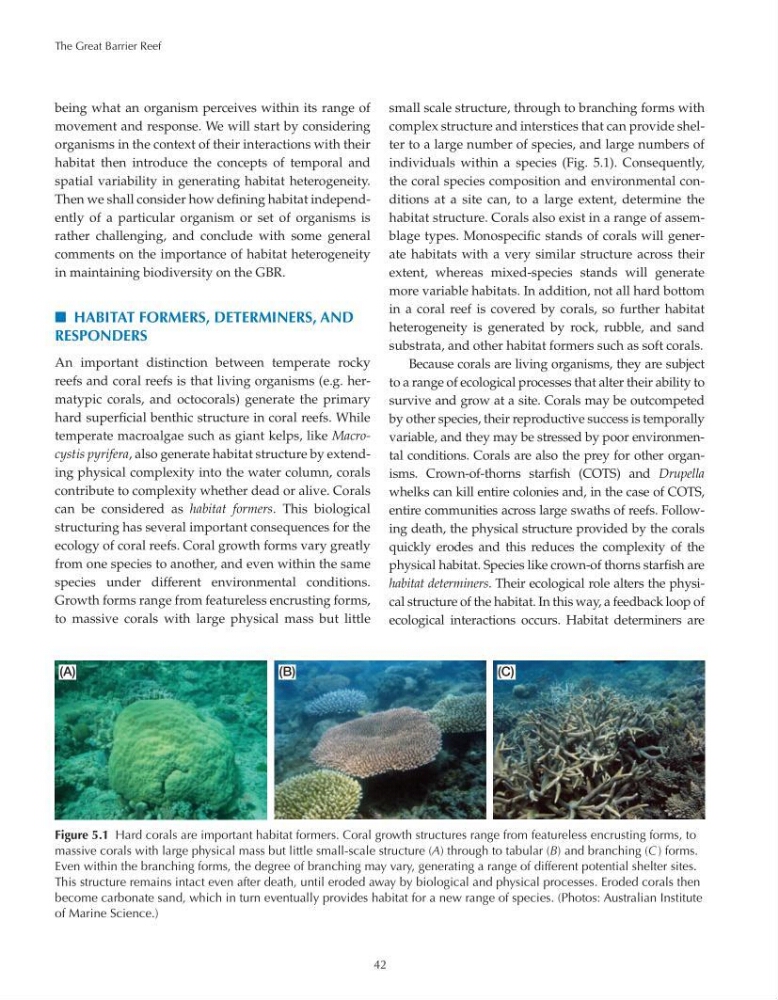
Growth forms range from featureless encrusting forms,
to massive corals with large physical mass but little
small scale structure, through to branching forms with
complex structure and interstices that can provide shelter to a large number of species, and large numbers of
individuals within a species (Fig. 5.1). Consequently,
the coral species composition and environmental conditions at a site can, to a large extent, determine the
habitat structure. Corals also exist in a range of assemblage types. Monospecific stands of corals will generate habitats with a very similar structure across their
extent, whereas mixed-species stands will generate
more variable habitats. In addition, not all hard bottom
in a coral reef is covered by corals, so further habitat
hetero geneity is generated by rock, rubble, and sand
substrata, and other habitat formers such as soft corals.
Because corals are living organisms, they are subject
to a range of ecological processes that alter their ability to
survive and grow at a site. Corals may be outcompeted
by other species, their reproductive success is temporally
variable, and they may be stressed by poor environmental conditions. Corals are also the prey for other organisms. Crown-of-thorns starfish (COTS) and Drupella
whelks can kill entire colonies and, in the case of COTS,
entire communities across large swaths of reefs. Following death, the physical structure provided by the corals
quickly erodes and this reduces the complexity of the
physical habitat. Species like crown-of thorns starfish are
habitat determiners. Their ecological role alters the physical structure of the habitat. In this way, a feedback loop of
ecological interactions occurs. Habitat determiners are
Figure 5.1 Hard corals are important habitat formers. Coral growth structures range from featureless encrusting forms, to
massive corals with large physical mass but little small-scale structure (A) through to tabular (B) and branching (C ) forms.
Even within the branching forms, the degree of branching may vary, generating a range of different potential shelter sites.
This structure remains intact even after death, until eroded away by biological and physical processes. Eroded corals then
become carbonate sand, which in turn eventually provides habitat for a new range of species. (Photos: Australian Institute
of Marine Science.)
(A)
(C)
(B)
42
being what an organism perceives within its range of
movement and response. We will start by considering
organisms in the context of their interactions with their
habitat then introduce the concepts of temporal and
spatial variability in generating habitat heterogeneity.
Then we shall consider how defining habitat independently of a particular organism or set of organisms is
rather challenging, and conclude with some general
comments on the importance of habitat heterogeneity
in maintaining biodiversity on the GBR.
N HABITAT FORMERS, DETERMINERS, AND
RESPONDERS
An important distinction between temperate rocky
reefs and coral reefs is that living organisms (e.g. hermatypic corals, and octocorals) generate the primary
hard superficial benthic structure in coral reefs. While
temperate macroalgae such as giant kelps, like Macrocystis pyrifera, also generate habitat structure by extending physical complexity into the water column, corals
contribute to complexity whether dead or alive. Corals
can be considered as habitat formers. This biological
structuring has several important consequences for the
ecology of coral reefs. Coral growth forms vary greatly
from one species to another, and even within the same
species under different environmental conditions.
Growth forms range from featureless encrusting forms,
to massive corals with large physical mass but little
small scale structure, through to branching forms with
complex structure and interstices that can provide shelter to a large number of species, and large numbers of
individuals within a species (Fig. 5.1). Consequently,
the coral species composition and environmental conditions at a site can, to a large extent, determine the
habitat structure. Corals also exist in a range of assemblage types. Monospecific stands of corals will generate habitats with a very similar structure across their
extent, whereas mixed-species stands will generate
more variable habitats. In addition, not all hard bottom
in a coral reef is covered by corals, so further habitat
hetero geneity is generated by rock, rubble, and sand
substrata, and other habitat formers such as soft corals.
Because corals are living organisms, they are subject
to a range of ecological processes that alter their ability to
survive and grow at a site. Corals may be outcompeted
by other species, their reproductive success is temporally
variable, and they may be stressed by poor environmental conditions. Corals are also the prey for other organisms. Crown-of-thorns starfish (COTS) and Drupella
whelks can kill entire colonies and, in the case of COTS,
entire communities across large swaths of reefs. Following death, the physical structure provided by the corals
quickly erodes and this reduces the complexity of the
physical habitat. Species like crown-of thorns starfish are
habitat determiners. Their ecological role alters the physical structure of the habitat. In this way, a feedback loop of
ecological interactions occurs. Habitat determiners are
Figure 5.1 Hard corals are important habitat formers. Coral growth structures range from featureless encrusting forms, to
massive corals with large physical mass but little small-scale structure (A) through to tabular (B) and branching (C ) forms.
Even within the branching forms, the degree of branching may vary, generating a range of different potential shelter sites.
This structure remains intact even after death, until eroded away by biological and physical processes. Eroded corals then
become carbonate sand, which in turn eventually provides habitat for a new range of species. (Photos: Australian Institute
of Marine Science.)
(A)
(C)
(B)