

The Great Barrier Reef
282
bore into soft calcareous rock. As they grow, the
original shell valves of the juvenile fuse to the anterior
end of a sealed, calcareous tube that is permanently
buried in the sand. The anterior end of this tube is
swollen like a balloon and perforated by numerous
tiny tubes, like the holes of a watering can. Watering
pots have lost the posterior adductor and pedal retractor muscles and their anterior equivalents are vestigial,
so the animal is only attached to its tube by retractor
muscles arising from the pallial line and by an array of
muscular papillae. A foot is present, but it is only small.
In its place, an enlarged pedal disc acts as an hydraulic
pump to bring water into the mantle cavity from the
interstitial water surrounding the anterior tube through
the perforations.
Tusk snails (Scaphopoda) are very elongate, cylindrical, bilaterally symmetrical molluscs. There are
about 25 species of scaphopods on the GBR. The mantle is fused mid-ventrally and the long tubular shell is
open at both ends. The head bears a long snout and two
groups of slender tentacles (captacula). The foot is
cylindrical and pointed. Scaphopods have no gills, distinct blood vessels or auricles. They burrow in sediments and use the captacula to haul foraminiferans to
the mouth.
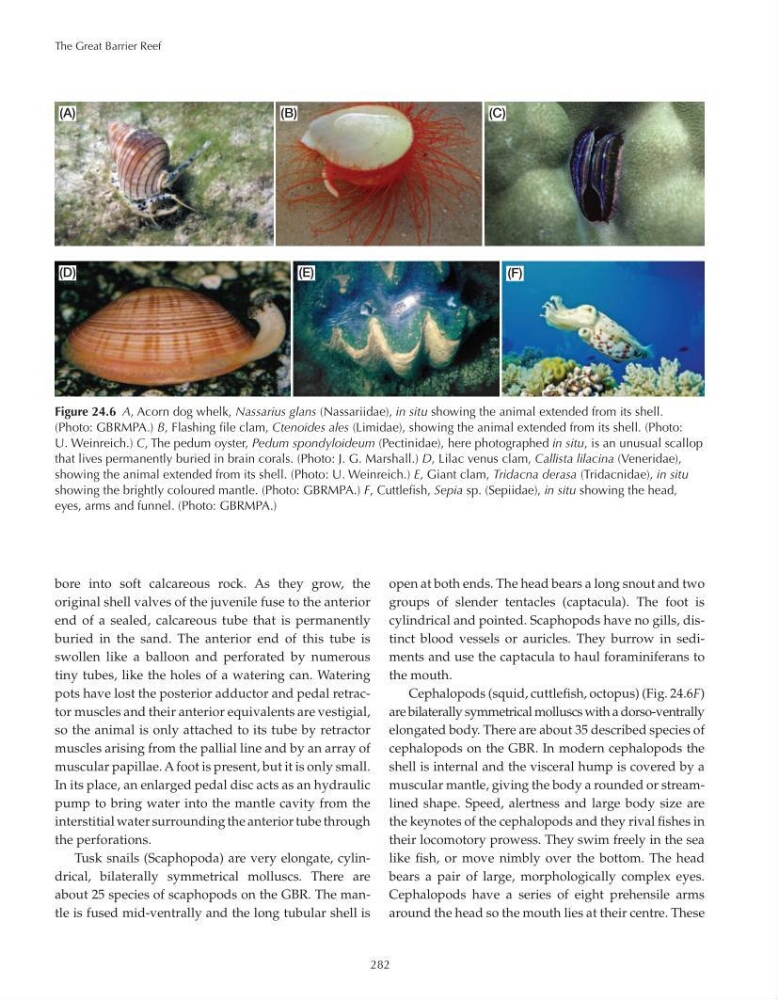
Cephalopods (squid, cuttlefish, octopus) (Fig. 24.6F)
are bilaterally symmetrical molluscs with a dorso-ventrally
elongated body. There are about 35 described species of
cephalopods on the GBR. In modern cephalopods the
shell is internal and the visceral hump is covered by a
muscular mantle, giving the body a rounded or streamlined shape. Speed, alertness and large body size are
the keynotes of the cephalopods and they rival fishes in
their locomotory prowess. They swim freely in the sea
like fish, or move nimbly over the bottom. The head
bears a pair of large, morphologically complex eyes.
Cephalopods have a series of eight prehensile arms
around the head so the mouth lies at their centre. These
(C)
(A)
(B)
(F)
(E)
(D)
Figure 24.6 A, Acorn dog whelk, Nassarius glans (Nassariidae), in situ showing the animal extended from its shell.
(Photo: GBRMPA.) B, Flashing file clam, Ctenoides ales (Limidae), showing the animal extended from its shell. (Photo:
U. Weinreich.) C, The pedum oyster, Pedum spondyloideum (Pectinidae), here photographed in situ, is an unusual scallop
that lives permanently buried in brain corals. (Photo: J. G. Marshall.) D, Lilac venus clam, Callista lilacina (Veneridae),
showing the animal extended from its shell. (Photo: U. Weinreich.) E, Giant clam, Tridacna derasa (Tridacnidae), in situ
showing the brightly coloured mantle. (Photo: GBRMPA.) F, Cuttlefish, Sepia sp. (Sepiidae), in situ showing the head,
eyes, arms and funnel. (Photo: GBRMPA.)
282
bore into soft calcareous rock. As they grow, the
original shell valves of the juvenile fuse to the anterior
end of a sealed, calcareous tube that is permanently
buried in the sand. The anterior end of this tube is
swollen like a balloon and perforated by numerous
tiny tubes, like the holes of a watering can. Watering
pots have lost the posterior adductor and pedal retractor muscles and their anterior equivalents are vestigial,
so the animal is only attached to its tube by retractor
muscles arising from the pallial line and by an array of
muscular papillae. A foot is present, but it is only small.
In its place, an enlarged pedal disc acts as an hydraulic
pump to bring water into the mantle cavity from the
interstitial water surrounding the anterior tube through
the perforations.
Tusk snails (Scaphopoda) are very elongate, cylindrical, bilaterally symmetrical molluscs. There are
about 25 species of scaphopods on the GBR. The mantle is fused mid-ventrally and the long tubular shell is
open at both ends. The head bears a long snout and two
groups of slender tentacles (captacula). The foot is
cylindrical and pointed. Scaphopods have no gills, distinct blood vessels or auricles. They burrow in sediments and use the captacula to haul foraminiferans to
the mouth.
Cephalopods (squid, cuttlefish, octopus) (Fig. 24.6F)
are bilaterally symmetrical molluscs with a dorso-ventrally
elongated body. There are about 35 described species of
cephalopods on the GBR. In modern cephalopods the
shell is internal and the visceral hump is covered by a
muscular mantle, giving the body a rounded or streamlined shape. Speed, alertness and large body size are
the keynotes of the cephalopods and they rival fishes in
their locomotory prowess. They swim freely in the sea
like fish, or move nimbly over the bottom. The head
bears a pair of large, morphologically complex eyes.
Cephalopods have a series of eight prehensile arms
around the head so the mouth lies at their centre. These
(C)
(A)
(B)
(F)
(E)
(D)
Figure 24.6 A, Acorn dog whelk, Nassarius glans (Nassariidae), in situ showing the animal extended from its shell.
(Photo: GBRMPA.) B, Flashing file clam, Ctenoides ales (Limidae), showing the animal extended from its shell. (Photo:
U. Weinreich.) C, The pedum oyster, Pedum spondyloideum (Pectinidae), here photographed in situ, is an unusual scallop
that lives permanently buried in brain corals. (Photo: J. G. Marshall.) D, Lilac venus clam, Callista lilacina (Veneridae),
showing the animal extended from its shell. (Photo: U. Weinreich.) E, Giant clam, Tridacna derasa (Tridacnidae), in situ
showing the brightly coloured mantle. (Photo: GBRMPA.) F, Cuttlefish, Sepia sp. (Sepiidae), in situ showing the head,
eyes, arms and funnel. (Photo: GBRMPA.)