

The Great Barrier Reef
252
sediments, associated with filamentous and encrusting
algae, as nestlers in dead coral substrate, and in the
infralittoral zone underneath decaying vegetation.
Members of this family have an eversible pharynx with
well developed jaws that they use to collect prey and
scavenge opportunistically (Fig. 22.2A). A closely related
family, the Phyllodocidae, is also common and they can
be abundant on reef flats at particular times of the year
when the mature worms congregate on the surface to
spawn, producing egg masses that are attached to pieces
of algae or substrate (Fig. 22.2K). Other phyllodocids
spawn in the water column (Fig. 22.2L).
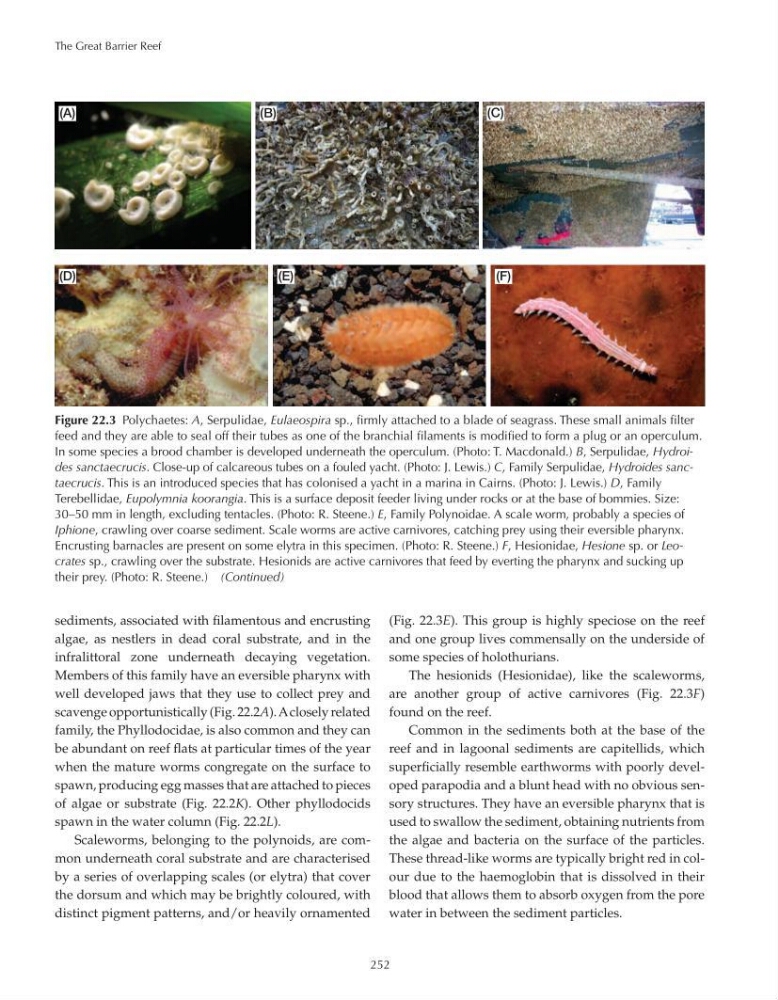
Scaleworms, belonging to the polynoids, are common underneath coral substrate and are characterised
by a series of overlapping scales (or elytra) that cover
the dorsum and which may be brightly coloured, with
distinct pigment patterns, and/or heavily ornamented
(Fig. 22.3E). This group is highly speciose on the reef
and one group lives commensally on the underside of
some species of holothurians.
The hesionids (Hesionidae), like the scaleworms,
are another group of active carnivores (Fig. 22.3F)
found on the reef.
Common in the sediments both at the base of the
reef and in lagoonal sediments are capitellids, which
superficially resemble earthworms with poorly developed parapodia and a blunt head with no obvious sensory structures. They have an eversible pharynx that is
used to swallow the sediment, obtaining nutrients from
the algae and bacteria on the surface of the particles.
These thread-like worms are typically bright red in colour due to the haemoglobin that is dissolved in their
blood that allows them to absorb oxygen from the pore
water in between the sediment particles.
Figure 22.3 Polychaetes: A, Serpulidae, Eulaeospira sp., firmly attached to a blade of seagrass. These small animals filter
feed and they are able to seal off their tubes as one of the branchial filaments is modified to form a plug or an operculum.
In some species a brood chamber is developed underneath the operculum. (Photo: T. Macdonald.) B, Serpulidae, Hydroides sanctaecrucis. Close-up of calcareous tubes on a fouled yacht. (Photo: J. Lewis.) C, Family Serpulidae, Hydroides sanctaecrucis. This is an introduced species that has colonised a yacht in a marina in Cairns. (Photo: J. Lewis.) D, Family
Terebellidae, Eupolymnia koorangia. This is a surface deposit feeder living under rocks or at the base of bommies. Size:
30–50 mm in length, excluding tentacles. (Photo: R. Steene.) E, Family Polynoidae. A scale worm, probably a species of
Iphione, crawling over coarse sediment. Scale worms are active carnivores, catching prey using their eversible pharynx.
Encrusting barnacles are present on some elytra in this specimen. (Photo: R. Steene.) F, Hesionidae, Hesione sp. or Leocrates sp., crawling over the substrate. Hesionids are active carnivores that feed by everting the pharynx and sucking up
their prey. (Photo: R. Steene.) (Continued)
(E)
(D)
(F)
(A)
(B)
(C)
252
sediments, associated with filamentous and encrusting
algae, as nestlers in dead coral substrate, and in the
infralittoral zone underneath decaying vegetation.
Members of this family have an eversible pharynx with
well developed jaws that they use to collect prey and
scavenge opportunistically (Fig. 22.2A). A closely related
family, the Phyllodocidae, is also common and they can
be abundant on reef flats at particular times of the year
when the mature worms congregate on the surface to
spawn, producing egg masses that are attached to pieces
of algae or substrate (Fig. 22.2K). Other phyllodocids
spawn in the water column (Fig. 22.2L).
Scaleworms, belonging to the polynoids, are common underneath coral substrate and are characterised
by a series of overlapping scales (or elytra) that cover
the dorsum and which may be brightly coloured, with
distinct pigment patterns, and/or heavily ornamented
(Fig. 22.3E). This group is highly speciose on the reef
and one group lives commensally on the underside of
some species of holothurians.
The hesionids (Hesionidae), like the scaleworms,
are another group of active carnivores (Fig. 22.3F)
found on the reef.
Common in the sediments both at the base of the
reef and in lagoonal sediments are capitellids, which
superficially resemble earthworms with poorly developed parapodia and a blunt head with no obvious sensory structures. They have an eversible pharynx that is
used to swallow the sediment, obtaining nutrients from
the algae and bacteria on the surface of the particles.
These thread-like worms are typically bright red in colour due to the haemoglobin that is dissolved in their
blood that allows them to absorb oxygen from the pore
water in between the sediment particles.
Figure 22.3 Polychaetes: A, Serpulidae, Eulaeospira sp., firmly attached to a blade of seagrass. These small animals filter
feed and they are able to seal off their tubes as one of the branchial filaments is modified to form a plug or an operculum.
In some species a brood chamber is developed underneath the operculum. (Photo: T. Macdonald.) B, Serpulidae, Hydroides sanctaecrucis. Close-up of calcareous tubes on a fouled yacht. (Photo: J. Lewis.) C, Family Serpulidae, Hydroides sanctaecrucis. This is an introduced species that has colonised a yacht in a marina in Cairns. (Photo: J. Lewis.) D, Family
Terebellidae, Eupolymnia koorangia. This is a surface deposit feeder living under rocks or at the base of bommies. Size:
30–50 mm in length, excluding tentacles. (Photo: R. Steene.) E, Family Polynoidae. A scale worm, probably a species of
Iphione, crawling over coarse sediment. Scale worms are active carnivores, catching prey using their eversible pharynx.
Encrusting barnacles are present on some elytra in this specimen. (Photo: R. Steene.) F, Hesionidae, Hesione sp. or Leocrates sp., crawling over the substrate. Hesionids are active carnivores that feed by everting the pharynx and sucking up
their prey. (Photo: R. Steene.) (Continued)
(E)
(D)
(F)
(A)
(B)
(C)