

22 – Worms
249
(K)
(J)
(L)
(H)
(G)
(I)
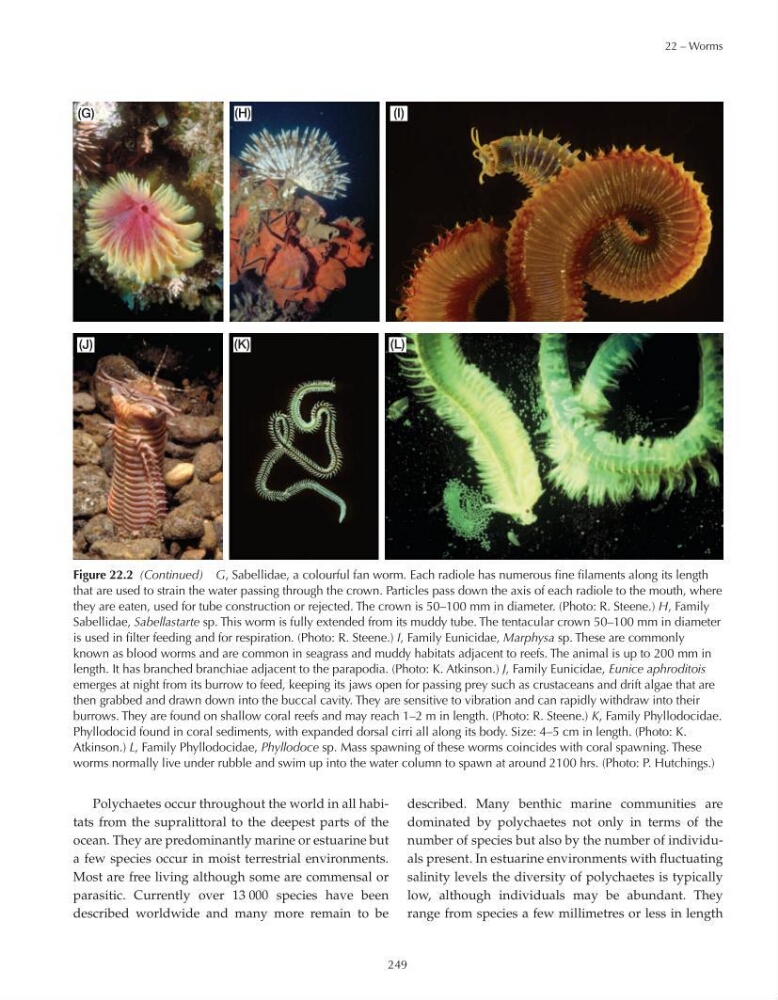
Figure 22.2 (Continued) G, Sabellidae, a colourful fan worm. Each radiole has numerous fine filaments along its length
that are used to strain the water passing through the crown. Particles pass down the axis of each radiole to the mouth, where
they are eaten, used for tube construction or rejected. The crown is 50–100 mm in diameter. (Photo: R. Steene.) H, Family
Sabellidae, Sabellastarte sp. This worm is fully extended from its muddy tube. The tentacular crown 50–100 mm in diameter
is used in filter feeding and for respiration. (Photo: R. Steene.) I, Family Eunicidae, Marphysa sp. These are commonly
known as blood worms and are common in seagrass and muddy habitats adjacent to reefs. The animal is up to 200 mm in
length. It has branched branchiae adjacent to the parapodia. (Photo: K. Atkinson.) J, Family Eunicidae, Eunice aphroditois
emerges at night from its burrow to feed, keeping its jaws open for passing prey such as crustaceans and drift algae that are
then grabbed and drawn down into the buccal cavity. They are sensitive to vibration and can rapidly withdraw into their
burrows. They are found on shallow coral reefs and may reach 1–2 m in length. (Photo: R. Steene.) K, Family Phyllodocidae.
Phyllodocid found in coral sediments, with expanded dorsal cirri all along its body. Size: 4–5 cm in length. (Photo: K.
Atkinson.) L, Family Phyllodocidae, Phyllodoce sp. Mass spawning of these worms coincides with coral spawning. These
worms normally live under rubble and swim up into the water column to spawn at around 2100 hrs. (Photo: P. Hutchings.)
Polychaetes occur throughout the world in all habitats from the supralittoral to the deepest parts of the
ocean. They are predominantly marine or estuarine but
a few species occur in moist terrestrial environments.
Most are free living although some are commensal or
parasitic. Currently over 13 000 species have been
described worldwide and many more remain to be
described. Many benthic marine communities are
dominated by polychaetes not only in terms of the
number of species but also by the number of individuals present. In estuarine environments with fluctuating
salinity levels the diversity of polychaetes is typically
low, although individuals may be abundant. They
range from species a few millimetres or less in length
249
(K)
(J)
(L)
(H)
(G)
(I)
Figure 22.2 (Continued) G, Sabellidae, a colourful fan worm. Each radiole has numerous fine filaments along its length
that are used to strain the water passing through the crown. Particles pass down the axis of each radiole to the mouth, where
they are eaten, used for tube construction or rejected. The crown is 50–100 mm in diameter. (Photo: R. Steene.) H, Family
Sabellidae, Sabellastarte sp. This worm is fully extended from its muddy tube. The tentacular crown 50–100 mm in diameter
is used in filter feeding and for respiration. (Photo: R. Steene.) I, Family Eunicidae, Marphysa sp. These are commonly
known as blood worms and are common in seagrass and muddy habitats adjacent to reefs. The animal is up to 200 mm in
length. It has branched branchiae adjacent to the parapodia. (Photo: K. Atkinson.) J, Family Eunicidae, Eunice aphroditois
emerges at night from its burrow to feed, keeping its jaws open for passing prey such as crustaceans and drift algae that are
then grabbed and drawn down into the buccal cavity. They are sensitive to vibration and can rapidly withdraw into their
burrows. They are found on shallow coral reefs and may reach 1–2 m in length. (Photo: R. Steene.) K, Family Phyllodocidae.
Phyllodocid found in coral sediments, with expanded dorsal cirri all along its body. Size: 4–5 cm in length. (Photo: K.
Atkinson.) L, Family Phyllodocidae, Phyllodoce sp. Mass spawning of these worms coincides with coral spawning. These
worms normally live under rubble and swim up into the water column to spawn at around 2100 hrs. (Photo: P. Hutchings.)
Polychaetes occur throughout the world in all habitats from the supralittoral to the deepest parts of the
ocean. They are predominantly marine or estuarine but
a few species occur in moist terrestrial environments.
Most are free living although some are commensal or
parasitic. Currently over 13 000 species have been
described worldwide and many more remain to be
described. Many benthic marine communities are
dominated by polychaetes not only in terms of the
number of species but also by the number of individuals present. In estuarine environments with fluctuating
salinity levels the diversity of polychaetes is typically
low, although individuals may be abundant. They
range from species a few millimetres or less in length