

22 – Worms
247
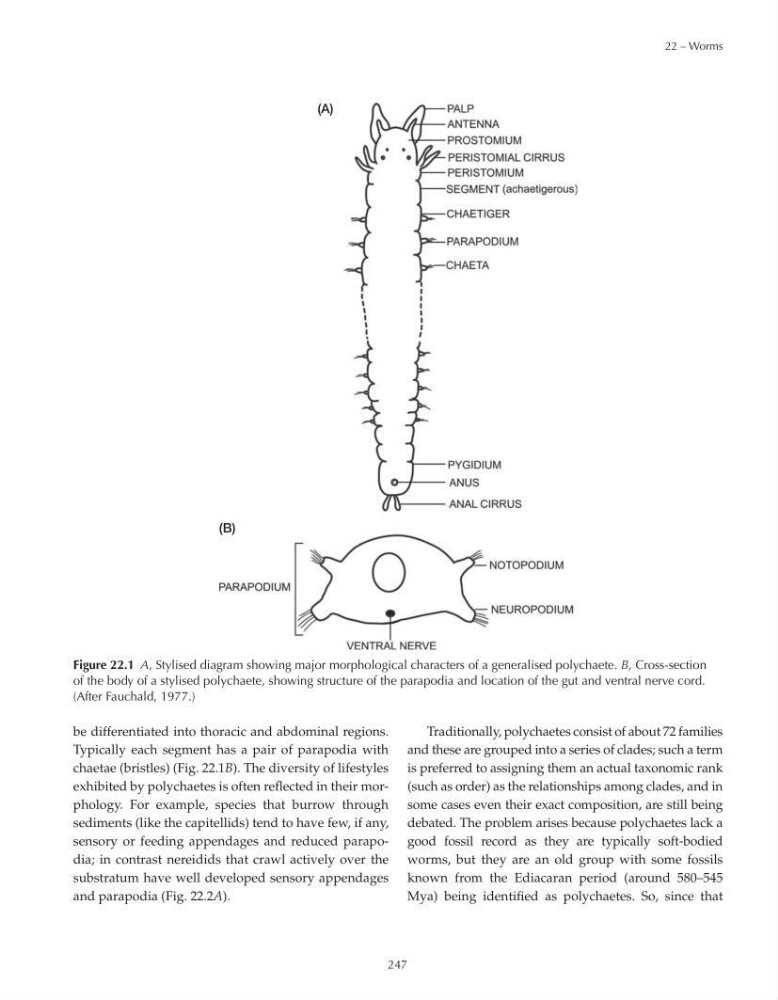
Figure 22.1 A, Stylised diagram showing major morphological characters of a generalised polychaete. B, Cross-section
of the body of a stylised polychaete, showing structure of the parapodia and location of the gut and ventral nerve cord.
(After Fauchald, 1977.)
be differentiated into thoracic and abdominal regions.
Typically each segment has a pair of parapodia with
chaetae (bristles) (Fig. 22.1B). The diversity of lifestyles
exhibited by polychaetes is often reflected in their morphology. For example, species that burrow through
sediments (like the capitellids) tend to have few, if any,
sensory or feeding appendages and reduced parapodia; in contrast nereidids that crawl actively over the
substratum have well developed sensory appendages
and parapodia (Fig. 22.2A).
Traditionally, polychaetes consist of about 72 families
and these are grouped into a series of clades; such a term
is preferred to assigning them an actual taxonomic rank
(such as order) as the relationships among clades, and in
some cases even their exact composition, are still being
debated. The problem arises because polychaetes lack a
good fossil record as they are typically soft-bodied
worms, but they are an old group with some fossils
known from the Ediacaran period (around 580–545
Mya) being identified as polychaetes. So, since that
(A)
(B)
247
Figure 22.1 A, Stylised diagram showing major morphological characters of a generalised polychaete. B, Cross-section
of the body of a stylised polychaete, showing structure of the parapodia and location of the gut and ventral nerve cord.
(After Fauchald, 1977.)
be differentiated into thoracic and abdominal regions.
Typically each segment has a pair of parapodia with
chaetae (bristles) (Fig. 22.1B). The diversity of lifestyles
exhibited by polychaetes is often reflected in their morphology. For example, species that burrow through
sediments (like the capitellids) tend to have few, if any,
sensory or feeding appendages and reduced parapodia; in contrast nereidids that crawl actively over the
substratum have well developed sensory appendages
and parapodia (Fig. 22.2A).
Traditionally, polychaetes consist of about 72 families
and these are grouped into a series of clades; such a term
is preferred to assigning them an actual taxonomic rank
(such as order) as the relationships among clades, and in
some cases even their exact composition, are still being
debated. The problem arises because polychaetes lack a
good fossil record as they are typically soft-bodied
worms, but they are an old group with some fossils
known from the Ediacaran period (around 580–545
Mya) being identified as polychaetes. So, since that
(A)
(B)