

The Great Barrier Reef
236
Where sclerites are present, they are nearly always
minute platelets or corpuscle-like forms, with almost
smooth surfaces, often appearing opalescent. Only one
genus has sclerites in the form of minute rods with a
coarse crystalline surface. A microscopic feature of the
family, observed only in histological preparations, is
that only the dorsal pair of mesenteries retain their filaments in the adult polyps; the filaments on the other six
mesenteries are absent or rudimentary.
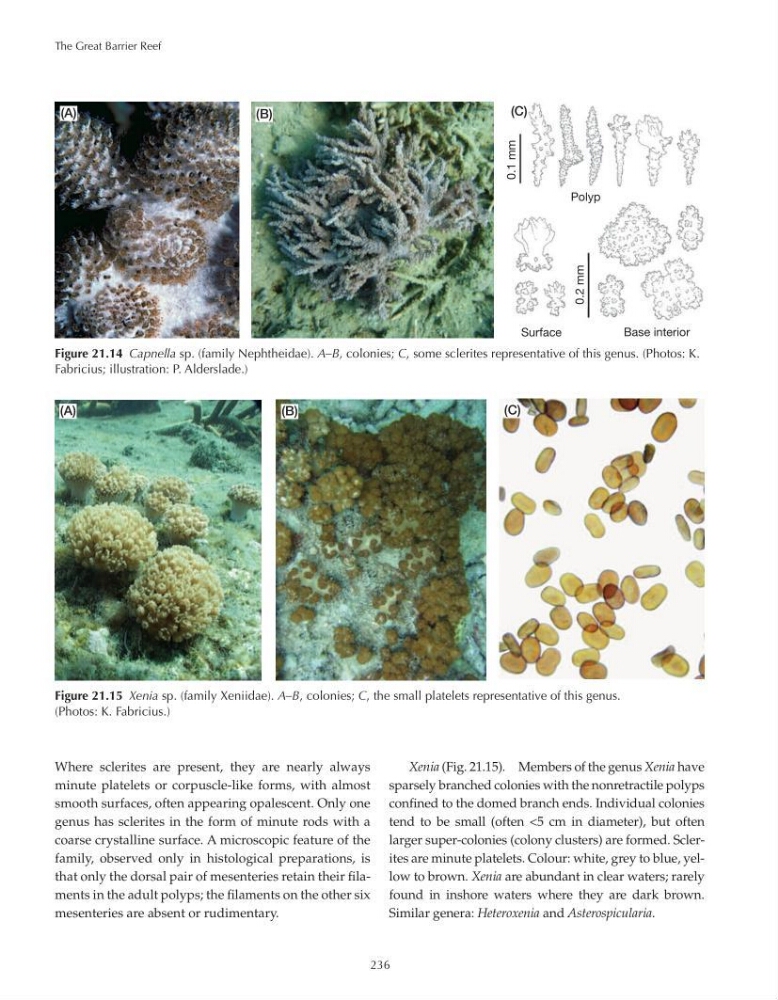
Xenia (Fig. 21.15). Members of the genus Xenia have
sparsely branched colonies with the nonretractile polyps
confined to the domed branch ends. Individual colonies
tend to be small (often <5 cm in diameter), but often
larger super-colonies (colony clusters) are formed. Sclerites are minute platelets. Colour: white, grey to blue, yellow to brown. Xenia are abundant in clear waters; rarely
found in inshore waters where they are dark brown.
Similar genera: Heteroxenia and Asterospicularia.
(A)
(B)
(C)
0.1 mm
0.2 mm
Polyp
Surface
Base interior
Figure 21.14 Capnella sp. (family Nephtheidae). A–B, colonies; C, some sclerites representative of this genus. (Photos: K.
Fabricius; illustration: P. Alderslade.)
Figure 21.15 Xenia sp. (family Xeniidae). A–B, colonies; C, the small platelets representative of this genus.
(Photos: K. Fabricius.)
(A)
(B)
(C)
236
Where sclerites are present, they are nearly always
minute platelets or corpuscle-like forms, with almost
smooth surfaces, often appearing opalescent. Only one
genus has sclerites in the form of minute rods with a
coarse crystalline surface. A microscopic feature of the
family, observed only in histological preparations, is
that only the dorsal pair of mesenteries retain their filaments in the adult polyps; the filaments on the other six
mesenteries are absent or rudimentary.
Xenia (Fig. 21.15). Members of the genus Xenia have
sparsely branched colonies with the nonretractile polyps
confined to the domed branch ends. Individual colonies
tend to be small (often <5 cm in diameter), but often
larger super-colonies (colony clusters) are formed. Sclerites are minute platelets. Colour: white, grey to blue, yellow to brown. Xenia are abundant in clear waters; rarely
found in inshore waters where they are dark brown.
Similar genera: Heteroxenia and Asterospicularia.
(A)
(B)
(C)
0.1 mm
0.2 mm
Polyp
Surface
Base interior
Figure 21.14 Capnella sp. (family Nephtheidae). A–B, colonies; C, some sclerites representative of this genus. (Photos: K.
Fabricius; illustration: P. Alderslade.)
Figure 21.15 Xenia sp. (family Xeniidae). A–B, colonies; C, the small platelets representative of this genus.
(Photos: K. Fabricius.)
(A)
(B)
(C)