

The Great Barrier Reef
230
for these to be fused into clumps or tubes. Sclerites include smooth branched rods, and prickly or tuberculate 6-radiates, spindles and platelets.
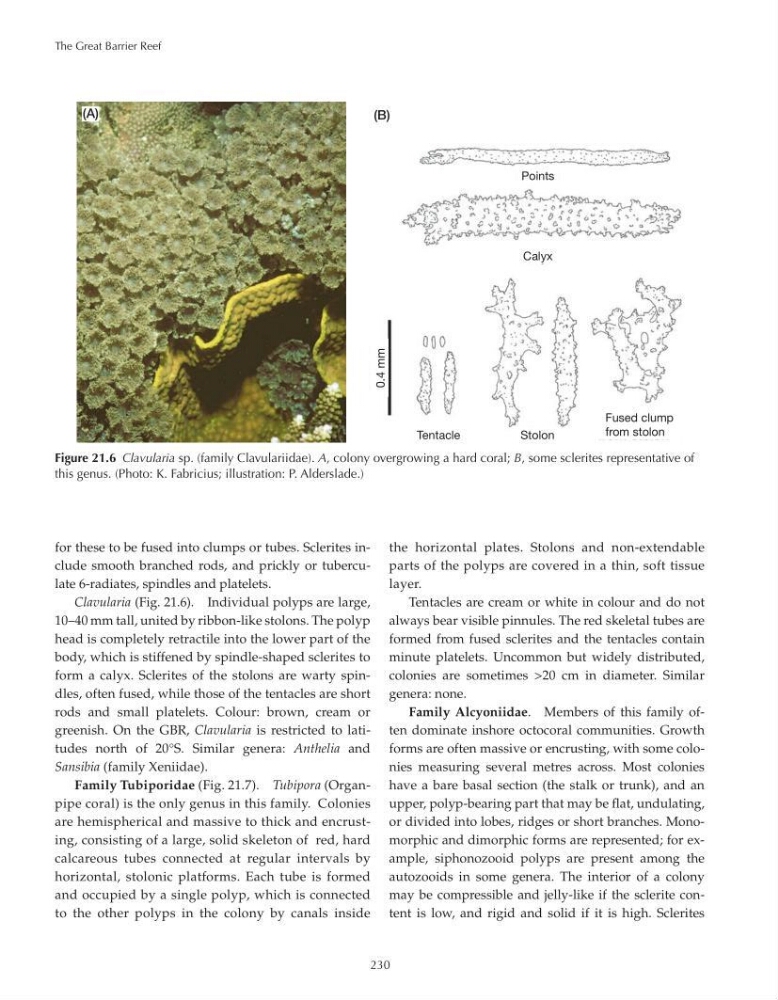
Clavularia (Fig. 21.6). Individual polyps are large,
10–40 mm tall, united by ribbon-like stolons. The polyp
head is completely retractile into the lower part of the
body, which is stiffened by spindle-shaped sclerites to
form a calyx. Sclerites of the stolons are warty spindles, often fused, while those of the tentacles are short
rods and small platelets. Colour: brown, cream or
greenish. On the GBR, Clavularia is restricted to latitudes north of 20°S. Similar genera: Anthelia and
Sansibia (family Xeniidae).
Family Tubiporidae (Fig. 21.7). Tubipora (Organpipe coral) is the only genus in this family. Colonies
are hemispherical and massive to thick and encrusting, consisting of a large, solid skeleton of red, hard
calcareous tubes connected at regular intervals by
horizontal, stolonic platforms. Each tube is formed
and occupied by a single polyp, which is connected
to the other polyps in the colony by canals inside
(A)
(B)
Points
Calyx
Tentacle
0.4 mm
Stolon
Fused clump
from stolon
Figure 21.6 Clavularia sp. (family Clavulariidae). A, colony overgrowing a hard coral; B, some sclerites representative of
this genus. (Photo: K. Fabricius; illustration: P. Alderslade.)
the hori zontal plates. Stolons and non-extendable
parts of the polyps are covered in a thin, soft tissue
layer.
Tentacles are cream or white in colour and do not
always bear visible pinnules. The red skeletal tubes are
formed from fused sclerites and the tentacles contain
minute platelets. Uncommon but widely distributed,
colonies are sometimes >20 cm in diameter. Similar
genera: none.
Family Alcyoniidae. Members of this family often dominate inshore octocoral communities. Growth
forms are often massive or encrusting, with some colonies measuring several metres across. Most colonies
have a bare basal section (the stalk or trunk), and an
upper, polyp-bearing part that may be flat, undulating,
or divided into lobes, ridges or short branches. Monomorphic and dimorphic forms are represented; for example, siphonozooid polyps are present among the
autozooids in some genera. The interior of a colony
may be compressible and jelly-like if the sclerite content is low, and rigid and solid if it is high. Sclerites
230
for these to be fused into clumps or tubes. Sclerites include smooth branched rods, and prickly or tuberculate 6-radiates, spindles and platelets.
Clavularia (Fig. 21.6). Individual polyps are large,
10–40 mm tall, united by ribbon-like stolons. The polyp
head is completely retractile into the lower part of the
body, which is stiffened by spindle-shaped sclerites to
form a calyx. Sclerites of the stolons are warty spindles, often fused, while those of the tentacles are short
rods and small platelets. Colour: brown, cream or
greenish. On the GBR, Clavularia is restricted to latitudes north of 20°S. Similar genera: Anthelia and
Sansibia (family Xeniidae).
Family Tubiporidae (Fig. 21.7). Tubipora (Organpipe coral) is the only genus in this family. Colonies
are hemispherical and massive to thick and encrusting, consisting of a large, solid skeleton of red, hard
calcareous tubes connected at regular intervals by
horizontal, stolonic platforms. Each tube is formed
and occupied by a single polyp, which is connected
to the other polyps in the colony by canals inside
(A)
(B)
Points
Calyx
Tentacle
0.4 mm
Stolon
Fused clump
from stolon
Figure 21.6 Clavularia sp. (family Clavulariidae). A, colony overgrowing a hard coral; B, some sclerites representative of
this genus. (Photo: K. Fabricius; illustration: P. Alderslade.)
the hori zontal plates. Stolons and non-extendable
parts of the polyps are covered in a thin, soft tissue
layer.
Tentacles are cream or white in colour and do not
always bear visible pinnules. The red skeletal tubes are
formed from fused sclerites and the tentacles contain
minute platelets. Uncommon but widely distributed,
colonies are sometimes >20 cm in diameter. Similar
genera: none.
Family Alcyoniidae. Members of this family often dominate inshore octocoral communities. Growth
forms are often massive or encrusting, with some colonies measuring several metres across. Most colonies
have a bare basal section (the stalk or trunk), and an
upper, polyp-bearing part that may be flat, undulating,
or divided into lobes, ridges or short branches. Monomorphic and dimorphic forms are represented; for example, siphonozooid polyps are present among the
autozooids in some genera. The interior of a colony
may be compressible and jelly-like if the sclerite content is low, and rigid and solid if it is high. Sclerites