

The Great Barrier Reef
228
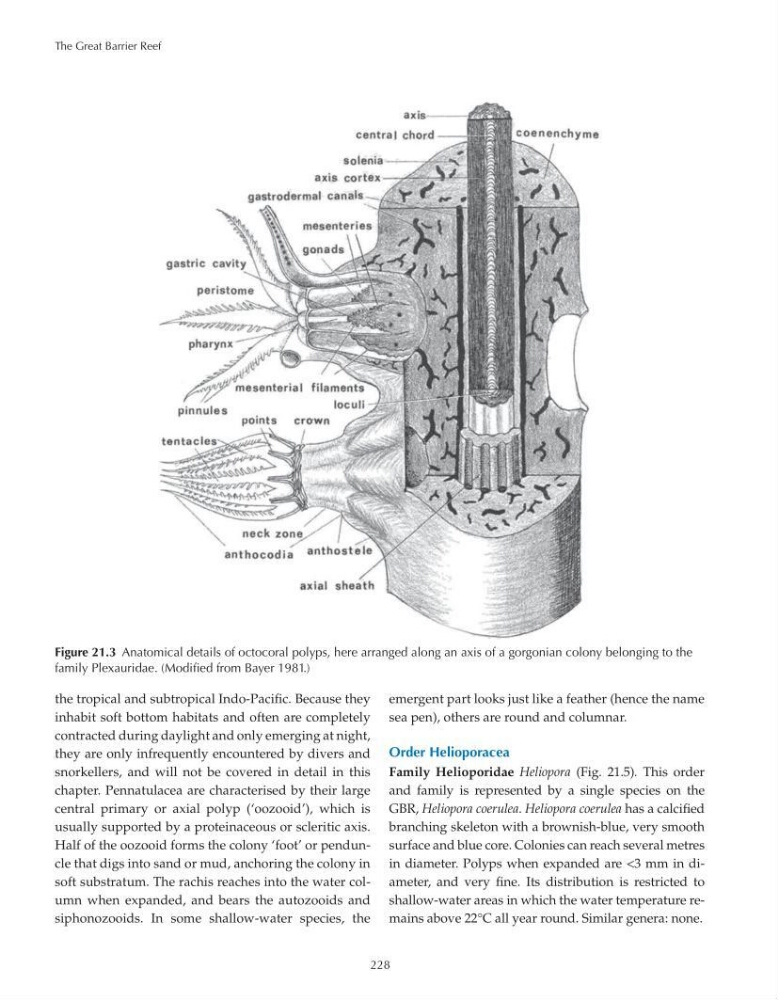
Figure 21.3 Anatomical details of octocoral polyps, here arranged along an axis of a gorgonian colony belonging to the
family Plexauridae. (Modified from Bayer 1981.)
the tropical and subtropical Indo-Pacific. Because they
inhabit soft bottom habitats and often are completely
contracted during daylight and only emerging at night,
they are only infrequently encountered by divers and
snorkellers, and will not be covered in detail in this
chapter. Pennatulacea are characterised by their large
central primary or axial polyp (‘oozooid’), which is
usually supported by a proteinaceous or scleritic axis.
Half of the oozooid forms the colony ‘foot’ or penduncle that digs into sand or mud, anchoring the colony in
soft substratum. The rachis reaches into the water column when expanded, and bears the autozooids and
siphonozooids. In some shallow-water species, the
emergent part looks just like a feather (hence the name
sea pen), others are round and columnar.
Order Helioporacea
Family Helioporidae Heliopora (Fig. 21.5). This order
and family is represented by a single species on the
GBR, Heliopora coerulea. Heliopora coerulea has a calcified
branching skeleton with a brownish-blue, very smooth
surface and blue core. Colonies can reach several metres
in diameter. Polyps when expanded are <3 mm in diameter, and very fine. Its distribution is restricted to
shallow-water areas in which the water temperature remains above 22°C all year round. Similar genera: none.
228
Figure 21.3 Anatomical details of octocoral polyps, here arranged along an axis of a gorgonian colony belonging to the
family Plexauridae. (Modified from Bayer 1981.)
the tropical and subtropical Indo-Pacific. Because they
inhabit soft bottom habitats and often are completely
contracted during daylight and only emerging at night,
they are only infrequently encountered by divers and
snorkellers, and will not be covered in detail in this
chapter. Pennatulacea are characterised by their large
central primary or axial polyp (‘oozooid’), which is
usually supported by a proteinaceous or scleritic axis.
Half of the oozooid forms the colony ‘foot’ or penduncle that digs into sand or mud, anchoring the colony in
soft substratum. The rachis reaches into the water column when expanded, and bears the autozooids and
siphonozooids. In some shallow-water species, the
emergent part looks just like a feather (hence the name
sea pen), others are round and columnar.
Order Helioporacea
Family Helioporidae Heliopora (Fig. 21.5). This order
and family is represented by a single species on the
GBR, Heliopora coerulea. Heliopora coerulea has a calcified
branching skeleton with a brownish-blue, very smooth
surface and blue core. Colonies can reach several metres
in diameter. Polyps when expanded are <3 mm in diameter, and very fine. Its distribution is restricted to
shallow-water areas in which the water temperature remains above 22°C all year round. Similar genera: none.