

20 – Hexacorals 2: Reef-building or Hard Corals
211
(A)
(B)
(C)
(D)
(E)
(F)
(G)
(H)
(I)
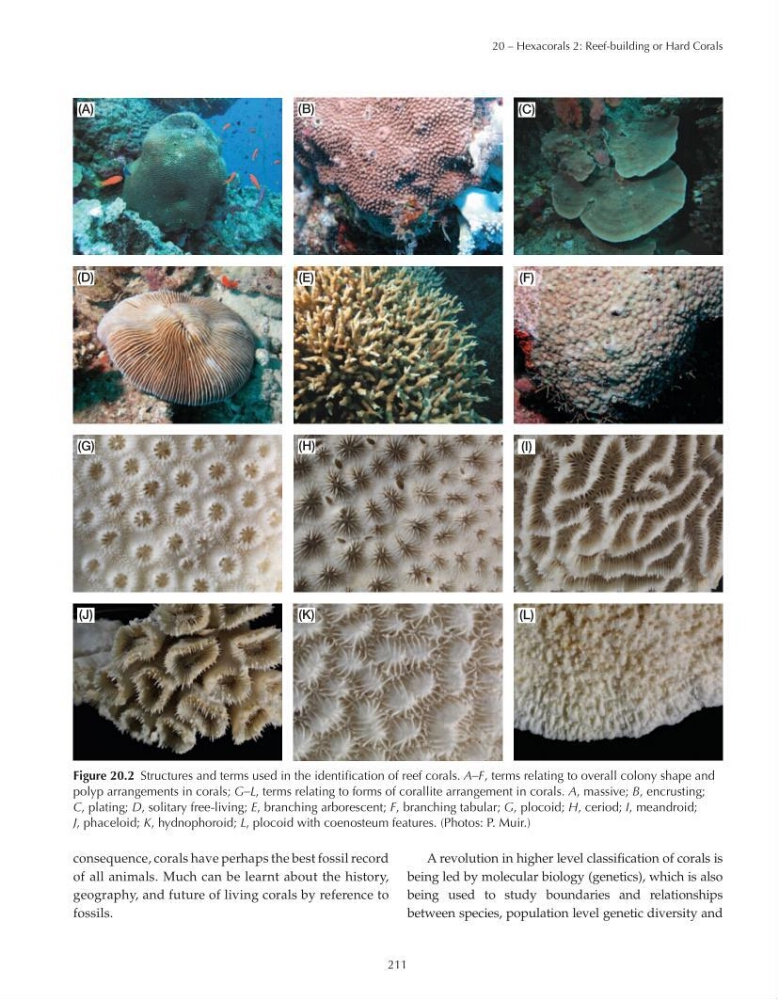
Figure 20.2 Structures and terms used in the identification of reef corals. A–F, terms relating to overall colony shape and
polyp arrangements in corals; G–L, terms relating to forms of corallite arrangement in corals. A, massive; B, encrusting;
C, plating; D, solitary free-living; E, branching arborescent; F, branching tabular; G, plocoid; H, ceriod; I, meandroid;
J, phaceloid; K, hydnophoroid; L, plocoid with coenosteum features. (Photos: P. Muir.)
(J)
(K)
(L)
consequence, corals have perhaps the best fossil record
of all animals. Much can be learnt about the history,
geography, and future of living corals by reference to
fossils.
A revolution in higher level classification of corals is
being led by molecular biology (genetics), which is also
being used to study boundaries and relationships
between species, population level genetic diversity and
211
(A)
(B)
(C)
(D)
(E)
(F)
(G)
(H)
(I)
Figure 20.2 Structures and terms used in the identification of reef corals. A–F, terms relating to overall colony shape and
polyp arrangements in corals; G–L, terms relating to forms of corallite arrangement in corals. A, massive; B, encrusting;
C, plating; D, solitary free-living; E, branching arborescent; F, branching tabular; G, plocoid; H, ceriod; I, meandroid;
J, phaceloid; K, hydnophoroid; L, plocoid with coenosteum features. (Photos: P. Muir.)
(J)
(K)
(L)
consequence, corals have perhaps the best fossil record
of all animals. Much can be learnt about the history,
geography, and future of living corals by reference to
fossils.
A revolution in higher level classification of corals is
being led by molecular biology (genetics), which is also
being used to study boundaries and relationships
between species, population level genetic diversity and