

19 – Hexacorals 1: Sea Anemones and Anemone-like Animals
201
predominantly skeleton-free orders. Valid identification of smaller specimens often requires verifying details of external and internal anatomy under a dissecting
microscope as well as histological preparation of thin
sections and tissue squashes for high power microscopic study. Fortunately for the field observer, many
coral reef species have large size, bright colouration,
unique habitat preferences or typical associates that allow for field identification with reasonable certainty.
N ORDER ACTINIARIA (SEA ANEMONES)
Throughout the world, sea anemones occur in most
marine environments, from rocky and soft intertidal to
deep abyssal substrata, and in many sizes from more
than a metre in diameter down to a millimetre or two.
Large sea anemones can be seen in both tropical reefs
and deep Antarctic waters, but the families represented
differ, with many of the deep sea species having strong
gelatinous column walls or heavy external coatings and
very large mouths while tropical species tend to have
soft bodies, smaller mouths and strong defence mechanisms. Not surprisingly, many of the tiny sea anemones
remain undescribed or unrecorded for Australia and
their presence in ecosystems may go unnoticed. Some
sea anemones harbour symbiotic dinoflagellates and
small-bodied species are sometimes used as indicators
for laboratory study of heat tolerance and other characteristics in these organisms.
Sea anemones occupy many habitats and microhabitats on coral reefs. Some favour elevated sites on the
reef surface, some extend from recesses within the
framework and others burrow within the sandy floor.
Sometimes closely related species have obvious differences in habitat preference, for example the two large
anemonefish hosts Heteractis magnifica and H. crispa
favour exposed high points and protected crevices
respectively.
The ‘swimming anemone’ Boloceroides mcmurrichi
lives unattached or very lightly attached, and is observed sporadically on reefs, sometimes in ‘swarms’ of
large numbers of individuals. Many other anemones
have the capability of changing location slowly by
actions of the pedal disc. Most anemones are highly
retractile and expandable, capable of greatly varying
the column and tentacle length, closing the oral disc
through the actions of a strong marginal sphincter, or
even of disappearing from sight completely by withdrawing into the substratum.
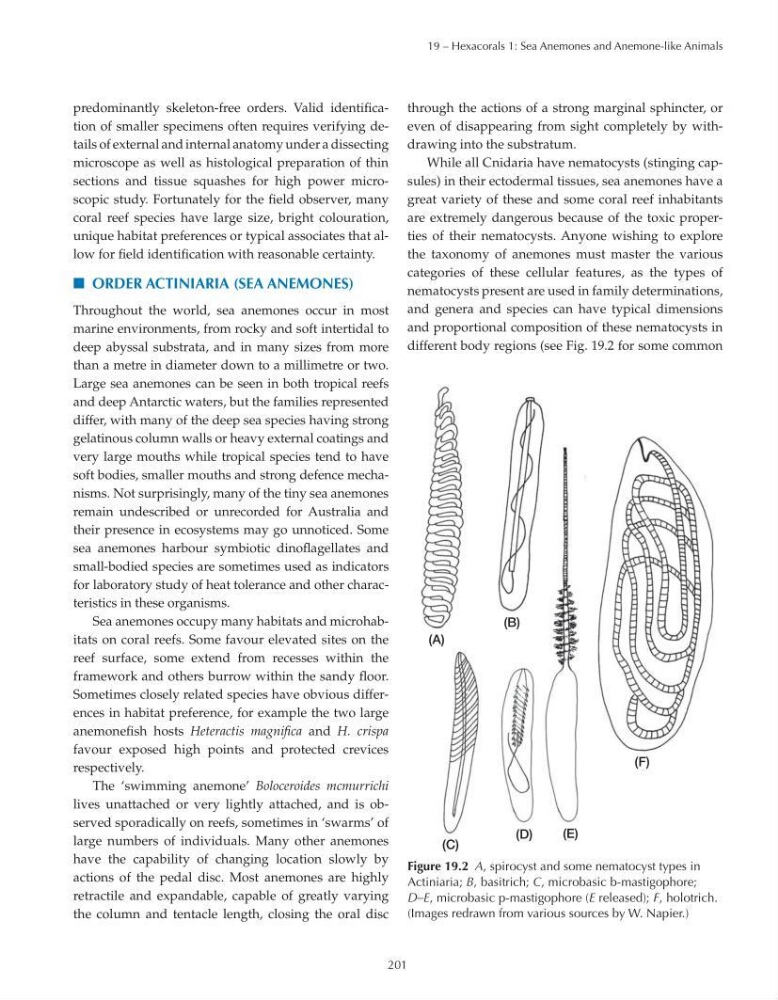
While all Cnidaria have nematocysts (stinging capsules) in their ectodermal tissues, sea anemones have a
great variety of these and some coral reef inhabitants
are extremely dangerous because of the toxic properties of their nematocysts. Anyone wishing to explore
the taxonomy of anemones must master the various
categories of these cellular features, as the types of
nematocysts present are used in family determinations,
and genera and species can have typical dimensions
and proportional composition of these nematocysts in
different body regions (see Fig. 19.2 for some common
(B)
(A)
(C)
(D)
(E)
(F)
Figure 19.2 A, spirocyst and some nematocyst types in
Actiniaria; B, basitrich; C, microbasic b-mastigophore;
D–E, microbasic p-mastigophore (E released); F, holotrich.
(Images redrawn from various sources by W. Napier.)
201
predominantly skeleton-free orders. Valid identification of smaller specimens often requires verifying details of external and internal anatomy under a dissecting
microscope as well as histological preparation of thin
sections and tissue squashes for high power microscopic study. Fortunately for the field observer, many
coral reef species have large size, bright colouration,
unique habitat preferences or typical associates that allow for field identification with reasonable certainty.
N ORDER ACTINIARIA (SEA ANEMONES)
Throughout the world, sea anemones occur in most
marine environments, from rocky and soft intertidal to
deep abyssal substrata, and in many sizes from more
than a metre in diameter down to a millimetre or two.
Large sea anemones can be seen in both tropical reefs
and deep Antarctic waters, but the families represented
differ, with many of the deep sea species having strong
gelatinous column walls or heavy external coatings and
very large mouths while tropical species tend to have
soft bodies, smaller mouths and strong defence mechanisms. Not surprisingly, many of the tiny sea anemones
remain undescribed or unrecorded for Australia and
their presence in ecosystems may go unnoticed. Some
sea anemones harbour symbiotic dinoflagellates and
small-bodied species are sometimes used as indicators
for laboratory study of heat tolerance and other characteristics in these organisms.
Sea anemones occupy many habitats and microhabitats on coral reefs. Some favour elevated sites on the
reef surface, some extend from recesses within the
framework and others burrow within the sandy floor.
Sometimes closely related species have obvious differences in habitat preference, for example the two large
anemonefish hosts Heteractis magnifica and H. crispa
favour exposed high points and protected crevices
respectively.
The ‘swimming anemone’ Boloceroides mcmurrichi
lives unattached or very lightly attached, and is observed sporadically on reefs, sometimes in ‘swarms’ of
large numbers of individuals. Many other anemones
have the capability of changing location slowly by
actions of the pedal disc. Most anemones are highly
retractile and expandable, capable of greatly varying
the column and tentacle length, closing the oral disc
through the actions of a strong marginal sphincter, or
even of disappearing from sight completely by withdrawing into the substratum.
While all Cnidaria have nematocysts (stinging capsules) in their ectodermal tissues, sea anemones have a
great variety of these and some coral reef inhabitants
are extremely dangerous because of the toxic properties of their nematocysts. Anyone wishing to explore
the taxonomy of anemones must master the various
categories of these cellular features, as the types of
nematocysts present are used in family determinations,
and genera and species can have typical dimensions
and proportional composition of these nematocysts in
different body regions (see Fig. 19.2 for some common
(B)
(A)
(C)
(D)
(E)
(F)
Figure 19.2 A, spirocyst and some nematocyst types in
Actiniaria; B, basitrich; C, microbasic b-mastigophore;
D–E, microbasic p-mastigophore (E released); F, holotrich.
(Images redrawn from various sources by W. Napier.)