

200
similar manner to the hard corals. Their attractive
radially symmetrical form and dramatic colouration,
combined with relatively simple environmental requirements, at least in some cases, make this group very popular with the aquarium trade. Because of this, some are
well known to hobbyists and their food and habitat requirements and even breeding and dividing patterns
are recorded on numerous web pages, although scarcely
documented in the scientific literature.
Whereas the classification and identification of Scleractinia and Alcyonaria are primarily based on skeletal
elements (solid skeleton in hard corals and elaborate
spinules in soft corals), other features of the polyp,
both macro- and microscopic, must be used for these
(B)
(C)
(A)
(D)
(E)
(H)
(G)
(F)
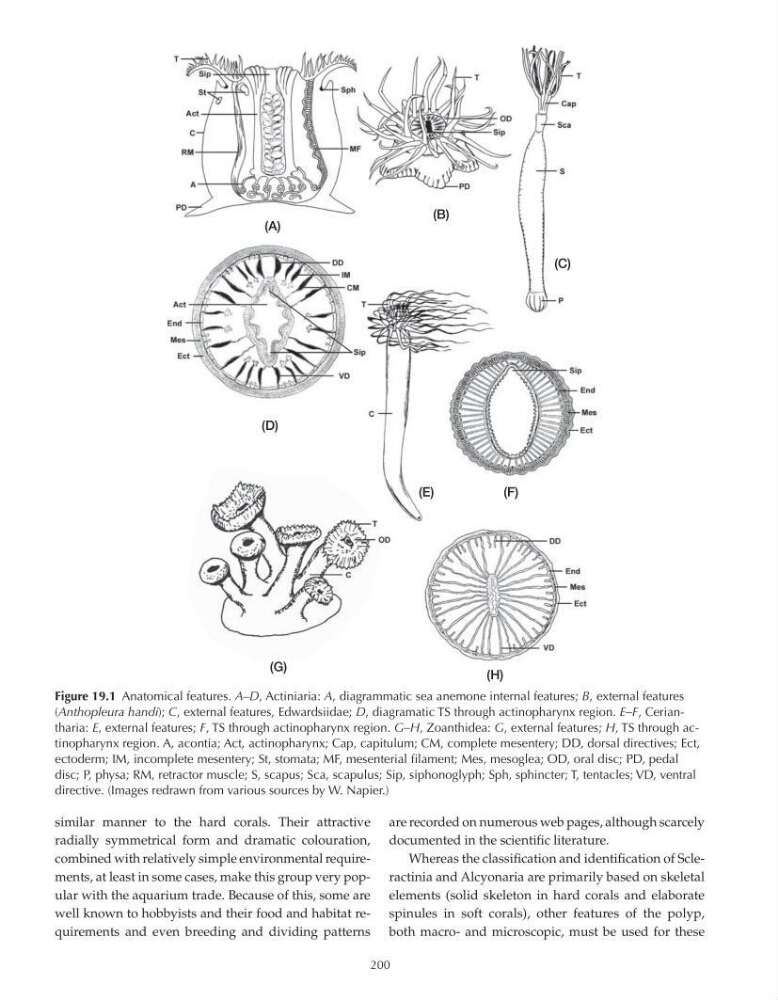
Figure 19.1 Anatomical features. A–D, Actiniaria: A, diagrammatic sea anemone internal features; B, external features
(Anthopleura handi); C, external features, Edwardsiidae; D, diagramatic TS through actinopharynx region. E–F, Ceriantharia: E, external features; F, TS through actinopharynx region. G–H, Zoanthidea: G, external features; H, TS through actinopharynx region. A, acontia; Act, actinopharynx; Cap, capitulum; CM, complete mesentery; DD, dorsal directives; Ect,
ectoderm; IM, incomplete mesentery; St, stomata; MF, mesenterial filament; Mes, mesoglea; OD, oral disc; PD, pedal
disc; P, physa; RM, retractor muscle; S, scapus; Sca, scapulus; Sip, siphonoglyph; Sph, sphincter; T, tentacles; VD, ventral
directive. (Images redrawn from various sources by W. Napier.)
similar manner to the hard corals. Their attractive
radially symmetrical form and dramatic colouration,
combined with relatively simple environmental requirements, at least in some cases, make this group very popular with the aquarium trade. Because of this, some are
well known to hobbyists and their food and habitat requirements and even breeding and dividing patterns
are recorded on numerous web pages, although scarcely
documented in the scientific literature.
Whereas the classification and identification of Scleractinia and Alcyonaria are primarily based on skeletal
elements (solid skeleton in hard corals and elaborate
spinules in soft corals), other features of the polyp,
both macro- and microscopic, must be used for these
(B)
(C)
(A)
(D)
(E)
(H)
(G)
(F)
Figure 19.1 Anatomical features. A–D, Actiniaria: A, diagrammatic sea anemone internal features; B, external features
(Anthopleura handi); C, external features, Edwardsiidae; D, diagramatic TS through actinopharynx region. E–F, Ceriantharia: E, external features; F, TS through actinopharynx region. G–H, Zoanthidea: G, external features; H, TS through actinopharynx region. A, acontia; Act, actinopharynx; Cap, capitulum; CM, complete mesentery; DD, dorsal directives; Ect,
ectoderm; IM, incomplete mesentery; St, stomata; MF, mesenterial filament; Mes, mesoglea; OD, oral disc; PD, pedal
disc; P, physa; RM, retractor muscle; S, scapus; Sca, scapulus; Sip, siphonoglyph; Sph, sphincter; T, tentacles; VD, ventral
directive. (Images redrawn from various sources by W. Napier.)