

18 – Pelagic Cnidaria and Ctenophora
189
causing great harm to the ecosystem in the process
(e.g. Mnemiopsis in the Black Sea and Phyllorhiza in
the Gulf of Mexico). In other cases, serious impacts
on the local biota have been caused by extreme concentrations of native species (e.g. blooms of Chrysaora
in the Gulf of Alaska and Aurelia in California).
Jellyfish can also be a food source for many species,
such as fishes and turtles, and they are heavily fished
in some parts of the world (e.g. China).
N TAXONOMIC OVERVIEW
Jellyfishes of the GBR fall into two phyla, the Cnidaria,
or medusae, and the Ctenophora, or comb jellies. Most
zoology textbooks give a good account of the classification and morphological differences between the two
phyla. Other gelatinous zooplankton include salps, or
pelagic tunicates in the Phylum Urochordata; these are
not dealt with in this chapter (see Chapter 14).
Cnidaria is the more familiar of the two phyla, comprising numerous quite different forms, including:
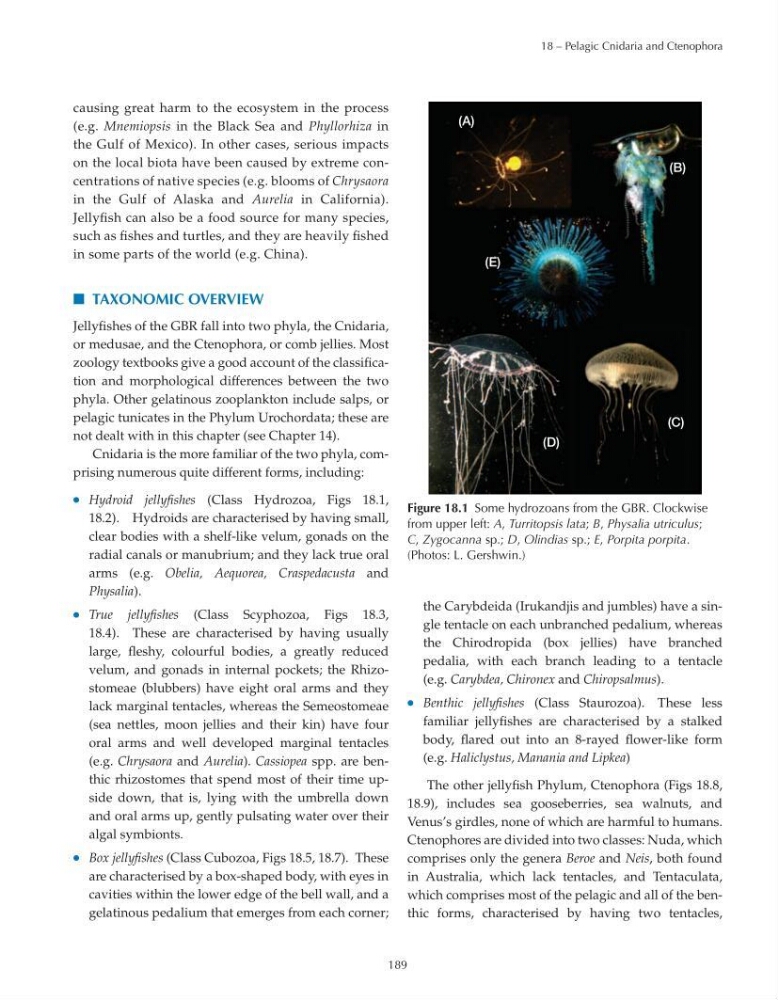
L Hydroid jellyfishes (Class Hydrozoa, Figs 18.1,
18.2). Hydroids are characterised by having small,
clear bodies with a shelf-like velum, gonads on the
radial canals or manubrium; and they lack true oral
arms (e.g. Obelia, Aequorea, Craspedacusta and
Physalia).
L True jellyfishes (Class Scyphozoa, Figs 18.3,
18.4). These are characterised by having usually
large, fleshy, colourful bodies, a greatly reduced
velum, and gonads in internal pockets; the Rhizostomeae (blubbers) have eight oral arms and they
lack marginal tentacles, whereas the Semeostomeae
(sea nettles, moon jellies and their kin) have four
oral arms and well developed marginal tentacles
(e.g. Chrysaora and Aurelia). Cassiopea spp. are benthic rhizostomes that spend most of their time upside down, that is, lying with the umbrella down
and oral arms up, gently pulsating water over their
algal symbionts.
L Box jellyfishes (Class Cubozoa, Figs 18.5, 18.7). These
are characterised by a box-shaped body, with eyes in
cavities within the lower edge of the bell wall, and a
gelatinous pedalium that emerges from each corner;
(A)
(B)
(E)
(D)
(C)
Figure 18.1 Some hydrozoans from the GBR. Clockwise
from upper left: A, Turritopsis lata; B, Physalia utriculus;
C, Zygocanna sp.; D, Olindias sp.; E, Porpita porpita.
(Photos: L. Gershwin.)
the Carybdeida (Irukandjis and jumbles) have a single tentacle on each unbranched pedalium, whereas
the Chirodropida (box jellies) have branched
pedalia, with each branch leading to a tentacle
(e.g. Carybdea, Chironex and Chiropsalmus).
L Benthic jellyfishes (Class Staurozoa). These less
familiar jellyfishes are characterised by a stalked
body, flared out into an 8-rayed flower-like form
(e.g. Haliclystus, Manania and Lipkea)
The other jellyfish Phylum, Ctenophora (Figs 18.8,
18.9), includes sea gooseberries, sea walnuts, and
Venus’s girdles, none of which are harmful to humans.
Ctenophores are divided into two classes: Nuda, which
comprises only the genera Beroe and Neis, both found
in Australia, which lack tentacles, and Tentaculata,
which comprises most of the pelagic and all of the benthic forms, characterised by having two tentacles,
189
causing great harm to the ecosystem in the process
(e.g. Mnemiopsis in the Black Sea and Phyllorhiza in
the Gulf of Mexico). In other cases, serious impacts
on the local biota have been caused by extreme concentrations of native species (e.g. blooms of Chrysaora
in the Gulf of Alaska and Aurelia in California).
Jellyfish can also be a food source for many species,
such as fishes and turtles, and they are heavily fished
in some parts of the world (e.g. China).
N TAXONOMIC OVERVIEW
Jellyfishes of the GBR fall into two phyla, the Cnidaria,
or medusae, and the Ctenophora, or comb jellies. Most
zoology textbooks give a good account of the classification and morphological differences between the two
phyla. Other gelatinous zooplankton include salps, or
pelagic tunicates in the Phylum Urochordata; these are
not dealt with in this chapter (see Chapter 14).
Cnidaria is the more familiar of the two phyla, comprising numerous quite different forms, including:
L Hydroid jellyfishes (Class Hydrozoa, Figs 18.1,
18.2). Hydroids are characterised by having small,
clear bodies with a shelf-like velum, gonads on the
radial canals or manubrium; and they lack true oral
arms (e.g. Obelia, Aequorea, Craspedacusta and
Physalia).
L True jellyfishes (Class Scyphozoa, Figs 18.3,
18.4). These are characterised by having usually
large, fleshy, colourful bodies, a greatly reduced
velum, and gonads in internal pockets; the Rhizostomeae (blubbers) have eight oral arms and they
lack marginal tentacles, whereas the Semeostomeae
(sea nettles, moon jellies and their kin) have four
oral arms and well developed marginal tentacles
(e.g. Chrysaora and Aurelia). Cassiopea spp. are benthic rhizostomes that spend most of their time upside down, that is, lying with the umbrella down
and oral arms up, gently pulsating water over their
algal symbionts.
L Box jellyfishes (Class Cubozoa, Figs 18.5, 18.7). These
are characterised by a box-shaped body, with eyes in
cavities within the lower edge of the bell wall, and a
gelatinous pedalium that emerges from each corner;
(A)
(B)
(E)
(D)
(C)
Figure 18.1 Some hydrozoans from the GBR. Clockwise
from upper left: A, Turritopsis lata; B, Physalia utriculus;
C, Zygocanna sp.; D, Olindias sp.; E, Porpita porpita.
(Photos: L. Gershwin.)
the Carybdeida (Irukandjis and jumbles) have a single tentacle on each unbranched pedalium, whereas
the Chirodropida (box jellies) have branched
pedalia, with each branch leading to a tentacle
(e.g. Carybdea, Chironex and Chiropsalmus).
L Benthic jellyfishes (Class Staurozoa). These less
familiar jellyfishes are characterised by a stalked
body, flared out into an 8-rayed flower-like form
(e.g. Haliclystus, Manania and Lipkea)
The other jellyfish Phylum, Ctenophora (Figs 18.8,
18.9), includes sea gooseberries, sea walnuts, and
Venus’s girdles, none of which are harmful to humans.
Ctenophores are divided into two classes: Nuda, which
comprises only the genera Beroe and Neis, both found
in Australia, which lack tentacles, and Tentaculata,
which comprises most of the pelagic and all of the benthic forms, characterised by having two tentacles,