

The Great Barrier Reef
148
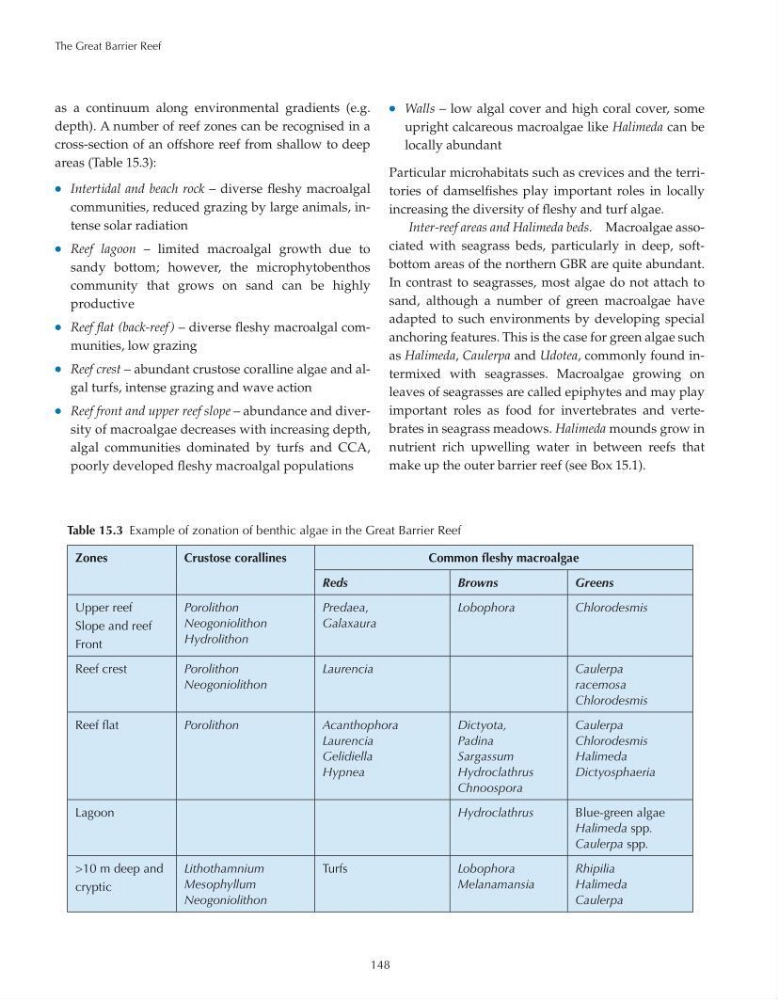
as a continuum along environmental gradients (e.g.
depth). A number of reef zones can be recognised in a
cross-section of an offshore reef from shallow to deep
areas (Table 15.3):
L Intertidal and beach rock – diverse fleshy macroalgal
communities, reduced grazing by large animals, intense solar radiation
L Reef lagoon – limited macroalgal growth due to
sandy bottom; however, the microphytobenthos
community that grows on sand can be highly
productive
L Reef flat (back-reef ) – diverse fleshy macroalgal communities, low grazing
L Reef crest – abundant crustose coralline algae and algal turfs, intense grazing and wave action
L Reef front and upper reef slope – abundance and diversity of macroalgae decreases with increasing depth,
algal communities dominated by turfs and CCA,
poorly developed fleshy macroalgal populations
L Walls – low algal cover and high coral cover, some
upright calcareous macroalgae like Halimeda can be
locally abundant
Particular microhabitats such as crevices and the territories of damselfishes play important roles in locally
increasing the diversity of fleshy and turf algae.
Inter-reef areas and Halimeda beds. Macroalgae associated with seagrass beds, particularly in deep, softbottom areas of the northern GBR are quite abundant.
In contrast to seagrasses, most algae do not attach to
sand, although a number of green macroalgae have
adapted to such environments by developing special
anchoring features. This is the case for green algae such
as Halimeda, Caulerpa and Udotea, commonly found intermixed with seagrasses. Macroalgae growing on
leaves of seagrasses are called epiphytes and may play
important roles as food for invertebrates and vertebrates in seagrass meadows. Halimeda mounds grow in
nutrient rich upwelling water in between reefs that
make up the outer barrier reef (see Box 15.1).
Table 15.3 Example of zonation of benthic algae in the Great Barrier Reef
Zones
Crustose corallines
Common fleshy macroalgae
Reds
Browns
Greens
Upper reef
Slope and reef
Front
Porolithon
Neogoniolithon
Hydrolithon
Predaea,
Galaxaura
Lobophora
Chlorodesmis
Reef crest
Porolithon
Neogoniolithon
Laurencia
Caulerpa
racemosa
Chlorodesmis
Reef flat
Porolithon
Acanthophora
Laurencia
Gelidiella
Hypnea
Dictyota,
Padina
Sargassum
Hydroclathrus
Chnoospora
Caulerpa
Chlorodesmis
Halimeda
Dictyosphaeria
Lagoon
Hydroclathrus
Blue-green algae
Halimeda spp.
Caulerpa spp.
>10 m deep and
cryptic
Lithothamnium
Mesophyllum
Neogoniolithon
Turfs
Lobophora
Melanamansia
Rhipilia
Halimeda
Caulerpa
148
as a continuum along environmental gradients (e.g.
depth). A number of reef zones can be recognised in a
cross-section of an offshore reef from shallow to deep
areas (Table 15.3):
L Intertidal and beach rock – diverse fleshy macroalgal
communities, reduced grazing by large animals, intense solar radiation
L Reef lagoon – limited macroalgal growth due to
sandy bottom; however, the microphytobenthos
community that grows on sand can be highly
productive
L Reef flat (back-reef ) – diverse fleshy macroalgal communities, low grazing
L Reef crest – abundant crustose coralline algae and algal turfs, intense grazing and wave action
L Reef front and upper reef slope – abundance and diversity of macroalgae decreases with increasing depth,
algal communities dominated by turfs and CCA,
poorly developed fleshy macroalgal populations
L Walls – low algal cover and high coral cover, some
upright calcareous macroalgae like Halimeda can be
locally abundant
Particular microhabitats such as crevices and the territories of damselfishes play important roles in locally
increasing the diversity of fleshy and turf algae.
Inter-reef areas and Halimeda beds. Macroalgae associated with seagrass beds, particularly in deep, softbottom areas of the northern GBR are quite abundant.
In contrast to seagrasses, most algae do not attach to
sand, although a number of green macroalgae have
adapted to such environments by developing special
anchoring features. This is the case for green algae such
as Halimeda, Caulerpa and Udotea, commonly found intermixed with seagrasses. Macroalgae growing on
leaves of seagrasses are called epiphytes and may play
important roles as food for invertebrates and vertebrates in seagrass meadows. Halimeda mounds grow in
nutrient rich upwelling water in between reefs that
make up the outer barrier reef (see Box 15.1).
Table 15.3 Example of zonation of benthic algae in the Great Barrier Reef
Zones
Crustose corallines
Common fleshy macroalgae
Reds
Browns
Greens
Upper reef
Slope and reef
Front
Porolithon
Neogoniolithon
Hydrolithon
Predaea,
Galaxaura
Lobophora
Chlorodesmis
Reef crest
Porolithon
Neogoniolithon
Laurencia
Caulerpa
racemosa
Chlorodesmis
Reef flat
Porolithon
Acanthophora
Laurencia
Gelidiella
Hypnea
Dictyota,
Padina
Sargassum
Hydroclathrus
Chnoospora
Caulerpa
Chlorodesmis
Halimeda
Dictyosphaeria
Lagoon
Hydroclathrus
Blue-green algae
Halimeda spp.
Caulerpa spp.
>10 m deep and
cryptic
Lithothamnium
Mesophyllum
Neogoniolithon
Turfs
Lobophora
Melanamansia
Rhipilia
Halimeda
Caulerpa