

14 – Plankton
131
was thrown out as ‘trash’ and hence disregarded. In situ
observations have revealed that the pelagic environment has an abundance of fine structures composed
of mucus, faeces and/or aggregations of phytoplankton cells. Mucus and gelatinous fragments are produced by a host of planktonic organisms that include
appen dicularians, heteropods, salps and jellyfishes.
Mucus fragments coalesce and become a microassemblage of bacteria, protists, phytoplankton and
other organisms that graze on them, such as copepods
of the family Oncaeidae. This so-called ‘marine snow’
becomes heavy and slowly leaves the photic zone, providing organic matter to organisms living in deep water
and ultimately sinks to the substratum as a ‘snow
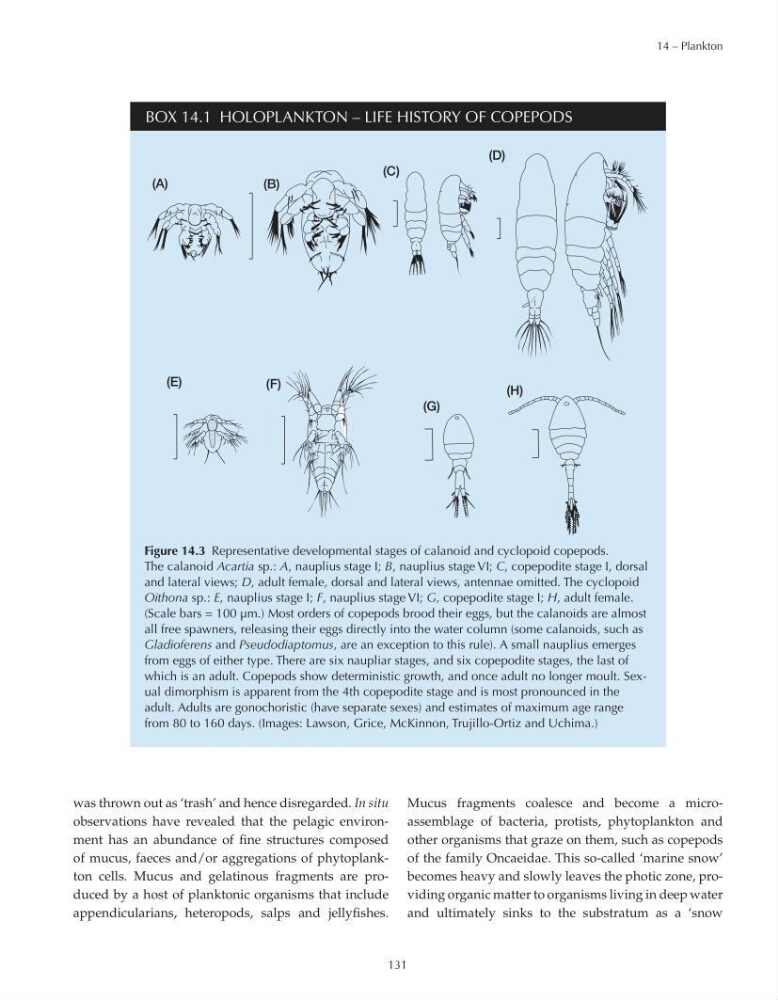
BOX 14.1 HOLOPLANKTON – LIFE HISTORY OF COPEPODS
(A)
(B)
(C)
(D)
(E)
(F)
(G)
(H)
Figure 14.3 Representative developmental stages of calanoid and cyclopoid copepods.
The calanoid Acartia sp.: A, nauplius stage I; B, nauplius stage VI; C, copepodite stage I, dorsal
and lateral views; D, adult female, dorsal and lateral views, antennae omitted. The cyclopoid
Oithona sp.: E, nauplius stage I; F, nauplius stage VI; G, copepodite stage I; H, adult female.
(Scale bars = 100 μm.) Most orders of copepods brood their eggs, but the calanoids are almost
all free spawners, releasing their eggs directly into the water column (some calanoids, such as
Gladioferens and Pseudodiaptomus, are an exception to this rule). A small nauplius emerges
from eggs of either type. There are six naupliar stages, and six copepodite stages, the last of
which is an adult. Copepods show deterministic growth, and once adult no longer moult. Sexual dimorphism is apparent from the 4th copepodite stage and is most pronounced in the
adult. Adults are gonochoristic (have separate sexes) and estimates of maximum age range
from 80 to 160 days. (Images: Lawson, Grice, McKinnon, Trujillo-Ortiz and Uchima.)
131
was thrown out as ‘trash’ and hence disregarded. In situ
observations have revealed that the pelagic environment has an abundance of fine structures composed
of mucus, faeces and/or aggregations of phytoplankton cells. Mucus and gelatinous fragments are produced by a host of planktonic organisms that include
appen dicularians, heteropods, salps and jellyfishes.
Mucus fragments coalesce and become a microassemblage of bacteria, protists, phytoplankton and
other organisms that graze on them, such as copepods
of the family Oncaeidae. This so-called ‘marine snow’
becomes heavy and slowly leaves the photic zone, providing organic matter to organisms living in deep water
and ultimately sinks to the substratum as a ‘snow
BOX 14.1 HOLOPLANKTON – LIFE HISTORY OF COPEPODS
(A)
(B)
(C)
(D)
(E)
(F)
(G)
(H)
Figure 14.3 Representative developmental stages of calanoid and cyclopoid copepods.
The calanoid Acartia sp.: A, nauplius stage I; B, nauplius stage VI; C, copepodite stage I, dorsal
and lateral views; D, adult female, dorsal and lateral views, antennae omitted. The cyclopoid
Oithona sp.: E, nauplius stage I; F, nauplius stage VI; G, copepodite stage I; H, adult female.
(Scale bars = 100 μm.) Most orders of copepods brood their eggs, but the calanoids are almost
all free spawners, releasing their eggs directly into the water column (some calanoids, such as
Gladioferens and Pseudodiaptomus, are an exception to this rule). A small nauplius emerges
from eggs of either type. There are six naupliar stages, and six copepodite stages, the last of
which is an adult. Copepods show deterministic growth, and once adult no longer moult. Sexual dimorphism is apparent from the 4th copepodite stage and is most pronounced in the
adult. Adults are gonochoristic (have separate sexes) and estimates of maximum age range
from 80 to 160 days. (Images: Lawson, Grice, McKinnon, Trujillo-Ortiz and Uchima.)