

The Great Barrier Reef
110
further research. A brief overview over these five types
of water quality issues is given here.
Both suspended sediments and phytoplankton
blooms can reduce light to benthic organisms via increased turbidity. Light limitation from turbidity reduces
gross photosynthesis and growth at deeper depths but
not in shallow water in hermatypic corals, seagrass and
macroalgae. Light limitation also greatly reduces coral
recruitment. The extent of trophic plasticity varies
between coral species and effects of light limitation are
most severe for more phototrophic species, and less
influential on trophically more plastic groups. Heterotrophic species such as filter feeders may be promoted at
low light.
Enrichment with POM enhances feeding rates and
growth in some corals, providing a growth advantage
that can partly or fully compensate for light reduction,
especially in high-flow environments. However, while
some corals can benefit from POM, heterotrophic filter
feeders will benefit even more than corals do, hence the
competitive advantage shifts from corals that can grow
at extremely low food concentrations to simpler, more
heterotrophic communities.
Dissolved inorganic nutrients can reduce coral calcification and increase macroalgal abundances. Excessive nutrients may shift coral communities towards
algal dominated communities, although this shift is
complicated by the abundance of algal grazing fish.
Where grazing fish (and other invertebrate grazers) are
abundant they may control algal proliferation and thus
reduce the manifestation of undesirable effects of nutrient enrichment. Dissolved inorganic nutrients are generally quickly removed from the water column through
biological uptake. It is therefore suspected that their
main role in affecting ecosystems is that of promoting
the organic enrichment of benthos, sediments and suspended particulate organic matter.
A more indirect effect of increased nutrients on coral
reef ecosystems may arise through an increased
probability of the formation of population outbreaks of
(A)
(B)
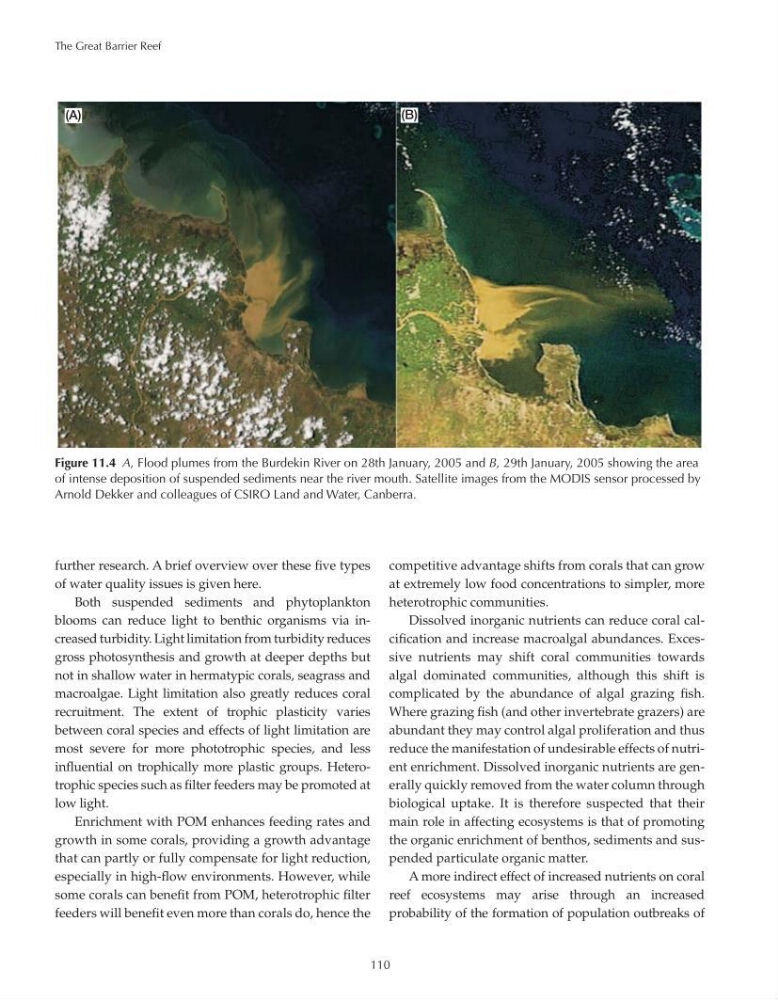
Figure 11.4 A, Flood plumes from the Burdekin River on 28th January, 2005 and B, 29th January, 2005 showing the area
of intense deposition of suspended sediments near the river mouth. Satellite images from the MODIS sensor processed by
Arnold Dekker and colleagues of CSIRO Land and Water, Canberra.
110
further research. A brief overview over these five types
of water quality issues is given here.
Both suspended sediments and phytoplankton
blooms can reduce light to benthic organisms via increased turbidity. Light limitation from turbidity reduces
gross photosynthesis and growth at deeper depths but
not in shallow water in hermatypic corals, seagrass and
macroalgae. Light limitation also greatly reduces coral
recruitment. The extent of trophic plasticity varies
between coral species and effects of light limitation are
most severe for more phototrophic species, and less
influential on trophically more plastic groups. Heterotrophic species such as filter feeders may be promoted at
low light.
Enrichment with POM enhances feeding rates and
growth in some corals, providing a growth advantage
that can partly or fully compensate for light reduction,
especially in high-flow environments. However, while
some corals can benefit from POM, heterotrophic filter
feeders will benefit even more than corals do, hence the
competitive advantage shifts from corals that can grow
at extremely low food concentrations to simpler, more
heterotrophic communities.
Dissolved inorganic nutrients can reduce coral calcification and increase macroalgal abundances. Excessive nutrients may shift coral communities towards
algal dominated communities, although this shift is
complicated by the abundance of algal grazing fish.
Where grazing fish (and other invertebrate grazers) are
abundant they may control algal proliferation and thus
reduce the manifestation of undesirable effects of nutrient enrichment. Dissolved inorganic nutrients are generally quickly removed from the water column through
biological uptake. It is therefore suspected that their
main role in affecting ecosystems is that of promoting
the organic enrichment of benthos, sediments and suspended particulate organic matter.
A more indirect effect of increased nutrients on coral
reef ecosystems may arise through an increased
probability of the formation of population outbreaks of
(A)
(B)
Figure 11.4 A, Flood plumes from the Burdekin River on 28th January, 2005 and B, 29th January, 2005 showing the area
of intense deposition of suspended sediments near the river mouth. Satellite images from the MODIS sensor processed by
Arnold Dekker and colleagues of CSIRO Land and Water, Canberra.