

11 – Terrestrial Runoff to the Great Barrier Reef and the Implications for Its Long Term Ecological Status
109
use; and a diverse array of other pollutants (e.g. heavy
metals, persistent organic pollutants, antibiotics, and
caffeine) and nutrients from urban land use associated
with sewage effluents and stormwater runoff.
Pollutants are transported through GBRCA rivers
primarily in large flow events following monsoonal/
cyclonic rainfall. As the rivers flood, a proportion of the
pollutant load is trapped on floodplains, especially in
riparian vegetation and wetlands. However, since
GBRCA rivers are relatively short and fast flowing
there is limited time for trapping and most rivers discharge a high proportion of their fine particulate and
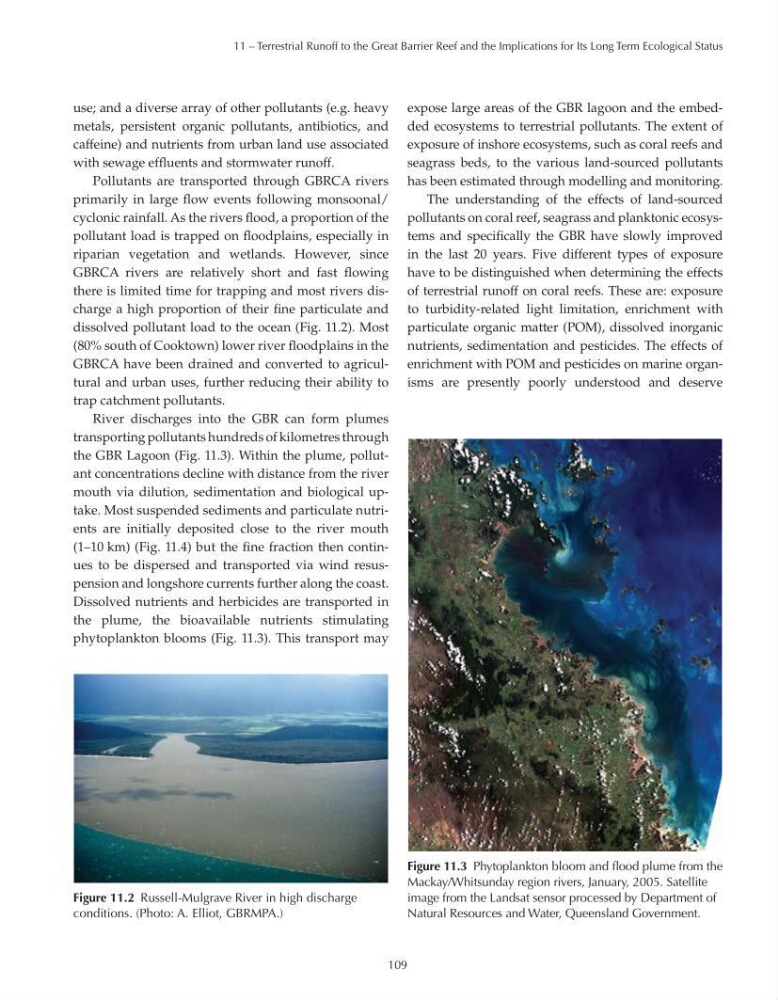
dissolved pollutant load to the ocean (Fig. 11.2). Most
(80% south of Cooktown) lower river floodplains in the
GBRCA have been drained and converted to agricultural and urban uses, further reducing their ability to
trap catchment pollutants.
River discharges into the GBR can form plumes
transporting pollutants hundreds of kilometres through
the GBR Lagoon (Fig. 11.3). Within the plume, pollutant concentrations decline with distance from the river
mouth via dilution, sedimentation and biological uptake. Most suspended sediments and particulate nutrients are initially deposited close to the river mouth
(1–10 km) (Fig. 11.4) but the fine fraction then continues to be dispersed and transported via wind resuspension and longshore currents further along the coast.
Dissolved nutrients and herbicides are transported in
the plume, the bioavailable nutrients stimulating
phytoplankton blooms (Fig. 11.3). This transport may
Figure 11.3 Phytoplankton bloom and flood plume from the
Mackay/Whitsunday region rivers, January, 2005. Satellite
image from the Landsat sensor processed by Department of
Natural Resources and Water, Queensland Government.
expose large areas of the GBR lagoon and the embedded ecosystems to terrestrial pollutants. The extent of
exposure of inshore ecosystems, such as coral reefs and
seagrass beds, to the various land-sourced pollutants
has been estimated through modelling and monitoring.
The understanding of the effects of land-sourced
pollutants on coral reef, seagrass and planktonic ecosystems and specifically the GBR have slowly improved
in the last 20 years. Five different types of exposure
have to be distinguished when determining the effects
of terrestrial runoff on coral reefs. These are: exposure
to turbidity-related light limitation, enrichment with
particulate organic matter (POM), dissolved inorganic
nutrients, sedimentation and pesticides. The effects of
enrichment with POM and pesticides on marine organisms are presently poorly understood and deserve
Figure 11.2 Russell-Mulgrave River in high discharge
conditions. (Photo: A. Elliot, GBRMPA.)
109
use; and a diverse array of other pollutants (e.g. heavy
metals, persistent organic pollutants, antibiotics, and
caffeine) and nutrients from urban land use associated
with sewage effluents and stormwater runoff.
Pollutants are transported through GBRCA rivers
primarily in large flow events following monsoonal/
cyclonic rainfall. As the rivers flood, a proportion of the
pollutant load is trapped on floodplains, especially in
riparian vegetation and wetlands. However, since
GBRCA rivers are relatively short and fast flowing
there is limited time for trapping and most rivers discharge a high proportion of their fine particulate and
dissolved pollutant load to the ocean (Fig. 11.2). Most
(80% south of Cooktown) lower river floodplains in the
GBRCA have been drained and converted to agricultural and urban uses, further reducing their ability to
trap catchment pollutants.
River discharges into the GBR can form plumes
transporting pollutants hundreds of kilometres through
the GBR Lagoon (Fig. 11.3). Within the plume, pollutant concentrations decline with distance from the river
mouth via dilution, sedimentation and biological uptake. Most suspended sediments and particulate nutrients are initially deposited close to the river mouth
(1–10 km) (Fig. 11.4) but the fine fraction then continues to be dispersed and transported via wind resuspension and longshore currents further along the coast.
Dissolved nutrients and herbicides are transported in
the plume, the bioavailable nutrients stimulating
phytoplankton blooms (Fig. 11.3). This transport may
Figure 11.3 Phytoplankton bloom and flood plume from the
Mackay/Whitsunday region rivers, January, 2005. Satellite
image from the Landsat sensor processed by Department of
Natural Resources and Water, Queensland Government.
expose large areas of the GBR lagoon and the embedded ecosystems to terrestrial pollutants. The extent of
exposure of inshore ecosystems, such as coral reefs and
seagrass beds, to the various land-sourced pollutants
has been estimated through modelling and monitoring.
The understanding of the effects of land-sourced
pollutants on coral reef, seagrass and planktonic ecosystems and specifically the GBR have slowly improved
in the last 20 years. Five different types of exposure
have to be distinguished when determining the effects
of terrestrial runoff on coral reefs. These are: exposure
to turbidity-related light limitation, enrichment with
particulate organic matter (POM), dissolved inorganic
nutrients, sedimentation and pesticides. The effects of
enrichment with POM and pesticides on marine organisms are presently poorly understood and deserve
Figure 11.2 Russell-Mulgrave River in high discharge
conditions. (Photo: A. Elliot, GBRMPA.)