

84 Organic compounds in soils, sediments & sludges
Soil 1
100
80
60
40
20
0
0.0 0.5 1.0 1.5 2.0 2.5 3.0 3.5
Soil 2
100
80
60
40
20
0
0.0 0.5 1.0 1.5 2.0 2.5 3.0 3.5
Soil 3
100
80
60
40
20
0
0.0 0.5 1.0 1.5 2.0 2.5 3.0 3.5
0.0 0.5 1.0 1.5 2.0 2.5 3.0 3.5
100
80
60
40
20
0
Soil 4
0.0 0.5 1.0 1.5 2.0 2.5 3.0 3.5
100
80
60
40
20
0
Soil 5
Adsorbed amount (µgg
Ϫ1
)
Equilibrium concentration (µg ml
Ϫ1 )
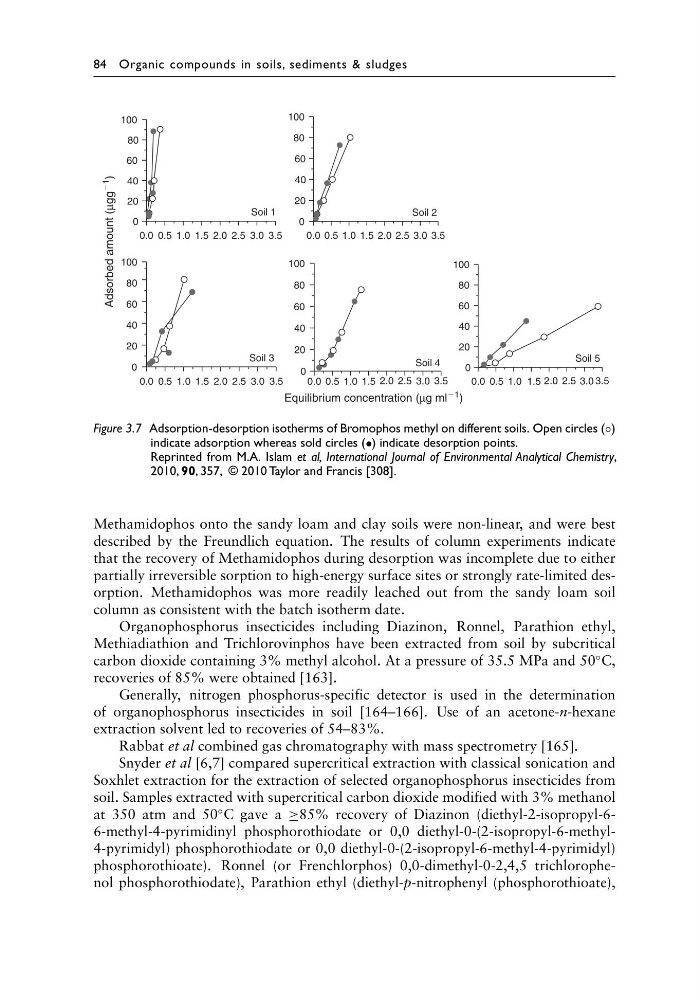
Figure 3.7 Adsorption-desorption isotherms of Bromophos methyl on different soils. Open circles (◦)
indicate adsorption whereas sold circles (•) indicate desorption points.
Reprinted from M.A. Islam et al, International Journal of Environmental Analytical Chemistry,
2010, 90, 357, © 2010 Taylor and Francis [308].
Methamidophos onto the sandy loam and clay soils were non-linear, and were best
described by the Freundlich equation. The results of column experiments indicate
that the recovery of Methamidophos during desorption was incomplete due to either
partially irreversible sorption to high-energy surface sites or strongly rate-limited desorption. Methamidophos was more readily leached out from the sandy loam soil
column as consistent with the batch isotherm date.
Organophosphorus insecticides including Diazinon, Ronnel, Parathion ethyl,
Methiadiathion and Trichlorovinphos have been extracted from soil by subcritical
carbon dioxide containing 3% methyl alcohol. At a pressure of 35.5 MPa and 50
◦ C,
recoveries of 85% were obtained [163].
Generally, nitrogen phosphorus-specific detector is used in the determination
of organophosphorus insecticides in soil [164–166]. Use of an acetone-n-hexane
extraction solvent led to recoveries of 54–83%.
Rabbat et al combined gas chromatography with mass spectrometry [165].
Snyder et al [6,7] compared supercritical extraction with classical sonication and
Soxhlet extraction for the extraction of selected organophosphorus insecticides from
soil. Samples extracted with supercritical carbon dioxide modified with 3% methanol
at 350 atm and 50
◦ C gave a ≥85% recovery of Diazinon (diethyl-2-isopropyl-66-methyl-4-pyrimidinyl phosphorothiodate or 0,0 diethyl-0-(2-isopropyl-6-methyl4-pyrimidyl) phosphorothiodate or 0,0 diethyl-0-(2-isopropyl-6-methyl-4-pyrimidyl)
phosphorothioate). Ronnel (or Frenchlorphos) 0,0-dimethyl-0-2,4,5 trichlorophenol phosphorothiodate), Parathion ethyl (diethyl-p-nitrophenyl (phosphorothioate),
Soil 1
100
80
60
40
20
0
0.0 0.5 1.0 1.5 2.0 2.5 3.0 3.5
Soil 2
100
80
60
40
20
0
0.0 0.5 1.0 1.5 2.0 2.5 3.0 3.5
Soil 3
100
80
60
40
20
0
0.0 0.5 1.0 1.5 2.0 2.5 3.0 3.5
0.0 0.5 1.0 1.5 2.0 2.5 3.0 3.5
100
80
60
40
20
0
Soil 4
0.0 0.5 1.0 1.5 2.0 2.5 3.0 3.5
100
80
60
40
20
0
Soil 5
Adsorbed amount (µgg
Ϫ1
)
Equilibrium concentration (µg ml
Ϫ1 )
Figure 3.7 Adsorption-desorption isotherms of Bromophos methyl on different soils. Open circles (◦)
indicate adsorption whereas sold circles (•) indicate desorption points.
Reprinted from M.A. Islam et al, International Journal of Environmental Analytical Chemistry,
2010, 90, 357, © 2010 Taylor and Francis [308].
Methamidophos onto the sandy loam and clay soils were non-linear, and were best
described by the Freundlich equation. The results of column experiments indicate
that the recovery of Methamidophos during desorption was incomplete due to either
partially irreversible sorption to high-energy surface sites or strongly rate-limited desorption. Methamidophos was more readily leached out from the sandy loam soil
column as consistent with the batch isotherm date.
Organophosphorus insecticides including Diazinon, Ronnel, Parathion ethyl,
Methiadiathion and Trichlorovinphos have been extracted from soil by subcritical
carbon dioxide containing 3% methyl alcohol. At a pressure of 35.5 MPa and 50
◦ C,
recoveries of 85% were obtained [163].
Generally, nitrogen phosphorus-specific detector is used in the determination
of organophosphorus insecticides in soil [164–166]. Use of an acetone-n-hexane
extraction solvent led to recoveries of 54–83%.
Rabbat et al combined gas chromatography with mass spectrometry [165].
Snyder et al [6,7] compared supercritical extraction with classical sonication and
Soxhlet extraction for the extraction of selected organophosphorus insecticides from
soil. Samples extracted with supercritical carbon dioxide modified with 3% methanol
at 350 atm and 50
◦ C gave a ≥85% recovery of Diazinon (diethyl-2-isopropyl-66-methyl-4-pyrimidinyl phosphorothiodate or 0,0 diethyl-0-(2-isopropyl-6-methyl4-pyrimidyl) phosphorothiodate or 0,0 diethyl-0-(2-isopropyl-6-methyl-4-pyrimidyl)
phosphorothioate). Ronnel (or Frenchlorphos) 0,0-dimethyl-0-2,4,5 trichlorophenol phosphorothiodate), Parathion ethyl (diethyl-p-nitrophenyl (phosphorothioate),