

Insecticides and herbicides in soils 83
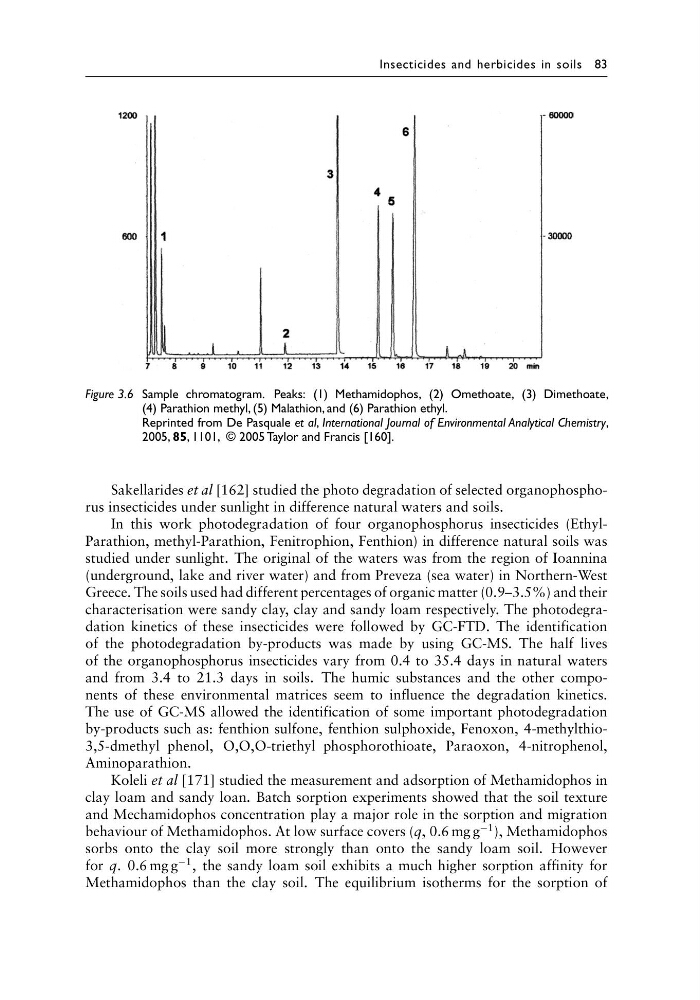
Figure 3.6 Sample chromatogram. Peaks: (1) Methamidophos, (2) Omethoate, (3) Dimethoate,
(4) Parathion methyl, (5) Malathion, and (6) Parathion ethyl.
Reprinted from De Pasquale et al, International Journal of Environmental Analytical Chemistry,
2005, 85, 1101, © 2005 Taylor and Francis [160].
Sakellarides et al [162] studied the photo degradation of selected organophosphorus insecticides under sunlight in difference natural waters and soils.
In this work photodegradation of four organophosphorus insecticides (EthylParathion, methyl-Parathion, Fenitrophion, Fenthion) in difference natural soils was
studied under sunlight. The original of the waters was from the region of Ioannina
(underground, lake and river water) and from Preveza (sea water) in Northern-West
Greece. The soils used had different percentages of organic matter (0.9–3.5%) and their
characterisation were sandy clay, clay and sandy loam respectively. The photodegradation kinetics of these insecticides were followed by GC-FTD. The identification
of the photodegradation by-products was made by using GC-MS. The half lives
of the organophosphorus insecticides vary from 0.4 to 35.4 days in natural waters
and from 3.4 to 21.3 days in soils. The humic substances and the other components of these environmental matrices seem to influence the degradation kinetics.
The use of GC-MS allowed the identification of some important photodegradation
by-products such as: fenthion sulfone, fenthion sulphoxide, Fenoxon, 4-methylthio3,5-dmethyl phenol, O,O,O-triethyl phosphorothioate, Paraoxon, 4-nitrophenol,
Aminoparathion.
Koleli et al [171] studied the measurement and adsorption of Methamidophos in
clay loam and sandy loan. Batch sorption experiments showed that the soil texture
and Mechamidophos concentration play a major role in the sorption and migration
behaviour of Methamidophos. At low surface covers (q, 0.6 mg g
−1 ), Methamidophos
sorbs onto the clay soil more strongly than onto the sandy loam soil. However
for q. 0.6 mg g
−1 , the sandy loam soil exhibits a much higher sorption affinity for
Methamidophos than the clay soil. The equilibrium isotherms for the sorption of
Figure 3.6 Sample chromatogram. Peaks: (1) Methamidophos, (2) Omethoate, (3) Dimethoate,
(4) Parathion methyl, (5) Malathion, and (6) Parathion ethyl.
Reprinted from De Pasquale et al, International Journal of Environmental Analytical Chemistry,
2005, 85, 1101, © 2005 Taylor and Francis [160].
Sakellarides et al [162] studied the photo degradation of selected organophosphorus insecticides under sunlight in difference natural waters and soils.
In this work photodegradation of four organophosphorus insecticides (EthylParathion, methyl-Parathion, Fenitrophion, Fenthion) in difference natural soils was
studied under sunlight. The original of the waters was from the region of Ioannina
(underground, lake and river water) and from Preveza (sea water) in Northern-West
Greece. The soils used had different percentages of organic matter (0.9–3.5%) and their
characterisation were sandy clay, clay and sandy loam respectively. The photodegradation kinetics of these insecticides were followed by GC-FTD. The identification
of the photodegradation by-products was made by using GC-MS. The half lives
of the organophosphorus insecticides vary from 0.4 to 35.4 days in natural waters
and from 3.4 to 21.3 days in soils. The humic substances and the other components of these environmental matrices seem to influence the degradation kinetics.
The use of GC-MS allowed the identification of some important photodegradation
by-products such as: fenthion sulfone, fenthion sulphoxide, Fenoxon, 4-methylthio3,5-dmethyl phenol, O,O,O-triethyl phosphorothioate, Paraoxon, 4-nitrophenol,
Aminoparathion.
Koleli et al [171] studied the measurement and adsorption of Methamidophos in
clay loam and sandy loan. Batch sorption experiments showed that the soil texture
and Mechamidophos concentration play a major role in the sorption and migration
behaviour of Methamidophos. At low surface covers (q, 0.6 mg g
−1 ), Methamidophos
sorbs onto the clay soil more strongly than onto the sandy loam soil. However
for q. 0.6 mg g
−1 , the sandy loam soil exhibits a much higher sorption affinity for
Methamidophos than the clay soil. The equilibrium isotherms for the sorption of