

80 Organic compounds in soils, sediments & sludges
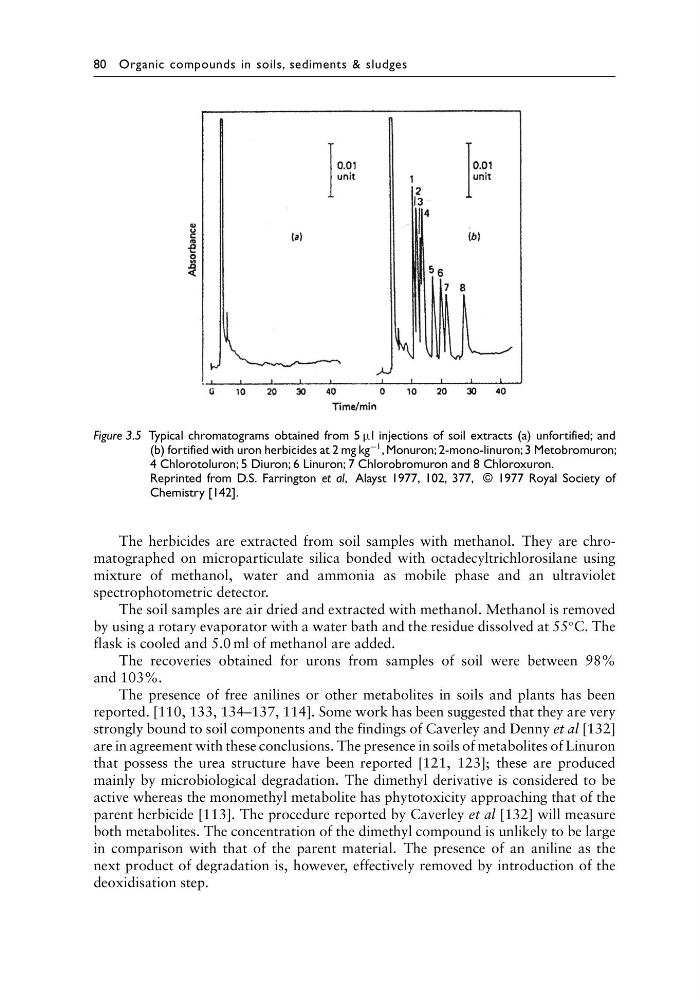
Figure 3.5 Typical chromatograms obtained from 5 µl injections of soil extracts (a) unfortified; and
(b) fortified with uron herbicides at 2 mg kg
−1 , Monuron; 2-mono-linuron; 3 Metobromuron;
4 Chlorotoluron; 5 Diuron; 6 Linuron; 7 Chlorobromuron and 8 Chloroxuron.
Reprinted from D.S. Farrington et al, Alayst 1977, 102, 377, © 1977 Royal Society of
Chemistry [142].
The herbicides are extracted from soil samples with methanol. They are chromatographed on microparticulate silica bonded with octadecyltrichlorosilane using
mixture of methanol, water and ammonia as mobile phase and an ultraviolet
spectrophotometric detector.
The soil samples are air dried and extracted with methanol. Methanol is removed
by using a rotary evaporator with a water bath and the residue dissolved at 55
◦ C. The
flask is cooled and 5.0 ml of methanol are added.
The recoveries obtained for urons from samples of soil were between 98%
and 103%.
The presence of free anilines or other metabolites in soils and plants has been
reported. [110, 133, 134–137, 114]. Some work has been suggested that they are very
strongly bound to soil components and the findings of Caverley and Denny et al [132]
are in agreement with these conclusions. The presence in soils of metabolites of Linuron
that possess the urea structure have been reported [121, 123]; these are produced
mainly by microbiological degradation. The dimethyl derivative is considered to be
active whereas the monomethyl metabolite has phytotoxicity approaching that of the
parent herbicide [113]. The procedure reported by Caverley et al [132] will measure
both metabolites. The concentration of the dimethyl compound is unlikely to be large
in comparison with that of the parent material. The presence of an aniline as the
next product of degradation is, however, effectively removed by introduction of the
deoxidisation step.
Figure 3.5 Typical chromatograms obtained from 5 µl injections of soil extracts (a) unfortified; and
(b) fortified with uron herbicides at 2 mg kg
−1 , Monuron; 2-mono-linuron; 3 Metobromuron;
4 Chlorotoluron; 5 Diuron; 6 Linuron; 7 Chlorobromuron and 8 Chloroxuron.
Reprinted from D.S. Farrington et al, Alayst 1977, 102, 377, © 1977 Royal Society of
Chemistry [142].
The herbicides are extracted from soil samples with methanol. They are chromatographed on microparticulate silica bonded with octadecyltrichlorosilane using
mixture of methanol, water and ammonia as mobile phase and an ultraviolet
spectrophotometric detector.
The soil samples are air dried and extracted with methanol. Methanol is removed
by using a rotary evaporator with a water bath and the residue dissolved at 55
◦ C. The
flask is cooled and 5.0 ml of methanol are added.
The recoveries obtained for urons from samples of soil were between 98%
and 103%.
The presence of free anilines or other metabolites in soils and plants has been
reported. [110, 133, 134–137, 114]. Some work has been suggested that they are very
strongly bound to soil components and the findings of Caverley and Denny et al [132]
are in agreement with these conclusions. The presence in soils of metabolites of Linuron
that possess the urea structure have been reported [121, 123]; these are produced
mainly by microbiological degradation. The dimethyl derivative is considered to be
active whereas the monomethyl metabolite has phytotoxicity approaching that of the
parent herbicide [113]. The procedure reported by Caverley et al [132] will measure
both metabolites. The concentration of the dimethyl compound is unlikely to be large
in comparison with that of the parent material. The presence of an aniline as the
next product of degradation is, however, effectively removed by introduction of the
deoxidisation step.