

Insecticides and herbicides in soils 79
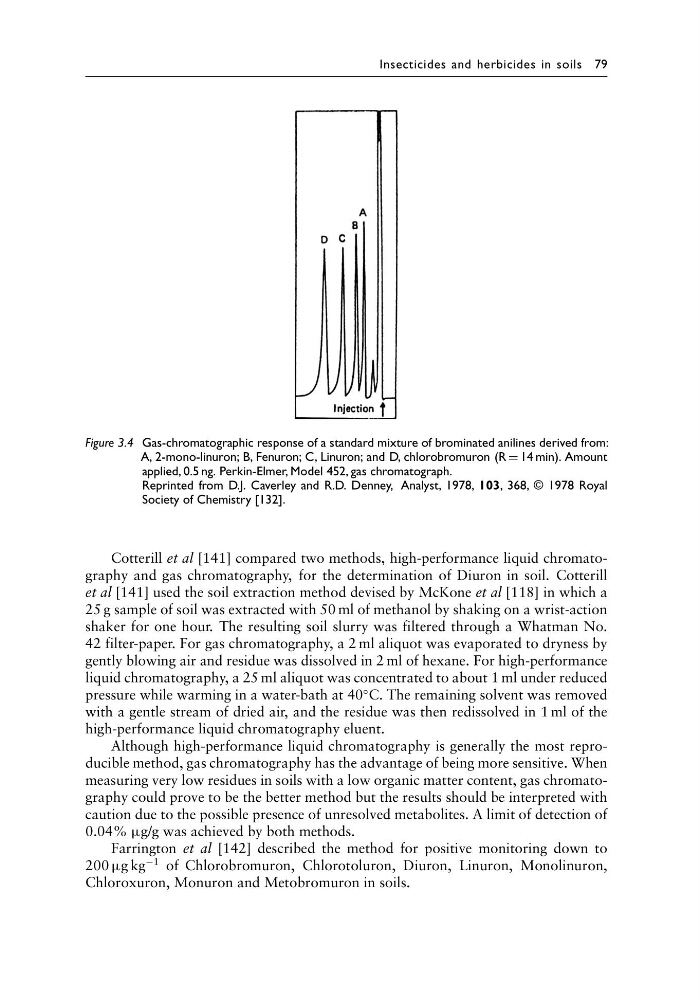
Figure 3.4 Gas-chromatographic response of a standard mixture of brominated anilines derived from:
A, 2-mono-linuron; B, Fenuron; C, Linuron; and D, chlorobromuron (R = 14 min). Amount
applied, 0.5 ng. Perkin-Elmer, Model 452, gas chromatograph.
Reprinted from D.J. Caverley and R.D. Denney, Analyst, 1978, 103, 368, © 1978 Royal
Society of Chemistry [132].
Cotterill et al [141] compared two methods, high-performance liquid chromatography and gas chromatography, for the determination of Diuron in soil. Cotterill
et al [141] used the soil extraction method devised by McKone et al [118] in which a
25 g sample of soil was extracted with 50 ml of methanol by shaking on a wrist-action
shaker for one hour. The resulting soil slurry was filtered through a Whatman No.
42 filter-paper. For gas chromatography, a 2 ml aliquot was evaporated to dryness by
gently blowing air and residue was dissolved in 2 ml of hexane. For high-performance
liquid chromatography, a 25 ml aliquot was concentrated to about 1 ml under reduced
pressure while warming in a water-bath at 40
◦ C. The remaining solvent was removed
with a gentle stream of dried air, and the residue was then redissolved in 1 ml of the
high-performance liquid chromatography eluent.
Although high-performance liquid chromatography is generally the most reproducible method, gas chromatography has the advantage of being more sensitive. When
measuring very low residues in soils with a low organic matter content, gas chromatography could prove to be the better method but the results should be interpreted with
caution due to the possible presence of unresolved metabolites. A limit of detection of
0.04% µg/g was achieved by both methods.
Farrington et al [142] described the method for positive monitoring down to
200 µg kg
−1 of Chlorobromuron, Chlorotoluron, Diuron, Linuron, Monolinuron,
Chloroxuron, Monuron and Metobromuron in soils.
Figure 3.4 Gas-chromatographic response of a standard mixture of brominated anilines derived from:
A, 2-mono-linuron; B, Fenuron; C, Linuron; and D, chlorobromuron (R = 14 min). Amount
applied, 0.5 ng. Perkin-Elmer, Model 452, gas chromatograph.
Reprinted from D.J. Caverley and R.D. Denney, Analyst, 1978, 103, 368, © 1978 Royal
Society of Chemistry [132].
Cotterill et al [141] compared two methods, high-performance liquid chromatography and gas chromatography, for the determination of Diuron in soil. Cotterill
et al [141] used the soil extraction method devised by McKone et al [118] in which a
25 g sample of soil was extracted with 50 ml of methanol by shaking on a wrist-action
shaker for one hour. The resulting soil slurry was filtered through a Whatman No.
42 filter-paper. For gas chromatography, a 2 ml aliquot was evaporated to dryness by
gently blowing air and residue was dissolved in 2 ml of hexane. For high-performance
liquid chromatography, a 25 ml aliquot was concentrated to about 1 ml under reduced
pressure while warming in a water-bath at 40
◦ C. The remaining solvent was removed
with a gentle stream of dried air, and the residue was then redissolved in 1 ml of the
high-performance liquid chromatography eluent.
Although high-performance liquid chromatography is generally the most reproducible method, gas chromatography has the advantage of being more sensitive. When
measuring very low residues in soils with a low organic matter content, gas chromatography could prove to be the better method but the results should be interpreted with
caution due to the possible presence of unresolved metabolites. A limit of detection of
0.04% µg/g was achieved by both methods.
Farrington et al [142] described the method for positive monitoring down to
200 µg kg
−1 of Chlorobromuron, Chlorotoluron, Diuron, Linuron, Monolinuron,
Chloroxuron, Monuron and Metobromuron in soils.