

Organometallic compounds in soils 115
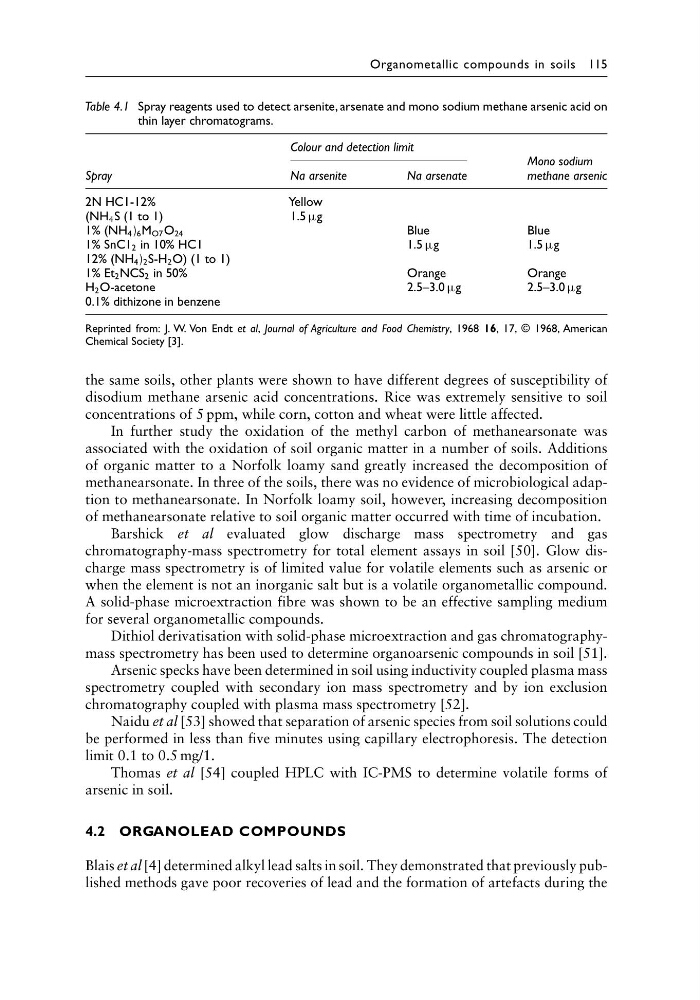
Table 4.1 Spray reagents used to detect arsenite, arsenate and mono sodium methane arsenic acid on
thin layer chromatograms.
Colour and detection limit
Mono sodium
Spray
Na arsenite
Na arsenate
methane arsenic
2N HC1-12%
Yellow
(NH 4 S (1 to 1)
1.5 µg
1% (NH 4 ) 6 M O7 O 24
Blue
Blue
1% SnC1 2 in 10% HC1
1.5 µg
1.5 µg
12% (NH 4 ) 2 S-H 2 O) (1 to 1)
1% Et 2 NCS 2 in 50%
Orange
Orange
H 2 O-acetone
2.5–3.0 µg
2.5–3.0 µg
0.1% dithizone in benzene
Reprinted from: J. W. Von Endt et al, Journal of Agriculture and Food Chemistry, 1968 16, 17, © 1968, American
Chemical Society [3].
the same soils, other plants were shown to have different degrees of susceptibility of
disodium methane arsenic acid concentrations. Rice was extremely sensitive to soil
concentrations of 5 ppm, while corn, cotton and wheat were little affected.
In further study the oxidation of the methyl carbon of methanearsonate was
associated with the oxidation of soil organic matter in a number of soils. Additions
of organic matter to a Norfolk loamy sand greatly increased the decomposition of
methanearsonate. In three of the soils, there was no evidence of microbiological adaption to methanearsonate. In Norfolk loamy soil, however, increasing decomposition
of methanearsonate relative to soil organic matter occurred with time of incubation.
Barshick et al evaluated glow discharge mass spectrometry and gas
chromatography-mass spectrometry for total element assays in soil [50]. Glow discharge mass spectrometry is of limited value for volatile elements such as arsenic or
when the element is not an inorganic salt but is a volatile organometallic compound.
A solid-phase microextraction fibre was shown to be an effective sampling medium
for several organometallic compounds.
Dithiol derivatisation with solid-phase microextraction and gas chromatographymass spectrometry has been used to determine organoarsenic compounds in soil [51].
Arsenic specks have been determined in soil using inductivity coupled plasma mass
spectrometry coupled with secondary ion mass spectrometry and by ion exclusion
chromatography coupled with plasma mass spectrometry [52].
Naidu et al [53] showed that separation of arsenic species from soil solutions could
be performed in less than five minutes using capillary electrophoresis. The detection
limit 0.1 to 0.5 mg/1.
Thomas et al [54] coupled HPLC with IC-PMS to determine volatile forms of
arsenic in soil.
4.2 ORGANOLEAD COMPOUNDS
Blais et al [4] determined alkyl lead salts in soil. They demonstrated that previously published methods gave poor recoveries of lead and the formation of artefacts during the
Table 4.1 Spray reagents used to detect arsenite, arsenate and mono sodium methane arsenic acid on
thin layer chromatograms.
Colour and detection limit
Mono sodium
Spray
Na arsenite
Na arsenate
methane arsenic
2N HC1-12%
Yellow
(NH 4 S (1 to 1)
1.5 µg
1% (NH 4 ) 6 M O7 O 24
Blue
Blue
1% SnC1 2 in 10% HC1
1.5 µg
1.5 µg
12% (NH 4 ) 2 S-H 2 O) (1 to 1)
1% Et 2 NCS 2 in 50%
Orange
Orange
H 2 O-acetone
2.5–3.0 µg
2.5–3.0 µg
0.1% dithizone in benzene
Reprinted from: J. W. Von Endt et al, Journal of Agriculture and Food Chemistry, 1968 16, 17, © 1968, American
Chemical Society [3].
the same soils, other plants were shown to have different degrees of susceptibility of
disodium methane arsenic acid concentrations. Rice was extremely sensitive to soil
concentrations of 5 ppm, while corn, cotton and wheat were little affected.
In further study the oxidation of the methyl carbon of methanearsonate was
associated with the oxidation of soil organic matter in a number of soils. Additions
of organic matter to a Norfolk loamy sand greatly increased the decomposition of
methanearsonate. In three of the soils, there was no evidence of microbiological adaption to methanearsonate. In Norfolk loamy soil, however, increasing decomposition
of methanearsonate relative to soil organic matter occurred with time of incubation.
Barshick et al evaluated glow discharge mass spectrometry and gas
chromatography-mass spectrometry for total element assays in soil [50]. Glow discharge mass spectrometry is of limited value for volatile elements such as arsenic or
when the element is not an inorganic salt but is a volatile organometallic compound.
A solid-phase microextraction fibre was shown to be an effective sampling medium
for several organometallic compounds.
Dithiol derivatisation with solid-phase microextraction and gas chromatographymass spectrometry has been used to determine organoarsenic compounds in soil [51].
Arsenic specks have been determined in soil using inductivity coupled plasma mass
spectrometry coupled with secondary ion mass spectrometry and by ion exclusion
chromatography coupled with plasma mass spectrometry [52].
Naidu et al [53] showed that separation of arsenic species from soil solutions could
be performed in less than five minutes using capillary electrophoresis. The detection
limit 0.1 to 0.5 mg/1.
Thomas et al [54] coupled HPLC with IC-PMS to determine volatile forms of
arsenic in soil.
4.2 ORGANOLEAD COMPOUNDS
Blais et al [4] determined alkyl lead salts in soil. They demonstrated that previously published methods gave poor recoveries of lead and the formation of artefacts during the