

Estrogenicity is mediated by binding to specific intracellular proteins
known as receptors. This binding causes a conformational change in the
receptor, enabling the estrogen–estrogen receptor complex to bind to specific
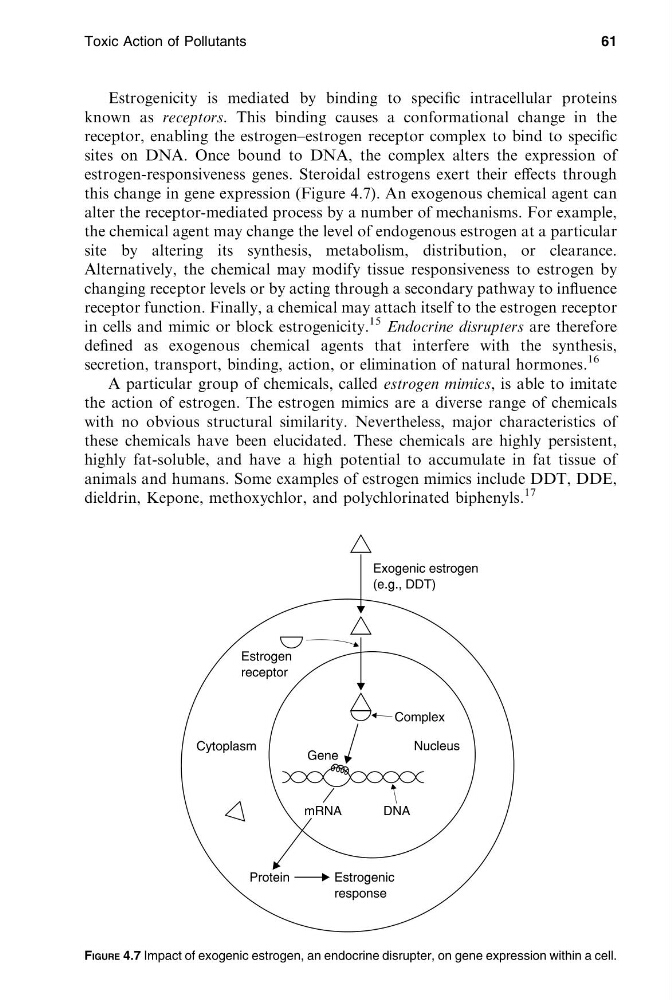
sites on DNA. Once bound to DNA, the complex alters the expression of
estrogen-responsiveness genes. Steroidal estrogens exert their effects through
this change in gene expression (Figure 4.7). An exogenous chemical agent can
alter the receptor-mediated process by a number of mechanisms. For example,
the chemical agent may change the level of endogenous estrogen at a particular
site by altering its synthesis, metabolism, distribution, or clearance.
Alternatively, the chemical may modify tissue responsiveness to estrogen by
changing receptor levels or by acting through a secondary pathway to influence
receptor function. Finally, a chemical may attach itself to the estrogen receptor
in cells and mimic or block estrogenicity.
15 Endocrine disrupters are therefore
defined as exogenous chemical agents that interfere with the synthesis,
secretion, transport, binding, action, or elimination of natural hormones.
16
A particular group of chemicals, called estrogen mimics, is able to imitate
the action of estrogen. The estrogen mimics are a diverse range of chemicals
with no obvious structural similarity. Nevertheless, major characteristics of
these chemicals have been elucidated. These chemicals are highly persistent,
highly fat-soluble, and have a high potential to accumulate in fat tissue of
animals and humans. Some examples of estrogen mimics include DDT, DDE,
dieldrin, Kepone, methoxychlor, and polychlorinated biphenyls.
17
Toxic Action of Pollutants
61
[16:54 26/8/04 P:/CRC PRESS/4365 MING-HO.751 (1670)/4365-004.3d]
Ref: 4365 MING-HO YU Chap-004 Page: 61 45-64
FIGURE 4.7 Impact of exogenic estrogen, an endocrine disrupter, on gene expression within a cell.
known as receptors. This binding causes a conformational change in the
receptor, enabling the estrogen–estrogen receptor complex to bind to specific
sites on DNA. Once bound to DNA, the complex alters the expression of
estrogen-responsiveness genes. Steroidal estrogens exert their effects through
this change in gene expression (Figure 4.7). An exogenous chemical agent can
alter the receptor-mediated process by a number of mechanisms. For example,
the chemical agent may change the level of endogenous estrogen at a particular
site by altering its synthesis, metabolism, distribution, or clearance.
Alternatively, the chemical may modify tissue responsiveness to estrogen by
changing receptor levels or by acting through a secondary pathway to influence
receptor function. Finally, a chemical may attach itself to the estrogen receptor
in cells and mimic or block estrogenicity.
15 Endocrine disrupters are therefore
defined as exogenous chemical agents that interfere with the synthesis,
secretion, transport, binding, action, or elimination of natural hormones.
16
A particular group of chemicals, called estrogen mimics, is able to imitate
the action of estrogen. The estrogen mimics are a diverse range of chemicals
with no obvious structural similarity. Nevertheless, major characteristics of
these chemicals have been elucidated. These chemicals are highly persistent,
highly fat-soluble, and have a high potential to accumulate in fat tissue of
animals and humans. Some examples of estrogen mimics include DDT, DDE,
dieldrin, Kepone, methoxychlor, and polychlorinated biphenyls.
17
Toxic Action of Pollutants
61
[16:54 26/8/04 P:/CRC PRESS/4365 MING-HO.751 (1670)/4365-004.3d]
Ref: 4365 MING-HO YU Chap-004 Page: 61 45-64
FIGURE 4.7 Impact of exogenic estrogen, an endocrine disrupter, on gene expression within a cell.