

Certain atmospheric pollutants, such as O 3 , PAN, and NO 2 , can act as free
radicals themselves. Extensive studies have been conducted on the nature of
O 3 -dependent peroxidation of lipid material in both plants and animals. Lipid
peroxidation can also occur as a result of free-radical-dependent reactions
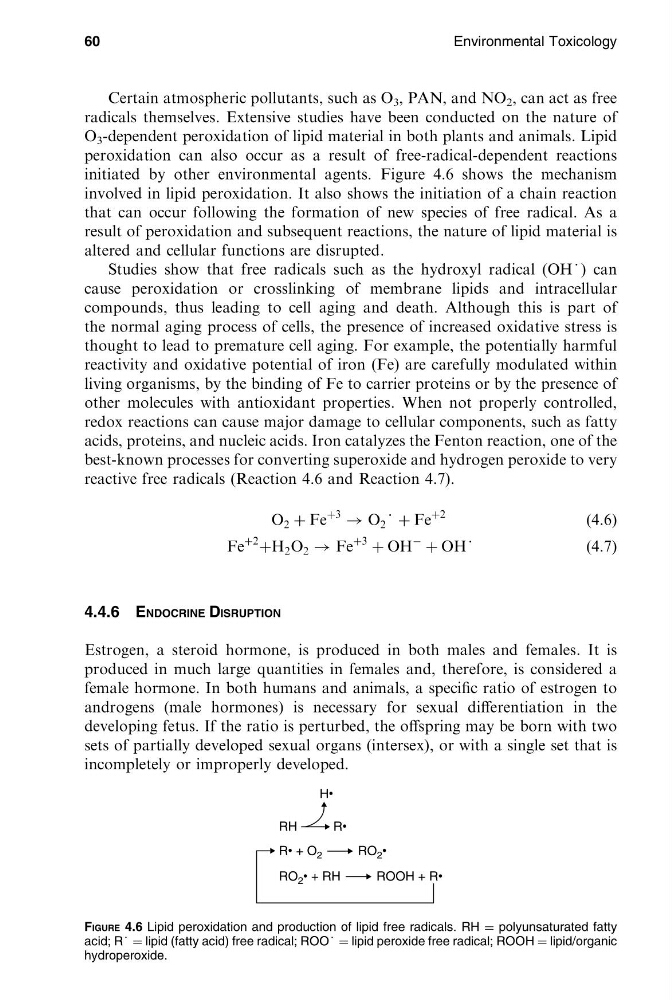
initiated by other environmental agents. Figure 4.6 shows the mechanism
involved in lipid peroxidation. It also shows the initiation of a chain reaction
that can occur following the formation of new species of free radical. As a
result of peroxidation and subsequent reactions, the nature of lipid material is
altered and cellular functions are disrupted.
Studies show that free radicals such as the hydroxyl radical (OH
Á ) can
cause peroxidation or crosslinking of membrane lipids and intracellular
compounds, thus leading to cell aging and death. Although this is part of
the normal aging process of cells, the presence of increased oxidative stress is
thought to lead to premature cell aging. For example, the potentially harmful
reactivity and oxidative potential of iron (Fe) are carefully modulated within
living organisms, by the binding of Fe to carrier proteins or by the presence of
other molecules with antioxidant properties. When not properly controlled,
redox reactions can cause major damage to cellular components, such as fatty
acids, proteins, and nucleic acids. Iron catalyzes the Fenton reaction, one of the
best-known processes for converting superoxide and hydrogen peroxide to very
reactive free radicals (Reaction 4.6 and Reaction 4.7).
O 2 þ Fe
þ3 ! O 2
Á þ Fe
þ2
ð4:6Þ
Fe
þ2 þH 2 O 2 ! Fe
þ3 þ OH
À þ OH
Á
ð4:7Þ
4.4.6 ENDOCRINE DISRUPTION
Estrogen, a steroid hormone, is produced in both males and females. It is
produced in much large quantities in females and, therefore, is considered a
female hormone. In both humans and animals, a specific ratio of estrogen to
androgens (male hormones) is necessary for sexual differentiation in the
developing fetus. If the ratio is perturbed, the offspring may be born with two
sets of partially developed sexual organs (intersex), or with a single set that is
incompletely or improperly developed.
60
Environmental Toxicology
[16:54 26/8/04 P:/CRC PRESS/4365 MING-HO.751 (1670)/4365-004.3d]
Ref: 4365 MING-HO YU Chap-004 Page: 60 45-64
FIGURE 4.6 Lipid peroxidation and production of lipid free radicals. RH ¼ polyunsaturated fatty
acid; R
Á ¼ lipid (fatty acid) free radical; ROO
Á ¼ lipid peroxide free radical; ROOH ¼ lipid/organic
hydroperoxide.
radicals themselves. Extensive studies have been conducted on the nature of
O 3 -dependent peroxidation of lipid material in both plants and animals. Lipid
peroxidation can also occur as a result of free-radical-dependent reactions
initiated by other environmental agents. Figure 4.6 shows the mechanism
involved in lipid peroxidation. It also shows the initiation of a chain reaction
that can occur following the formation of new species of free radical. As a
result of peroxidation and subsequent reactions, the nature of lipid material is
altered and cellular functions are disrupted.
Studies show that free radicals such as the hydroxyl radical (OH
Á ) can
cause peroxidation or crosslinking of membrane lipids and intracellular
compounds, thus leading to cell aging and death. Although this is part of
the normal aging process of cells, the presence of increased oxidative stress is
thought to lead to premature cell aging. For example, the potentially harmful
reactivity and oxidative potential of iron (Fe) are carefully modulated within
living organisms, by the binding of Fe to carrier proteins or by the presence of
other molecules with antioxidant properties. When not properly controlled,
redox reactions can cause major damage to cellular components, such as fatty
acids, proteins, and nucleic acids. Iron catalyzes the Fenton reaction, one of the
best-known processes for converting superoxide and hydrogen peroxide to very
reactive free radicals (Reaction 4.6 and Reaction 4.7).
O 2 þ Fe
þ3 ! O 2
Á þ Fe
þ2
ð4:6Þ
Fe
þ2 þH 2 O 2 ! Fe
þ3 þ OH
À þ OH
Á
ð4:7Þ
4.4.6 ENDOCRINE DISRUPTION
Estrogen, a steroid hormone, is produced in both males and females. It is
produced in much large quantities in females and, therefore, is considered a
female hormone. In both humans and animals, a specific ratio of estrogen to
androgens (male hormones) is necessary for sexual differentiation in the
developing fetus. If the ratio is perturbed, the offspring may be born with two
sets of partially developed sexual organs (intersex), or with a single set that is
incompletely or improperly developed.
60
Environmental Toxicology
[16:54 26/8/04 P:/CRC PRESS/4365 MING-HO.751 (1670)/4365-004.3d]
Ref: 4365 MING-HO YU Chap-004 Page: 60 45-64
FIGURE 4.6 Lipid peroxidation and production of lipid free radicals. RH ¼ polyunsaturated fatty
acid; R
Á ¼ lipid (fatty acid) free radical; ROO
Á ¼ lipid peroxide free radical; ROOH ¼ lipid/organic
hydroperoxide.