

esis,
7,8 protein synthesis, lipid metabolism, and others. Much of the action of F
on these processes can be attributed to F-dependent inhibition of enzymes.
Enzymes that are inhibited by F include enolase, phosphoglucomutase,
phosphatase, hexokinase, PEP carboxylase, pyruvate kinase, succinic dehydrogenase, malic dehydrogenase, pyrophosphatase, phytase, nitrate reductase,
mitochondrial ATPase, and urease.
12
Inhibition of lipase,
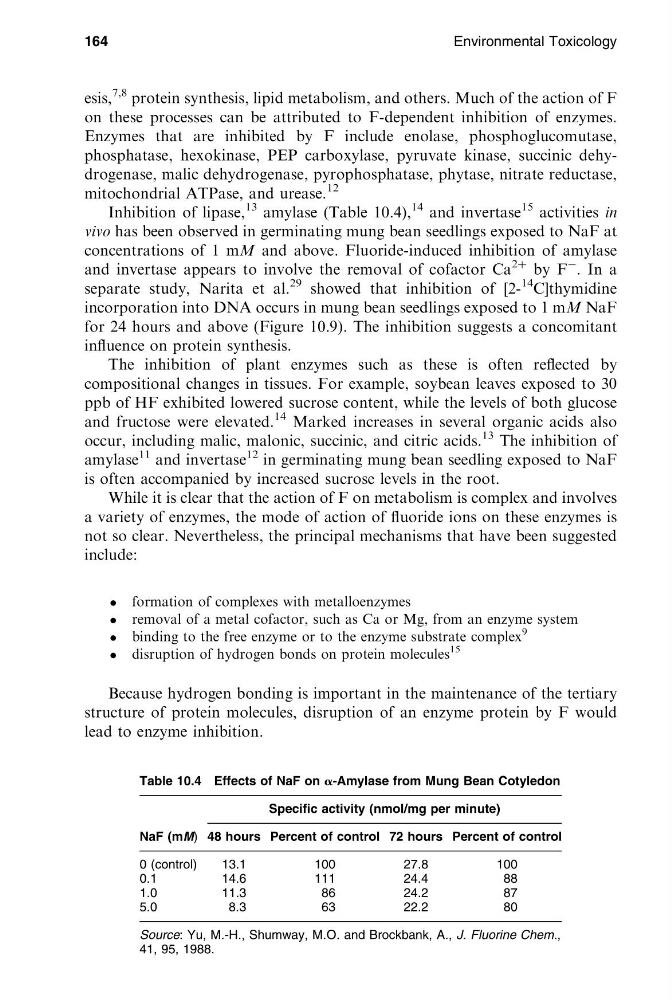
13 amylase (Table 10.4),
14 and invertase
15 activities in
vivo has been observed in germinating mung bean seedlings exposed to NaF at
concentrations of 1 mM and above. Fluoride-induced inhibition of amylase
and invertase appears to involve the removal of cofactor Ca
2þ by F
À . In a
separate study, Narita et al.
29 showed that inhibition of [214 C]thymidine
incorporation into DNA occurs in mung bean seedlings exposed to 1 mM NaF
for 24 hours and above (Figure 10.9). The inhibition suggests a concomitant
influence on protein synthesis.
The inhibition of plant enzymes such as these is often reflected by
compositional changes in tissues. For example, soybean leaves exposed to 30
ppb of HF exhibited lowered sucrose content, while the levels of both glucose
and fructose were elevated.
14 Marked increases in several organic acids also
occur, including malic, malonic, succinic, and citric acids.
13 The inhibition of
amylase
11 and invertase
12 in germinating mung bean seedling exposed to NaF
is often accompanied by increased sucrose levels in the root.
While it is clear that the action of F on metabolism is complex and involves
a variety of enzymes, the mode of action of fluoride ions on these enzymes is
not so clear. Nevertheless, the principal mechanisms that have been suggested
include:
formation of complexes with metalloenzymes
removal of a metal cofactor, such as Ca or Mg, from an enzyme system
binding to the free enzyme or to the enzyme substrate complex
9
disruption of hydrogen bonds on protein molecules
15
Because hydrogen bonding is important in the maintenance of the tertiary
structure of protein molecules, disruption of an enzyme protein by F would
lead to enzyme inhibition.
164
Environmental Toxicology
[16:52 26/8/04 P:/CRC PRESS/4365 MING-HO.751 (1670)/4365-010.3d]
Ref: 4365 MING-HO YU Chap-010 Page: 164 149-170
Table 10.4 Effects of NaF on a-Amylase from Mung Bean Cotyledon
Specific activity (nmol/mg per minute)
NaF (mM) 48 hours Percent of control 72 hours Percent of control
0 (control)
13.1
100
27.8
100
0.1
14.6
111
24.4
88
1.0
11.3
86
24.2
87
5.0
8.3
63
22.2
80
Source: Yu, M.-H., Shumway, M.O. and Brockbank, A., J. Fluorine Chem.,
41, 95, 1988.
7,8 protein synthesis, lipid metabolism, and others. Much of the action of F
on these processes can be attributed to F-dependent inhibition of enzymes.
Enzymes that are inhibited by F include enolase, phosphoglucomutase,
phosphatase, hexokinase, PEP carboxylase, pyruvate kinase, succinic dehydrogenase, malic dehydrogenase, pyrophosphatase, phytase, nitrate reductase,
mitochondrial ATPase, and urease.
12
Inhibition of lipase,
13 amylase (Table 10.4),
14 and invertase
15 activities in
vivo has been observed in germinating mung bean seedlings exposed to NaF at
concentrations of 1 mM and above. Fluoride-induced inhibition of amylase
and invertase appears to involve the removal of cofactor Ca
2þ by F
À . In a
separate study, Narita et al.
29 showed that inhibition of [214 C]thymidine
incorporation into DNA occurs in mung bean seedlings exposed to 1 mM NaF
for 24 hours and above (Figure 10.9). The inhibition suggests a concomitant
influence on protein synthesis.
The inhibition of plant enzymes such as these is often reflected by
compositional changes in tissues. For example, soybean leaves exposed to 30
ppb of HF exhibited lowered sucrose content, while the levels of both glucose
and fructose were elevated.
14 Marked increases in several organic acids also
occur, including malic, malonic, succinic, and citric acids.
13 The inhibition of
amylase
11 and invertase
12 in germinating mung bean seedling exposed to NaF
is often accompanied by increased sucrose levels in the root.
While it is clear that the action of F on metabolism is complex and involves
a variety of enzymes, the mode of action of fluoride ions on these enzymes is
not so clear. Nevertheless, the principal mechanisms that have been suggested
include:
formation of complexes with metalloenzymes
removal of a metal cofactor, such as Ca or Mg, from an enzyme system
binding to the free enzyme or to the enzyme substrate complex
9
disruption of hydrogen bonds on protein molecules
15
Because hydrogen bonding is important in the maintenance of the tertiary
structure of protein molecules, disruption of an enzyme protein by F would
lead to enzyme inhibition.
164
Environmental Toxicology
[16:52 26/8/04 P:/CRC PRESS/4365 MING-HO.751 (1670)/4365-010.3d]
Ref: 4365 MING-HO YU Chap-010 Page: 164 149-170
Table 10.4 Effects of NaF on a-Amylase from Mung Bean Cotyledon
Specific activity (nmol/mg per minute)
NaF (mM) 48 hours Percent of control 72 hours Percent of control
0 (control)
13.1
100
27.8
100
0.1
14.6
111
24.4
88
1.0
11.3
86
24.2
87
5.0
8.3
63
22.2
80
Source: Yu, M.-H., Shumway, M.O. and Brockbank, A., J. Fluorine Chem.,
41, 95, 1988.