

suffering from chronic exposure to F through feed containing high F levels.
The clinical basis for the lameness is not well understood.
1
Impaired appetite is normally observed, which may result in decreased
weight gain, cachexia, and lower milk yield. Decrease in milk production may
be secondary to appetite impairment or other responses. Evidence that animals
may be suffering chronic F effects may be obtained from chemical analysis of
the feed, or by testing for elevated levels of F in urine and body tissues.
22
Affected animals may exhibit increased susceptibility to other environmental
stresses and decrease in longevity.
A number of factors influence the manifestation of dental and skeletal
fluorosis, including:
amount and bioavailability of F ingested
duration of ingestion
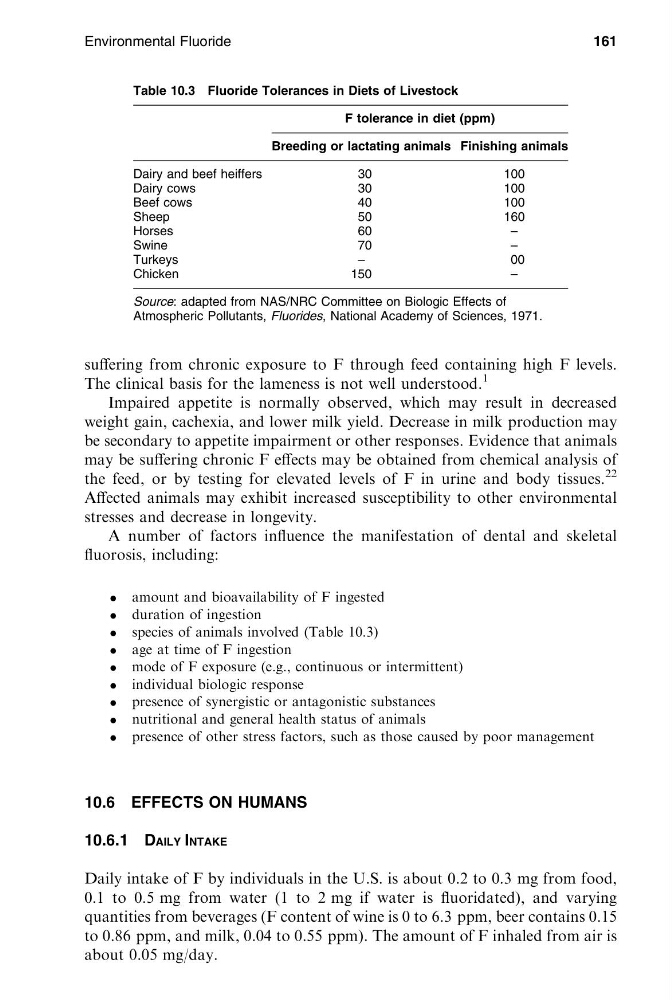
species of animals involved (Table 10.3)
age at time of F ingestion
mode of F exposure (e.g., continuous or intermittent)
individual biologic response
presence of synergistic or antagonistic substances
nutritional and general health status of animals
presence of other stress factors, such as those caused by poor management
10.6 EFFECTS ON HUMANS
10.6.1 DAILY INTAKE
Daily intake of F by individuals in the U.S. is about 0.2 to 0.3 mg from food,
0.1 to 0.5 mg from water (1 to 2 mg if water is fluoridated), and varying
quantities from beverages (F content of wine is 0 to 6.3 ppm, beer contains 0.15
to 0.86 ppm, and milk, 0.04 to 0.55 ppm). The amount of F inhaled from air is
about 0.05 mg/day.
Environmental Fluoride
161
[16:52 26/8/04 P:/CRC PRESS/4365 MING-HO.751 (1670)/4365-010.3d]
Ref: 4365 MING-HO YU Chap-010 Page: 161 149-170
Table 10.3 Fluoride Tolerances in Diets of Livestock
F tolerance in diet (ppm)
Breeding or lactating animals Finishing animals
Dairy and beef heiffers
30
100
Dairy cows
30
100
Beef cows
40
100
Sheep
50
160
Horses
60
–
Swine
70
–
Turkeys
–
00
Chicken
150
–
Source: adapted from NAS/NRC Committee on Biologic Effects of
Atmospheric Pollutants, Fluorides, National Academy of Sciences, 1971.
The clinical basis for the lameness is not well understood.
1
Impaired appetite is normally observed, which may result in decreased
weight gain, cachexia, and lower milk yield. Decrease in milk production may
be secondary to appetite impairment or other responses. Evidence that animals
may be suffering chronic F effects may be obtained from chemical analysis of
the feed, or by testing for elevated levels of F in urine and body tissues.
22
Affected animals may exhibit increased susceptibility to other environmental
stresses and decrease in longevity.
A number of factors influence the manifestation of dental and skeletal
fluorosis, including:
amount and bioavailability of F ingested
duration of ingestion
species of animals involved (Table 10.3)
age at time of F ingestion
mode of F exposure (e.g., continuous or intermittent)
individual biologic response
presence of synergistic or antagonistic substances
nutritional and general health status of animals
presence of other stress factors, such as those caused by poor management
10.6 EFFECTS ON HUMANS
10.6.1 DAILY INTAKE
Daily intake of F by individuals in the U.S. is about 0.2 to 0.3 mg from food,
0.1 to 0.5 mg from water (1 to 2 mg if water is fluoridated), and varying
quantities from beverages (F content of wine is 0 to 6.3 ppm, beer contains 0.15
to 0.86 ppm, and milk, 0.04 to 0.55 ppm). The amount of F inhaled from air is
about 0.05 mg/day.
Environmental Fluoride
161
[16:52 26/8/04 P:/CRC PRESS/4365 MING-HO.751 (1670)/4365-010.3d]
Ref: 4365 MING-HO YU Chap-010 Page: 161 149-170
Table 10.3 Fluoride Tolerances in Diets of Livestock
F tolerance in diet (ppm)
Breeding or lactating animals Finishing animals
Dairy and beef heiffers
30
100
Dairy cows
30
100
Beef cows
40
100
Sheep
50
160
Horses
60
–
Swine
70
–
Turkeys
–
00
Chicken
150
–
Source: adapted from NAS/NRC Committee on Biologic Effects of
Atmospheric Pollutants, Fluorides, National Academy of Sciences, 1971.