

subject to more rapid wear, and erosion of the enamel from the dentin. It is
noteworthy that dental lesions are not seen in animals brought into endemic
fluorosis areas after their permanent teeth have erupted.
17
Recent studies indicate a widespread chronic effect of environmental F on
wildlife. Fluoride contamination of vegetation arises from various industrial
activities, noted previously, and combustion of coal. Studies conducted by
European scientists have shown that a large number of deer in several
European countries suffer from both dental and skeletal fluorosis.
18,19
However, during the past three decades, much improvement has been made
in controlling F emission, as evidenced by comparative field studies showing
that F contamination of vegetation has decreased significantly in recent years.
Concomitantly, decreases were observed in F levels in dental and skeletal
samples of wild animals.
Studies on deer population affected by F are relatively limited in the U.S.
There is no obvious active research in this area, presumably because
atmospheric F pollution in the U.S is limited to local areas, and is not
considered a serious environmental problem. Nevertheless, studies have
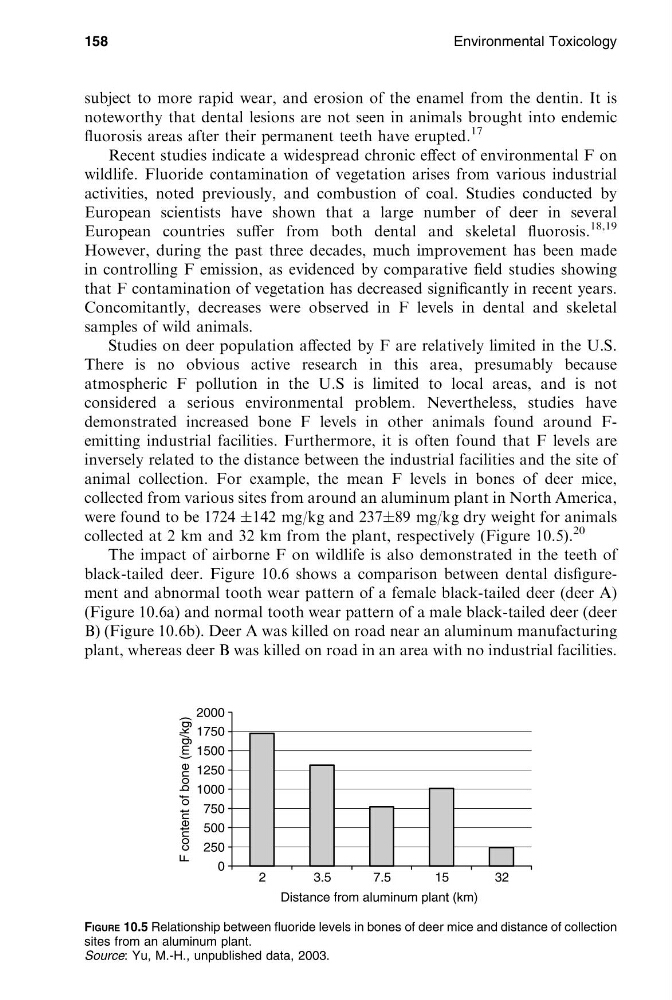
demonstrated increased bone F levels in other animals found around Femitting industrial facilities. Furthermore, it is often found that F levels are
inversely related to the distance between the industrial facilities and the site of
animal collection. For example, the mean F levels in bones of deer mice,
collected from various sites from around an aluminum plant in North America,
were found to be 1724 Æ142 mg/kg and 237Æ89 mg/kg dry weight for animals
collected at 2 km and 32 km from the plant, respectively (Figure 10.5).
20
The impact of airborne F on wildlife is also demonstrated in the teeth of
black-tailed deer. Figure 10.6 shows a comparison between dental disfigurement and abnormal tooth wear pattern of a female black-tailed deer (deer A)
(Figure 10.6a) and normal tooth wear pattern of a male black-tailed deer (deer
B) (Figure 10.6b). Deer A was killed on road near an aluminum manufacturing
plant, whereas deer B was killed on road in an area with no industrial facilities.
158
Environmental Toxicology
[16:52 26/8/04 P:/CRC PRESS/4365 MING-HO.751 (1670)/4365-010.3d]
Ref: 4365 MING-HO YU Chap-010 Page: 158 149-170
FIGURE 10.5 Relationship between fluoride levels in bones of deer mice and distance of collection
sites from an aluminum plant.
Source: Yu, M.-H., unpublished data, 2003.
noteworthy that dental lesions are not seen in animals brought into endemic
fluorosis areas after their permanent teeth have erupted.
17
Recent studies indicate a widespread chronic effect of environmental F on
wildlife. Fluoride contamination of vegetation arises from various industrial
activities, noted previously, and combustion of coal. Studies conducted by
European scientists have shown that a large number of deer in several
European countries suffer from both dental and skeletal fluorosis.
18,19
However, during the past three decades, much improvement has been made
in controlling F emission, as evidenced by comparative field studies showing
that F contamination of vegetation has decreased significantly in recent years.
Concomitantly, decreases were observed in F levels in dental and skeletal
samples of wild animals.
Studies on deer population affected by F are relatively limited in the U.S.
There is no obvious active research in this area, presumably because
atmospheric F pollution in the U.S is limited to local areas, and is not
considered a serious environmental problem. Nevertheless, studies have
demonstrated increased bone F levels in other animals found around Femitting industrial facilities. Furthermore, it is often found that F levels are
inversely related to the distance between the industrial facilities and the site of
animal collection. For example, the mean F levels in bones of deer mice,
collected from various sites from around an aluminum plant in North America,
were found to be 1724 Æ142 mg/kg and 237Æ89 mg/kg dry weight for animals
collected at 2 km and 32 km from the plant, respectively (Figure 10.5).
20
The impact of airborne F on wildlife is also demonstrated in the teeth of
black-tailed deer. Figure 10.6 shows a comparison between dental disfigurement and abnormal tooth wear pattern of a female black-tailed deer (deer A)
(Figure 10.6a) and normal tooth wear pattern of a male black-tailed deer (deer
B) (Figure 10.6b). Deer A was killed on road near an aluminum manufacturing
plant, whereas deer B was killed on road in an area with no industrial facilities.
158
Environmental Toxicology
[16:52 26/8/04 P:/CRC PRESS/4365 MING-HO.751 (1670)/4365-010.3d]
Ref: 4365 MING-HO YU Chap-010 Page: 158 149-170
FIGURE 10.5 Relationship between fluoride levels in bones of deer mice and distance of collection
sites from an aluminum plant.
Source: Yu, M.-H., unpublished data, 2003.