

10.3 INDUSTRIAL SOURCES OF FLUORIDE POLLUTION
10.3.1 INTRODUCTION
Anthropogenic sources of F include a variety of industries, such as primary
aluminum production, phosphate fertilizer and elemental phosphorus (P)
plants, primary iron and steel production, and ceramics industries (tile, brick
and glass works, etc.). Combustion of fuel, especially coal, and incineration of
solid waste also cause F emission. F content in coal ranges from 0.001 to
0.048% in the U.S. (average, 0.008%). The forms of F that are emitted from
industrial processes include hydrogen fluoride (HF), fluorspar, cryolite, and
silicon tetrafluoride (SiF 4 ). In addition to deposition in surface waters,
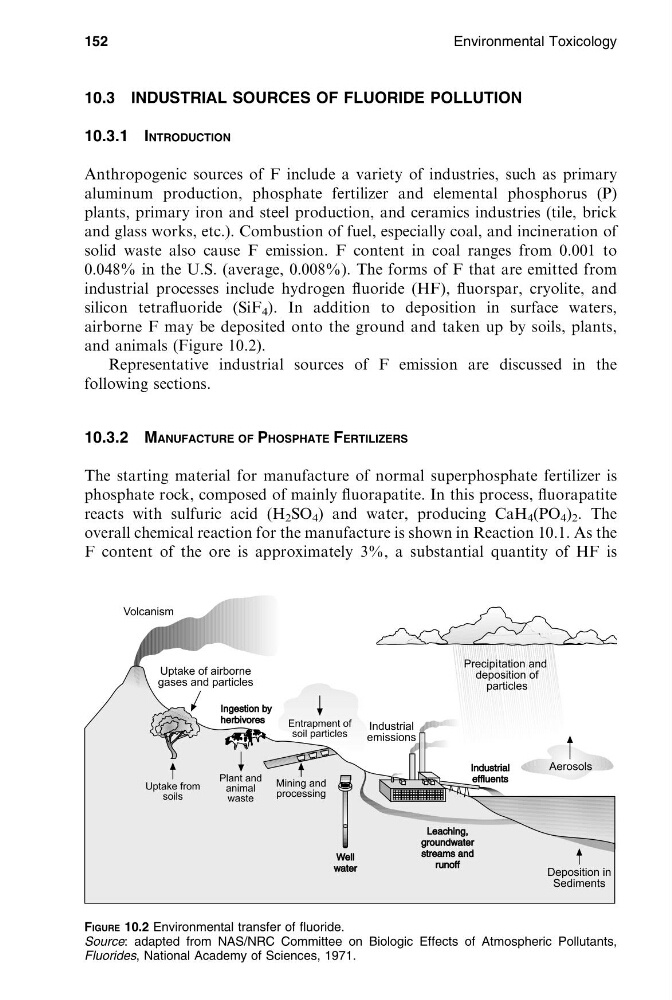
airborne F may be deposited onto the ground and taken up by soils, plants,
and animals (Figure 10.2).
Representative industrial sources of F emission are discussed in the
following sections.
10.3.2 MANUFACTURE OF PHOSPHATE FERTILIZERS
The starting material for manufacture of normal superphosphate fertilizer is
phosphate rock, composed of mainly fluorapatite. In this process, fluorapatite
reacts with sulfuric acid (H 2 SO 4 ) and water, producing CaH 4 (PO 4 ) 2 . The
overall chemical reaction for the manufacture is shown in Reaction 10.1. As the
F content of the ore is approximately 3%, a substantial quantity of HF is
152
Environmental Toxicology
[16:52 26/8/04 P:/CRC PRESS/4365 MING-HO.751 (1670)/4365-010.3d]
Ref: 4365 MING-HO YU Chap-010 Page: 152 149-170
FIGURE 10.2 Environmental transfer of fluoride.
Source: adapted from NAS/NRC Committee on Biologic Effects of Atmospheric Pollutants,
Fluorides, National Academy of Sciences, 1971.
10.3.1 INTRODUCTION
Anthropogenic sources of F include a variety of industries, such as primary
aluminum production, phosphate fertilizer and elemental phosphorus (P)
plants, primary iron and steel production, and ceramics industries (tile, brick
and glass works, etc.). Combustion of fuel, especially coal, and incineration of
solid waste also cause F emission. F content in coal ranges from 0.001 to
0.048% in the U.S. (average, 0.008%). The forms of F that are emitted from
industrial processes include hydrogen fluoride (HF), fluorspar, cryolite, and
silicon tetrafluoride (SiF 4 ). In addition to deposition in surface waters,
airborne F may be deposited onto the ground and taken up by soils, plants,
and animals (Figure 10.2).
Representative industrial sources of F emission are discussed in the
following sections.
10.3.2 MANUFACTURE OF PHOSPHATE FERTILIZERS
The starting material for manufacture of normal superphosphate fertilizer is
phosphate rock, composed of mainly fluorapatite. In this process, fluorapatite
reacts with sulfuric acid (H 2 SO 4 ) and water, producing CaH 4 (PO 4 ) 2 . The
overall chemical reaction for the manufacture is shown in Reaction 10.1. As the
F content of the ore is approximately 3%, a substantial quantity of HF is
152
Environmental Toxicology
[16:52 26/8/04 P:/CRC PRESS/4365 MING-HO.751 (1670)/4365-010.3d]
Ref: 4365 MING-HO YU Chap-010 Page: 152 149-170
FIGURE 10.2 Environmental transfer of fluoride.
Source: adapted from NAS/NRC Committee on Biologic Effects of Atmospheric Pollutants,
Fluorides, National Academy of Sciences, 1971.