

10.2.2 AIR
Fluoride concentrations in the air in U.S. residential and rural communities
vary markedly, ranging from less than 0.04 ppb to 1.2 ppb (0.03 to 0.90 mg/
m
3 ).
1 In many cities in less-developed countries, the level is much higher. For
example, in Beijing, China, the level is reported to be 0.11 to 2.14 ppb (0.08 to
1.61 mg/m
3 ; average, 0.61 mg/m
3 ).
2
10.2.3 NATURAL WATERS
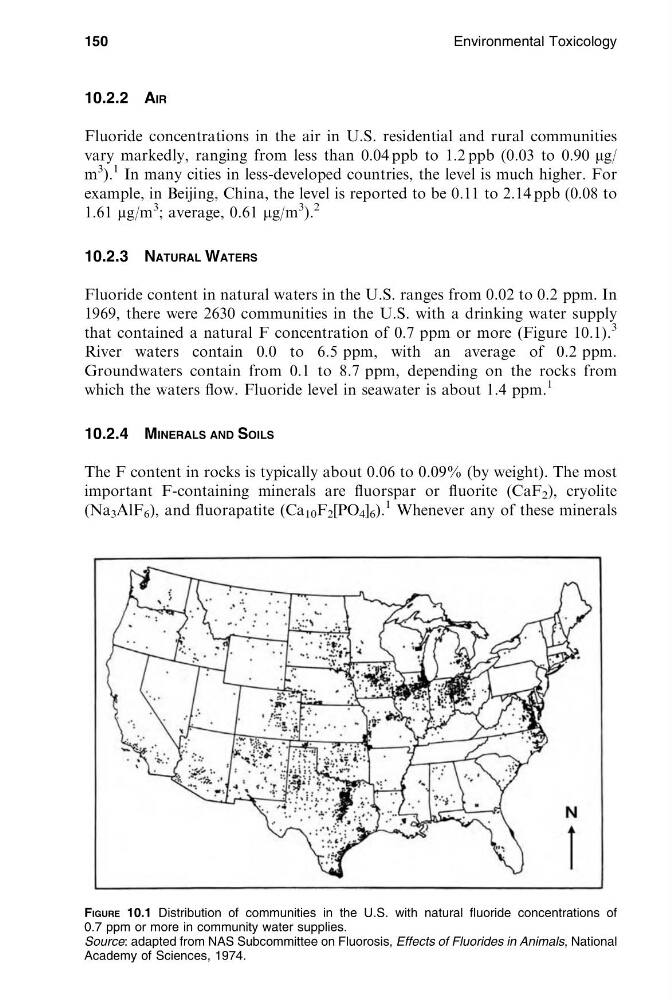
Fluoride content in natural waters in the U.S. ranges from 0.02 to 0.2 ppm. In
1969, there were 2630 communities in the U.S. with a drinking water supply
that contained a natural F concentration of 0.7 ppm or more (Figure 10.1).
3
River waters contain 0.0 to 6.5 ppm, with an average of 0.2 ppm.
Groundwaters contain from 0.1 to 8.7 ppm, depending on the rocks from
which the waters flow. Fluoride level in seawater is about 1.4 ppm.
1
10.2.4 MINERALS AND SOILS
The F content in rocks is typically about 0.06 to 0.09% (by weight). The most
important F-containing minerals are fluorspar or fluorite (CaF 2 ), cryolite
(Na 3 AlF 6 ), and fluorapatite (Ca 10 F 2 [PO 4 ] 6 ).
1 Whenever any of these minerals
150
Environmental Toxicology
[16:52 26/8/04 P:/CRC PRESS/4365 MING-HO.751 (1670)/4365-010.3d]
Ref: 4365 MING-HO YU Chap-010 Page: 150 149-170
FIGURE 10.1 Distribution of communities in the U.S. with natural fluoride concentrations of
0.7 ppm or more in community water supplies.
Source: adapted from NAS Subcommittee on Fluorosis, Effects of Fluorides in Animals, National
Academy of Sciences, 1974.
Fluoride concentrations in the air in U.S. residential and rural communities
vary markedly, ranging from less than 0.04 ppb to 1.2 ppb (0.03 to 0.90 mg/
m
3 ).
1 In many cities in less-developed countries, the level is much higher. For
example, in Beijing, China, the level is reported to be 0.11 to 2.14 ppb (0.08 to
1.61 mg/m
3 ; average, 0.61 mg/m
3 ).
2
10.2.3 NATURAL WATERS
Fluoride content in natural waters in the U.S. ranges from 0.02 to 0.2 ppm. In
1969, there were 2630 communities in the U.S. with a drinking water supply
that contained a natural F concentration of 0.7 ppm or more (Figure 10.1).
3
River waters contain 0.0 to 6.5 ppm, with an average of 0.2 ppm.
Groundwaters contain from 0.1 to 8.7 ppm, depending on the rocks from
which the waters flow. Fluoride level in seawater is about 1.4 ppm.
1
10.2.4 MINERALS AND SOILS
The F content in rocks is typically about 0.06 to 0.09% (by weight). The most
important F-containing minerals are fluorspar or fluorite (CaF 2 ), cryolite
(Na 3 AlF 6 ), and fluorapatite (Ca 10 F 2 [PO 4 ] 6 ).
1 Whenever any of these minerals
150
Environmental Toxicology
[16:52 26/8/04 P:/CRC PRESS/4365 MING-HO.751 (1670)/4365-010.3d]
Ref: 4365 MING-HO YU Chap-010 Page: 150 149-170
FIGURE 10.1 Distribution of communities in the U.S. with natural fluoride concentrations of
0.7 ppm or more in community water supplies.
Source: adapted from NAS Subcommittee on Fluorosis, Effects of Fluorides in Animals, National
Academy of Sciences, 1974.