

The NO formed in Reaction 8.4 persists when temperature is cooled
rapidly, as is the case in ambient air. Reaction 8.5 is one of the few that are
slowed down by an increase in temperature.
8.3.2 MAJOR REACTIVE N SPECIES IN THE TROPOSPHERE
Several reactive N species, including NO, NO 2 , nitric acid (HNO 3 ), occur in the
troposphere. Among these, NO 2 is of particular environmental concern
because it plays a complex and important role in the production of
photochemical oxidants and acidic deposition. NO 2 is a unique air pollutant
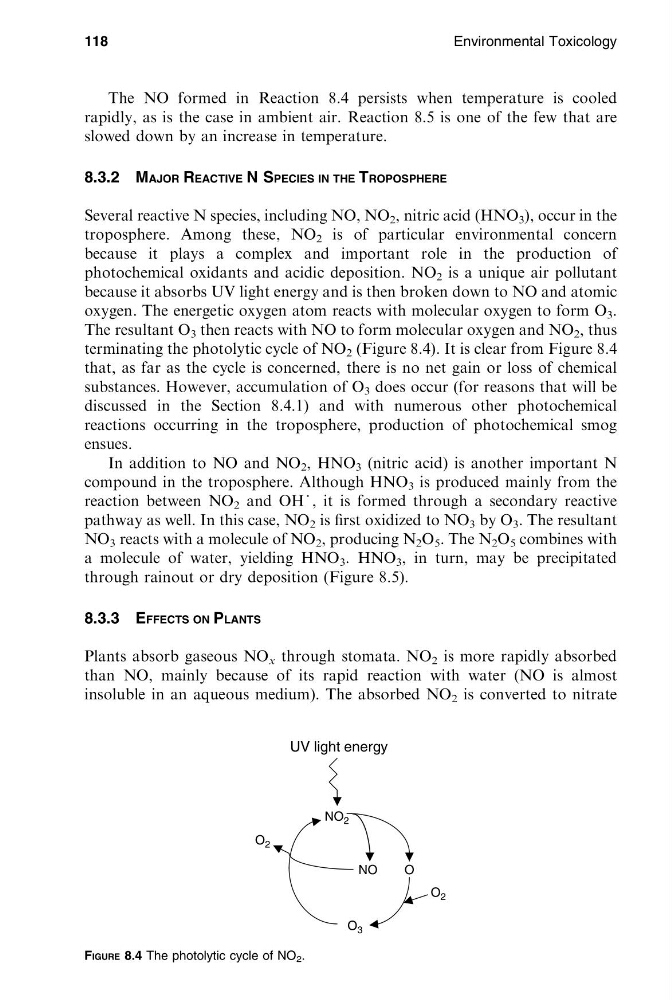
because it absorbs UV light energy and is then broken down to NO and atomic
oxygen. The energetic oxygen atom reacts with molecular oxygen to form O 3 .
The resultant O 3 then reacts with NO to form molecular oxygen and NO 2 , thus
terminating the photolytic cycle of NO 2 (Figure 8.4). It is clear from Figure 8.4
that, as far as the cycle is concerned, there is no net gain or loss of chemical
substances. However, accumulation of O 3 does occur (for reasons that will be
discussed in the Section 8.4.1) and with numerous other photochemical
reactions occurring in the troposphere, production of photochemical smog
ensues.
In addition to NO and NO 2 , HNO 3 (nitric acid) is another important N
compound in the troposphere. Although HNO 3 is produced mainly from the
reaction between NO 2 and OH
Á , it is formed through a secondary reactive
pathway as well. In this case, NO 2 is first oxidized to NO 3 by O 3 . The resultant
NO 3 reacts with a molecule of NO 2 , producing N 2 O 5 . The N 2 O 5 combines with
a molecule of water, yielding HNO 3 . HNO 3 , in turn, may be precipitated
through rainout or dry deposition (Figure 8.5).
8.3.3 EFFECTS ON PLANTS
Plants absorb gaseous NO x through stomata. NO 2 is more rapidly absorbed
than NO, mainly because of its rapid reaction with water (NO is almost
insoluble in an aqueous medium). The absorbed NO 2 is converted to nitrate
118
Environmental Toxicology
[16:53 26/8/04 P:/CRC PRESS/4365 MING-HO.751 (1670)/4365-008.3d]
Ref: 4365 MING-HO YU Chap-008 Page: 118 111-134
UV light energy
FIGURE 8.4 The photolytic cycle of NO 2 .
rapidly, as is the case in ambient air. Reaction 8.5 is one of the few that are
slowed down by an increase in temperature.
8.3.2 MAJOR REACTIVE N SPECIES IN THE TROPOSPHERE
Several reactive N species, including NO, NO 2 , nitric acid (HNO 3 ), occur in the
troposphere. Among these, NO 2 is of particular environmental concern
because it plays a complex and important role in the production of
photochemical oxidants and acidic deposition. NO 2 is a unique air pollutant
because it absorbs UV light energy and is then broken down to NO and atomic
oxygen. The energetic oxygen atom reacts with molecular oxygen to form O 3 .
The resultant O 3 then reacts with NO to form molecular oxygen and NO 2 , thus
terminating the photolytic cycle of NO 2 (Figure 8.4). It is clear from Figure 8.4
that, as far as the cycle is concerned, there is no net gain or loss of chemical
substances. However, accumulation of O 3 does occur (for reasons that will be
discussed in the Section 8.4.1) and with numerous other photochemical
reactions occurring in the troposphere, production of photochemical smog
ensues.
In addition to NO and NO 2 , HNO 3 (nitric acid) is another important N
compound in the troposphere. Although HNO 3 is produced mainly from the
reaction between NO 2 and OH
Á , it is formed through a secondary reactive
pathway as well. In this case, NO 2 is first oxidized to NO 3 by O 3 . The resultant
NO 3 reacts with a molecule of NO 2 , producing N 2 O 5 . The N 2 O 5 combines with
a molecule of water, yielding HNO 3 . HNO 3 , in turn, may be precipitated
through rainout or dry deposition (Figure 8.5).
8.3.3 EFFECTS ON PLANTS
Plants absorb gaseous NO x through stomata. NO 2 is more rapidly absorbed
than NO, mainly because of its rapid reaction with water (NO is almost
insoluble in an aqueous medium). The absorbed NO 2 is converted to nitrate
118
Environmental Toxicology
[16:53 26/8/04 P:/CRC PRESS/4365 MING-HO.751 (1670)/4365-008.3d]
Ref: 4365 MING-HO YU Chap-008 Page: 118 111-134
UV light energy
FIGURE 8.4 The photolytic cycle of NO 2 .