

6.3 MECHANISM OF BIOTRANSFORMATION
In the two phases of biotransformation shown in Figure 6.2 and Figure 6.3, a
lipophilic foreign chemical is first oxidized in a Phase I reaction so that a
functional group, such as –OH, –NH 2 , –COOH, or –SH, is introduced into the
molecule, forming a product called a primary metabolite. A slight increase in
hydrophilicity usually occurs as a result of the reaction.
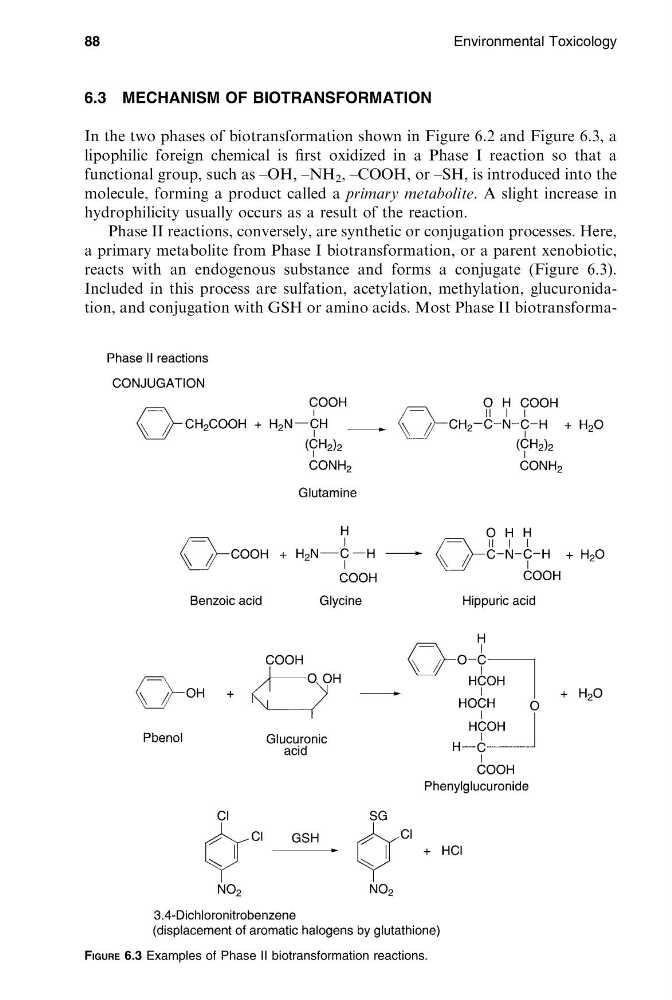
Phase II reactions, conversely, are synthetic or conjugation processes. Here,
a primary metabolite from Phase I biotransformation, or a parent xenobiotic,
reacts with an endogenous substance and forms a conjugate (Figure 6.3).
Included in this process are sulfation, acetylation, methylation, glucuronidation, and conjugation with GSH or amino acids. Most Phase II biotransforma88
Environmental Toxicology
[16:54 26/8/04 P:/CRC PRESS/4365 MING-HO.751 (1670)/4365-006.3d]
Ref: 4365 MING-HO YU Chap-006 Page: 88 85-98
FIGURE 6.3 Examples of Phase II biotransformation reactions.
In the two phases of biotransformation shown in Figure 6.2 and Figure 6.3, a
lipophilic foreign chemical is first oxidized in a Phase I reaction so that a
functional group, such as –OH, –NH 2 , –COOH, or –SH, is introduced into the
molecule, forming a product called a primary metabolite. A slight increase in
hydrophilicity usually occurs as a result of the reaction.
Phase II reactions, conversely, are synthetic or conjugation processes. Here,
a primary metabolite from Phase I biotransformation, or a parent xenobiotic,
reacts with an endogenous substance and forms a conjugate (Figure 6.3).
Included in this process are sulfation, acetylation, methylation, glucuronidation, and conjugation with GSH or amino acids. Most Phase II biotransforma88
Environmental Toxicology
[16:54 26/8/04 P:/CRC PRESS/4365 MING-HO.751 (1670)/4365-006.3d]
Ref: 4365 MING-HO YU Chap-006 Page: 88 85-98
FIGURE 6.3 Examples of Phase II biotransformation reactions.