

2.3 Solutions
77
2.26 (i) Work done by the spring W s =
1
2
kx 2 =
1
2
× 20 × 10 3 × (0.12) 2 = 144 J
(ii) Work done by friction W f =
1
2 mv 2 − W s =
1
2 × 50 × 3 2 − 144 = 81 J
(iii) W f = μmgs
∴ μ =
W f
mgs
=
81
50 × 9.8 × (0.60 + 0.12)
= 0.2296
(iv) If v 1 is the velocity of the crate as it passes position A after rebonding
1
2
mv
2
1 = W s − μ mgs
1
2
× 50v
2
1 = 144 − 0.2296 × 50 × 9.8 × (0.60 + .012) = 63
∴ v 1 = 1.587 m/s
2.3.4 Collisions
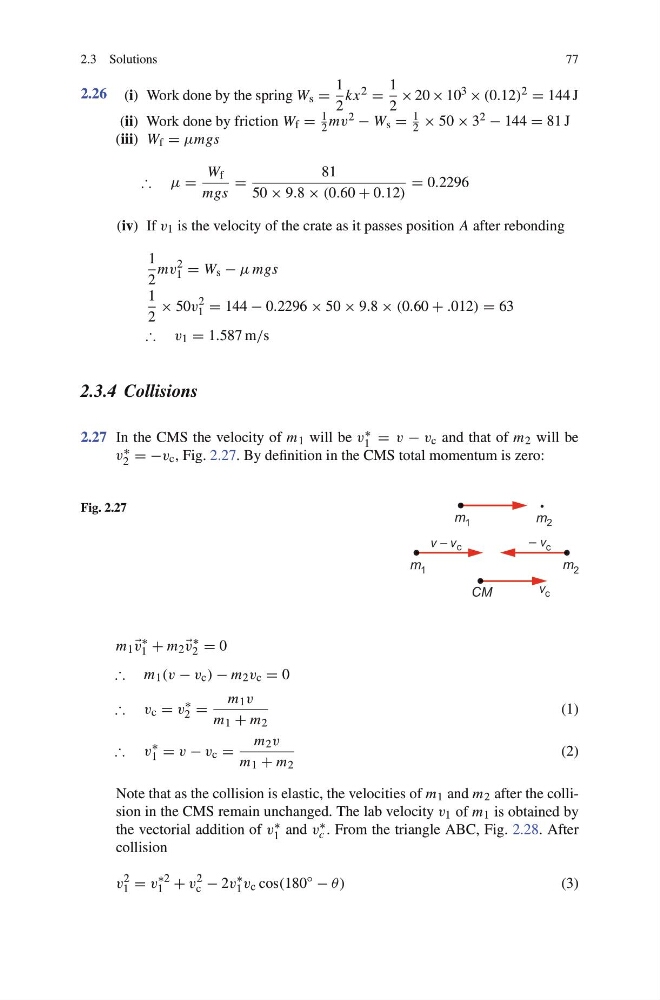
2.27 In the CMS the velocity of m 1 will be v ∗
1 = v − v c and that of m 2 will be
v ∗
2 = −v c , Fig. 2.27. By definition in the CMS total momentum is zero:
Fig. 2.27
m 1
v
∗
1 + m 2
v
∗
2 = 0
∴ m 1 (v − v c ) − m 2 v c = 0
∴ v c = v
∗
2 =
m 1 v
m 1 + m 2
(1)
∴ v
∗
1 = v − v c =
m 2 v
m 1 + m 2
(2)
Note that as the collision is elastic, the velocities of m 1 and m 2 after the collision in the CMS remain unchanged. The lab velocity v 1 of m 1 is obtained by
the vectorial addition of v ∗
1 and v ∗
c . From the triangle ABC, Fig. 2.28. After
collision
v
2
1 = v
∗2
1 + v
2
c − 2v
∗
1 v c cos(180
◦
− θ)
(3)
77
2.26 (i) Work done by the spring W s =
1
2
kx 2 =
1
2
× 20 × 10 3 × (0.12) 2 = 144 J
(ii) Work done by friction W f =
1
2 mv 2 − W s =
1
2 × 50 × 3 2 − 144 = 81 J
(iii) W f = μmgs
∴ μ =
W f
mgs
=
81
50 × 9.8 × (0.60 + 0.12)
= 0.2296
(iv) If v 1 is the velocity of the crate as it passes position A after rebonding
1
2
mv
2
1 = W s − μ mgs
1
2
× 50v
2
1 = 144 − 0.2296 × 50 × 9.8 × (0.60 + .012) = 63
∴ v 1 = 1.587 m/s
2.3.4 Collisions
2.27 In the CMS the velocity of m 1 will be v ∗
1 = v − v c and that of m 2 will be
v ∗
2 = −v c , Fig. 2.27. By definition in the CMS total momentum is zero:
Fig. 2.27
m 1
v
∗
1 + m 2
v
∗
2 = 0
∴ m 1 (v − v c ) − m 2 v c = 0
∴ v c = v
∗
2 =
m 1 v
m 1 + m 2
(1)
∴ v
∗
1 = v − v c =
m 2 v
m 1 + m 2
(2)
Note that as the collision is elastic, the velocities of m 1 and m 2 after the collision in the CMS remain unchanged. The lab velocity v 1 of m 1 is obtained by
the vectorial addition of v ∗
1 and v ∗
c . From the triangle ABC, Fig. 2.28. After
collision
v
2
1 = v
∗2
1 + v
2
c − 2v
∗
1 v c cos(180
◦
− θ)
(3)