

2.3 Solutions
75
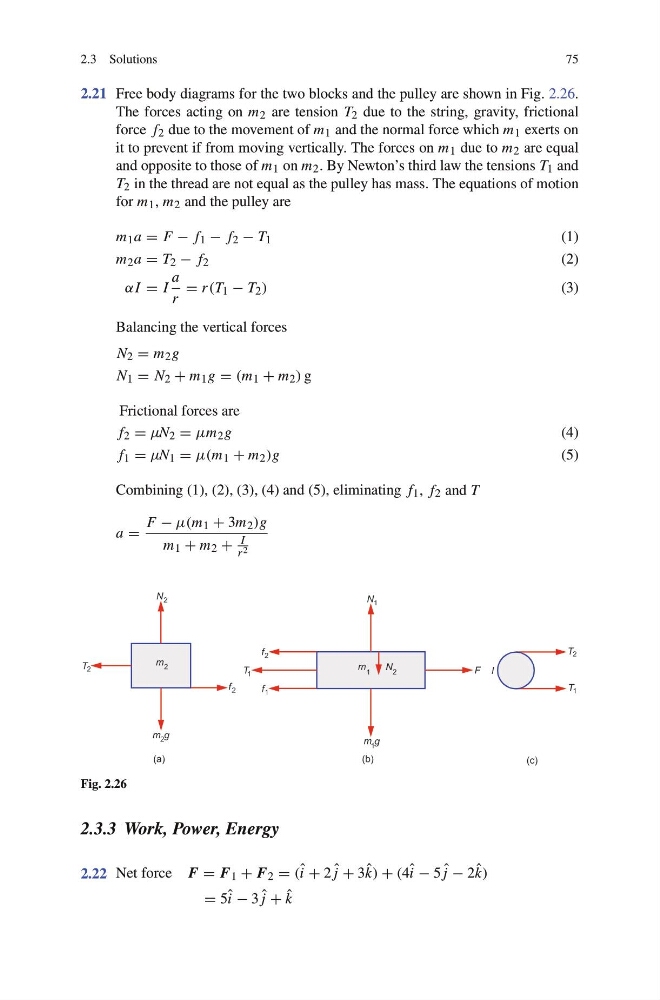
2.21 Free body diagrams for the two blocks and the pulley are shown in Fig. 2.26.
The forces acting on m 2 are tension T 2 due to the string, gravity, frictional
force f 2 due to the movement of m 1 and the normal force which m 1 exerts on
it to prevent if from moving vertically. The forces on m 1 due to m 2 are equal
and opposite to those of m 1 on m 2 . By Newton’s third law the tensions T 1 and
T 2 in the thread are not equal as the pulley has mass. The equations of motion
for m 1 , m 2 and the pulley are
m 1 a = F − f 1 − f 2 − T 1
(1)
m 2 a = T 2 − f 2
(2)
α I = I
a
r
= r (T 1 − T 2 )
(3)
Balancing the vertical forces
N 2 = m 2 g
N 1 = N 2 + m 1 g = (m 1 + m 2 ) g
Frictional forces are
f 2 = μN 2 = μm 2 g
(4)
f 1 = μN 1 = μ(m 1 + m 2 )g
(5)
Combining (1), (2), (3), (4) and (5), eliminating f 1 , f 2 and T
a =
F − μ(m 1 + 3m 2 )g
m 1 + m 2 +
I
r 2
Fig. 2.26
2.3.3 Work, Power, Energy
2.22 Net force F = F 1 + F 2 = ( ˆ
i + 2 ˆ
j + 3 ˆ
k) + (4 ˆ
i − 5 ˆ
j − 2 ˆ
k)
= 5 ˆ
i − 3 ˆ
j + ˆ
k
75
2.21 Free body diagrams for the two blocks and the pulley are shown in Fig. 2.26.
The forces acting on m 2 are tension T 2 due to the string, gravity, frictional
force f 2 due to the movement of m 1 and the normal force which m 1 exerts on
it to prevent if from moving vertically. The forces on m 1 due to m 2 are equal
and opposite to those of m 1 on m 2 . By Newton’s third law the tensions T 1 and
T 2 in the thread are not equal as the pulley has mass. The equations of motion
for m 1 , m 2 and the pulley are
m 1 a = F − f 1 − f 2 − T 1
(1)
m 2 a = T 2 − f 2
(2)
α I = I
a
r
= r (T 1 − T 2 )
(3)
Balancing the vertical forces
N 2 = m 2 g
N 1 = N 2 + m 1 g = (m 1 + m 2 ) g
Frictional forces are
f 2 = μN 2 = μm 2 g
(4)
f 1 = μN 1 = μ(m 1 + m 2 )g
(5)
Combining (1), (2), (3), (4) and (5), eliminating f 1 , f 2 and T
a =
F − μ(m 1 + 3m 2 )g
m 1 + m 2 +
I
r 2
Fig. 2.26
2.3.3 Work, Power, Energy
2.22 Net force F = F 1 + F 2 = ( ˆ
i + 2 ˆ
j + 3 ˆ
k) + (4 ˆ
i − 5 ˆ
j − 2 ˆ
k)
= 5 ˆ
i − 3 ˆ
j + ˆ
k