

762
15 Optics
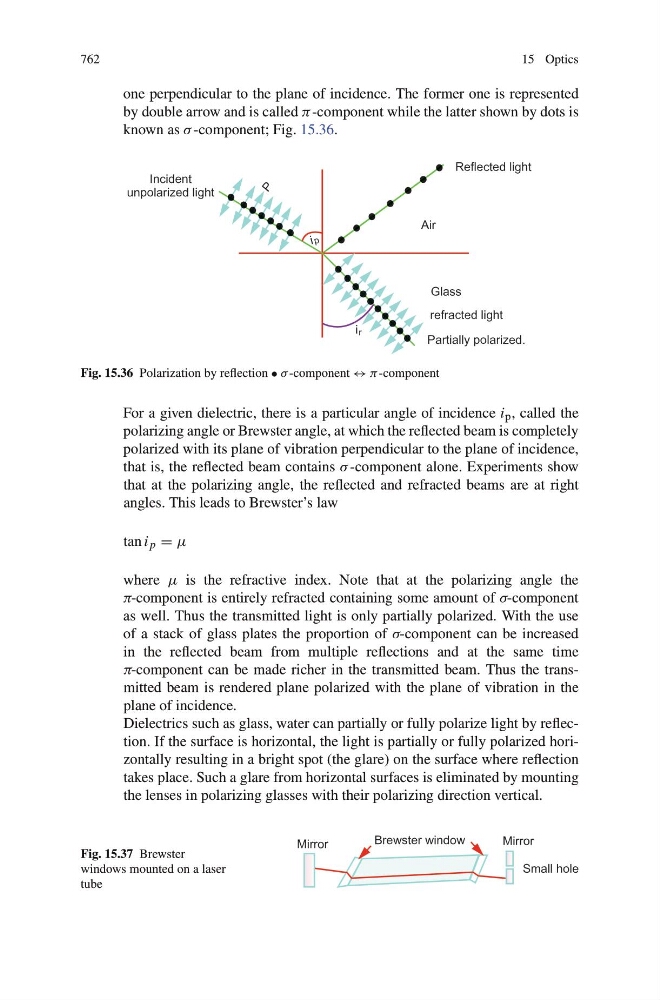
one perpendicular to the plane of incidence. The former one is represented
by double arrow and is called π -component while the latter shown by dots is
known as σ -component; Fig. 15.36.
Fig. 15.36 Polarization by reflection • σ -component ↔ π -component
For a given dielectric, there is a particular angle of incidence i p , called the
polarizing angle or Brewster angle, at which the reflected beam is completely
polarized with its plane of vibration perpendicular to the plane of incidence,
that is, the reflected beam contains σ -component alone. Experiments show
that at the polarizing angle, the reflected and refracted beams are at right
angles. This leads to Brewster’s law
tan i p = μ
where μ is the refractive index. Note that at the polarizing angle the
π-component is entirely refracted containing some amount of σ-component
as well. Thus the transmitted light is only partially polarized. With the use
of a stack of glass plates the proportion of σ-component can be increased
in the reflected beam from multiple reflections and at the same time
π-component can be made richer in the transmitted beam. Thus the transmitted beam is rendered plane polarized with the plane of vibration in the
plane of incidence.
Dielectrics such as glass, water can partially or fully polarize light by reflection. If the surface is horizontal, the light is partially or fully polarized horizontally resulting in a bright spot (the glare) on the surface where reflection
takes place. Such a glare from horizontal surfaces is eliminated by mounting
the lenses in polarizing glasses with their polarizing direction vertical.
Fig. 15.37 Brewster
windows mounted on a laser
tube