

15.3 Solutions
761
D =
θ
αL
=
13.2 ◦
66 ◦ × 2
= 0.1 g/100 c.c. = 1.0 g/L
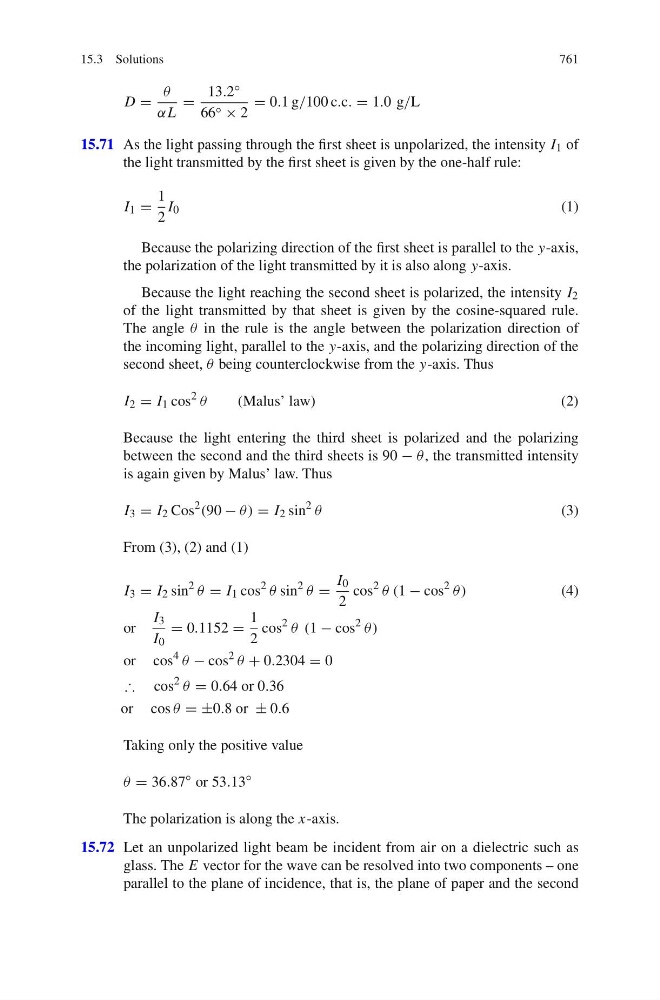
15.71 As the light passing through the first sheet is unpolarized, the intensity I 1 of
the light transmitted by the first sheet is given by the one-half rule:
I 1 =
1
2
I 0
(1)
Because the polarizing direction of the first sheet is parallel to the y-axis,
the polarization of the light transmitted by it is also along y-axis.
Because the light reaching the second sheet is polarized, the intensity I 2
of the light transmitted by that sheet is given by the cosine-squared rule.
The angle θ in the rule is the angle between the polarization direction of
the incoming light, parallel to the y-axis, and the polarizing direction of the
second sheet, θ being counterclockwise from the y-axis. Thus
I 2 = I 1 cos
2
θ
(Malus’ law)
(2)
Because the light entering the third sheet is polarized and the polarizing
between the second and the third sheets is 90 − θ , the transmitted intensity
is again given by Malus’ law. Thus
I 3 = I 2 Cos
2
(90 − θ) = I 2 sin
2
θ
(3)
From (3), (2) and (1)
I 3 = I 2 sin
2
θ = I 1 cos
2
θ sin
2
θ =
I 0
2
cos
2
θ (1 − cos
2
θ)
(4)
or
I 3
I 0
= 0.1152 =
1
2
cos
2
θ (1 − cos
2
θ)
or cos
4
θ − cos
2
θ + 0.2304 = 0
∴ cos
2
θ = 0.64 or 0.36
or cos θ = ±0.8 or ± 0.6
Taking only the positive value
θ = 36.87
◦ or 53.13
◦
The polarization is along the x-axis.
15.72 Let an unpolarized light beam be incident from air on a dielectric such as
glass. The E vector for the wave can be resolved into two components – one
parallel to the plane of incidence, that is, the plane of paper and the second