

744
15 Optics
where we have used the identity
sin B + sin C = 2 sin
B + C
2
cos
B − C
2
(4)
Equation (3) represents simple harmonic vibration of frequency ω/2π
and amplitude A = 2A cos(δ/2). The amplitude of the resulting wave
varies from 2A through 0 to −2A according to the value of δ. The resulting intensity I at the given point is proportional to the square of the
amplitude or A 2 :
I ∝ 4A
2 cos
2 δ
2
(5)
If δ = (2n + 1)π(n = 0, 1, 2, . . .) then A = 0, i.e. the crests of one
wave coincide with the troughs of the other, the two waves interfere
destructively to give zero intensity, i.e. darkness.
If δ = 2nπ , then A = 2A, i.e. the two waves interfere constructively
to produce maximum intensity of 4A 2 . Here the crests of one wave are
an integral number of wavelengths ahead of crest of the other so that the
waves are reinforced:
By eqn (1), prob. (15.21), δ =
2π
λ
(S 2 P − S 1 P) =
2π
λ
dx
L
∴ I = 4A
2 cos
2
π dx
λL
(6)
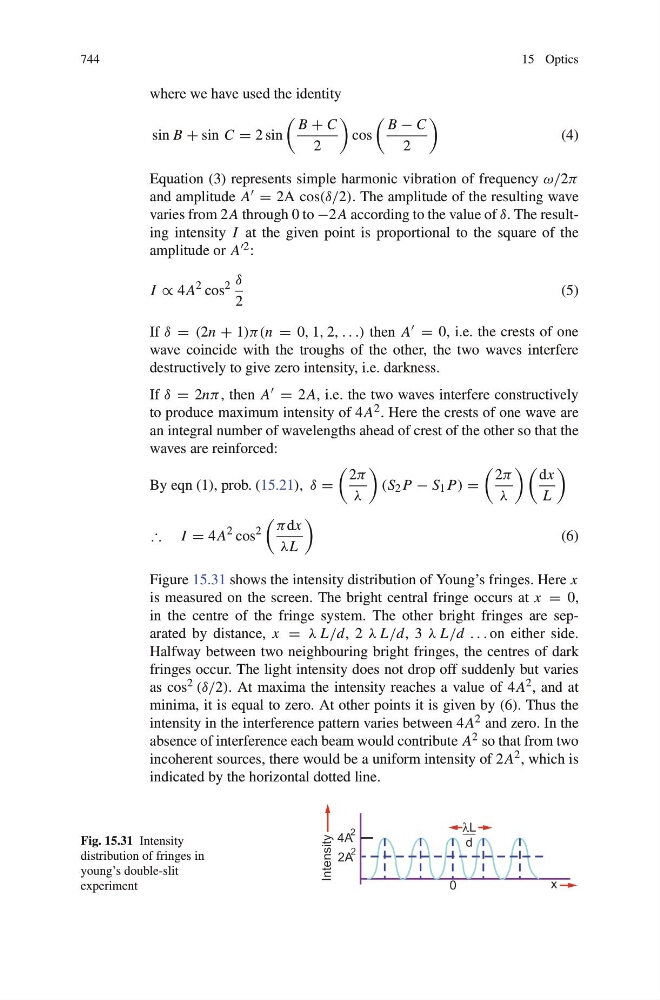
Figure 15.31 shows the intensity distribution of Young’s fringes. Here x
is measured on the screen. The bright central fringe occurs at x = 0,
in the centre of the fringe system. The other bright fringes are separated by distance, x = λ L/d, 2 λ L/d, 3 λ L/d . . . on either side.
Halfway between two neighbouring bright fringes, the centres of dark
fringes occur. The light intensity does not drop off suddenly but varies
as cos 2 (δ/2). At maxima the intensity reaches a value of 4 A 2 , and at
minima, it is equal to zero. At other points it is given by (6). Thus the
intensity in the interference pattern varies between 4 A 2 and zero. In the
absence of interference each beam would contribute A 2 so that from two
incoherent sources, there would be a uniform intensity of 2A 2 , which is
indicated by the horizontal dotted line.
Fig. 15.31 Intensity
distribution of fringes in
young’s double-slit
experiment