

15.3 Solutions
743
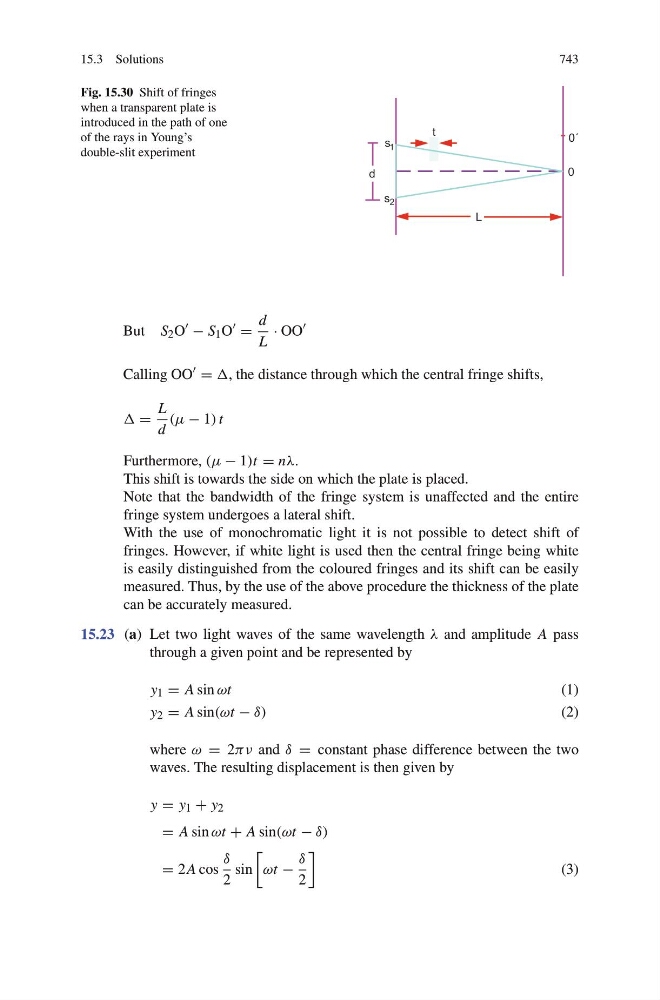
Fig. 15.30 Shift of fringes
when a transparent plate is
introduced in the path of one
of the rays in Young’s
double-slit experiment
But S 2 O
− S 1 O
=
d
L
· OO
Calling OO
= , the distance through which the central fringe shifts,
=
L
d
(μ − 1) t
Furthermore, (μ − 1)t = nλ.
This shift is towards the side on which the plate is placed.
Note that the bandwidth of the fringe system is unaffected and the entire
fringe system undergoes a lateral shift.
With the use of monochromatic light it is not possible to detect shift of
fringes. However, if white light is used then the central fringe being white
is easily distinguished from the coloured fringes and its shift can be easily
measured. Thus, by the use of the above procedure the thickness of the plate
can be accurately measured.
15.23 (a) Let two light waves of the same wavelength λ and amplitude A pass
through a given point and be represented by
y 1 = A sin ωt
(1)
y 2 = A sin(ωt − δ)
(2)
where ω = 2πν and δ = constant phase difference between the two
waves. The resulting displacement is then given by
y = y 1 + y 2
= A sin ωt + A sin(ωt − δ)
= 2A cos
δ
2
sin
ωt −
δ
2
(3)