

15.3 Solutions
741
x 2
a 2 −
y 2
b 2 = 1
( 6 )
This is the equation of a hyperbola with the centre at the origin and the foci
on the x-axis. In three dimensions, the locus of P would be a hyperboloid,
the figure of revolution of the hyperbola.
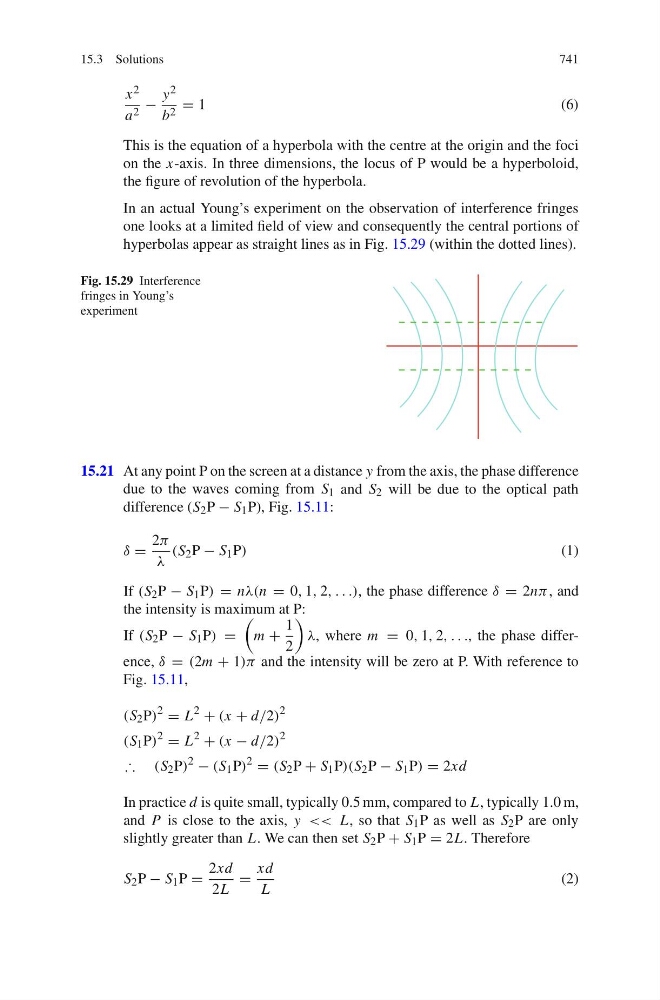
In an actual Young’s experiment on the observation of interference fringes
one looks at a limited field of view and consequently the central portions of
hyperbolas appear as straight lines as in Fig. 15.29 (within the dotted lines).
Fig. 15.29 Interference
fringes in Young’s
experiment
15.21 At any point P on the screen at a distance y from the axis, the phase difference
due to the waves coming from S 1 and S 2 will be due to the optical path
difference (S 2 P − S 1 P), Fig. 15.11:
δ =
2π
λ
(S 2 P − S 1 P)
(1)
If (S 2 P − S 1 P) = nλ(n = 0, 1, 2, . . .), the phase difference δ = 2nπ , and
the intensity is maximum at P:
If (S 2 P − S 1 P) =
m +
1
2
λ, where m = 0, 1, 2, . . ., the phase difference, δ = (2m + 1)π and the intensity will be zero at P. With reference to
Fig. 15.11,
(S 2 P)
2
= L
2
+ (x + d/2)
2
(S 1 P)
2
= L
2
+ (x − d/2)
2
∴ (S 2 P)
2
− (S 1 P)
2
= (S 2 P + S 1 P)(S 2 P − S 1 P) = 2xd
In practice d is quite small, typically 0.5 mm, compared to L, typically 1.0 m,
and P is close to the axis, y << L, so that S 1 P as well as S 2 P are only
slightly greater than L. We can then set S 2 P + S 1 P = 2L. Therefore
S 2 P − S 1 P =
2xd
2L
=
xd
L
(2)