

740
15 Optics
15.19 For a thin lens d = 0. The transformation matrix then becomes
(see prob. 15.18)
1
0
P 23 + n P 12 1
or
⎛
⎝
1
0
−(n − 1)
1
r 1
−
1
r 2
1
⎞
⎠ or
⎛
⎝
1
0
−
1
f
0
⎞
⎠
Thus −
1
f 1
−
1
f 2
= −
1
f
or
1
f 1
+
1
f 2
=
1
f
15.3.4 Interference
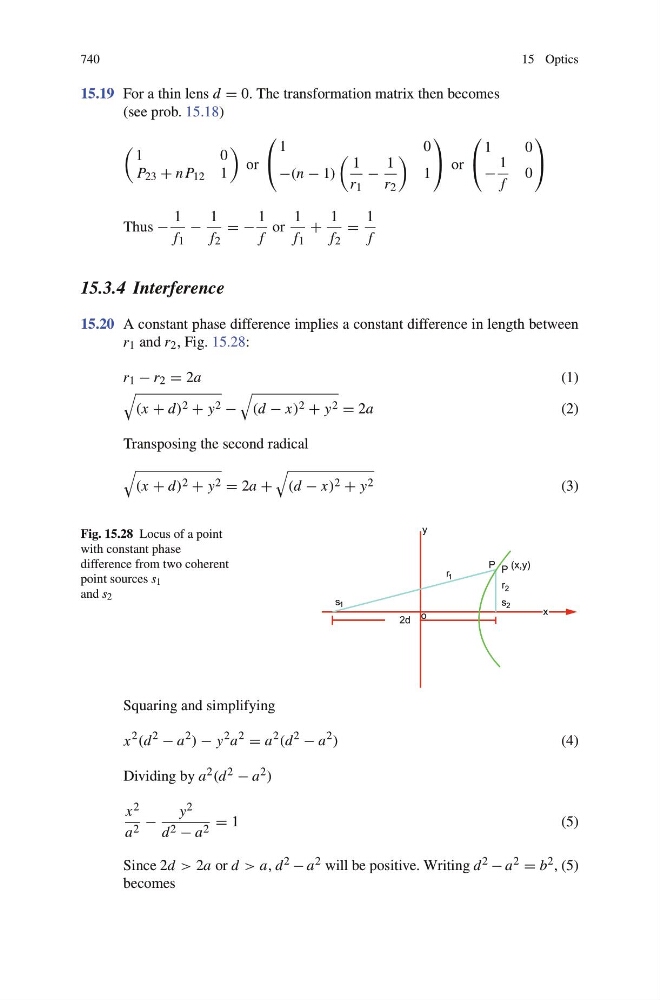
15.20 A constant phase difference implies a constant difference in length between
r 1 and r 2 , Fig. 15.28:
r 1 − r 2 = 2a
(1)
(x + d) 2 + y 2 −
(d − x) 2 + y 2 = 2a
(2)
Transposing the second radical
(x + d) 2 + y 2 = 2a +
(d − x) 2 + y 2
(3)
Fig. 15.28 Locus of a point
with constant phase
difference from two coherent
point sources s 1
and s 2
Squaring and simplifying
x
2
(d
2
− a
2
) − y
2 a
2
= a
2
(d
2
− a
2
)
(4)
Dividing by a 2 (d 2 − a 2 )
x 2
a 2 −
y 2
d 2 − a 2 = 1
( 5 )
Since 2d > 2a or d > a, d 2 − a 2 will be positive. Writing d 2 − a 2 = b 2 , (5)
becomes