

734
15 Optics
∴
1
f 1
+
1
f 2
=
1
F
= (n − 1)
1
r 1
−
1
r 2
(lens maker’s formula)
(5)
For a biconvex lens r 1 is positive and r 2 negative. For double-concave
lens r 1 is negative and r 2 positive.
(b) If the lens of refractive index n 1 is immersed in a medium of index
n 2 , then n = n 1 /n 2 , n = 1.2/1.33 = 0.9, and the first bracket in (5)
becomes n − 1 = −0.1 resulting in a negative value of F. Thus the
plastic lens immersed in water acts as a diverging lens.
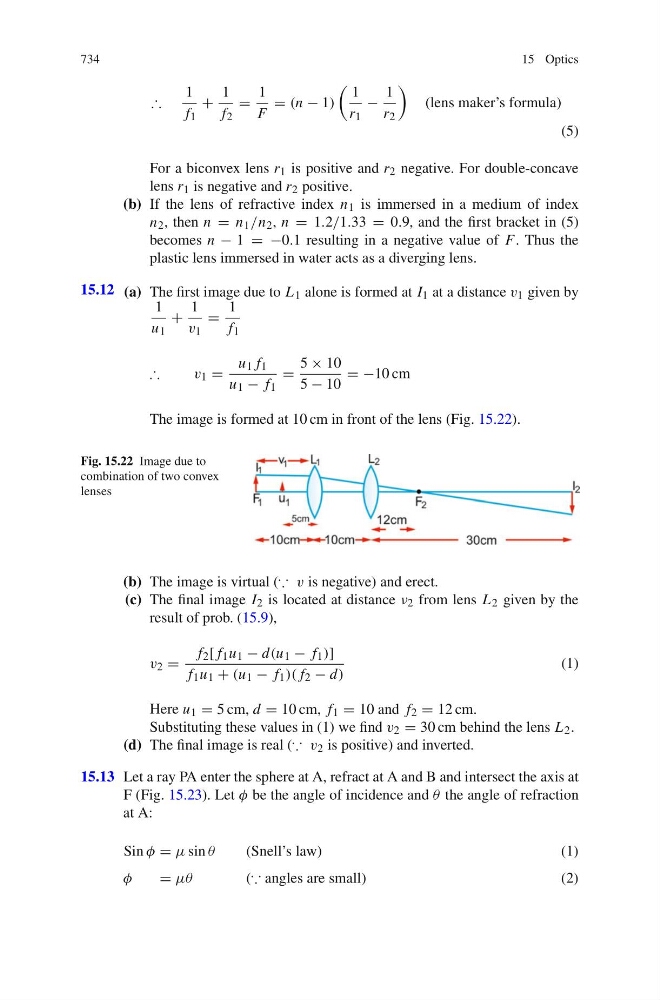
15.12 (a) The first image due to L 1 alone is formed at I 1 at a distance v 1 given by
1
u 1
+
1
v 1
=
1
f 1
∴
v 1 =
u 1 f 1
u 1 − f 1
=
5 × 10
5 − 10
= −10 cm
The image is formed at 10 cm in front of the lens (Fig. 15.22).
Fig. 15.22 Image due to
combination of two convex
lenses
(b) The image is virtual (∵ v is negative) and erect.
(c) The final image I 2 is located at distance ν 2 from lens L 2 given by the
result of prob. (15.9),
v 2 =
f 2 [ f 1 u 1 − d(u 1 − f 1 )]
f 1 u 1 + (u 1 − f 1 )( f 2 − d)
(1)
Here u 1 = 5 cm, d = 10 cm, f 1 = 10 and f 2 = 12 cm.
Substituting these values in (1) we find v 2 = 30 cm behind the lens L 2 .
(d) The final image is real (∵ v 2 is positive) and inverted.
15.13 Let a ray PA enter the sphere at A, refract at A and B and intersect the axis at
F (Fig. 15.23). Let φ be the angle of incidence and θ the angle of refraction
at A:
Sin φ = μ sin θ
(Snell’s law)
(1)
φ
= μθ
(∵ angles are small)
(2)