

15.3 Solutions
733
(d) From the result of (c), we have
d
2
=
D
f
(D − 4 f )
Since d 2 must be positive, it follows that D > 4 f .
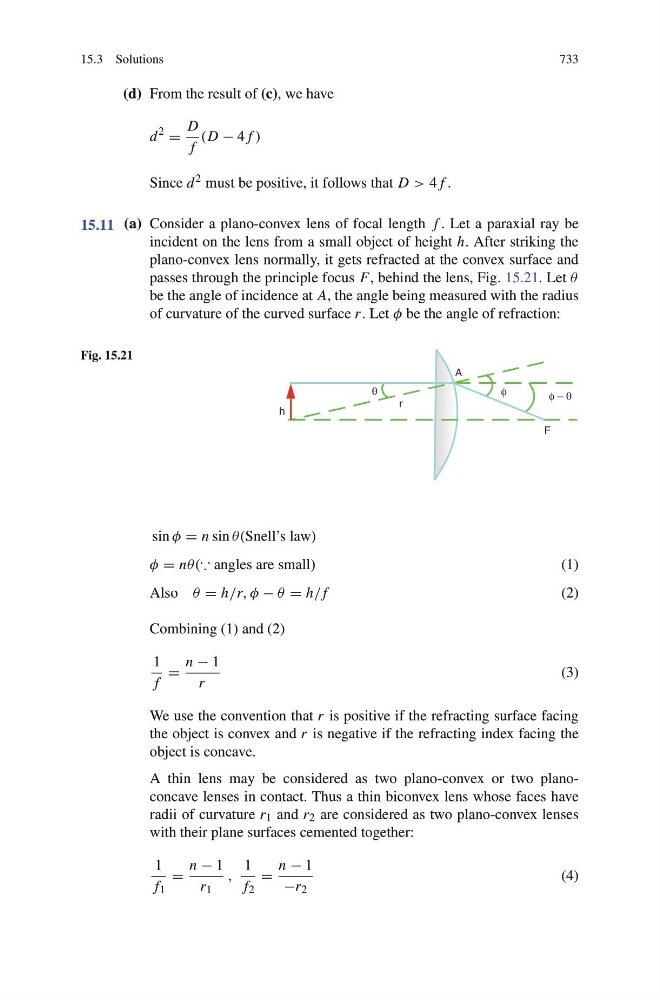
15.11 (a) Consider a plano-convex lens of focal length f . Let a paraxial ray be
incident on the lens from a small object of height h. After striking the
plano-convex lens normally, it gets refracted at the convex surface and
passes through the principle focus F, behind the lens, Fig. 15.21. Let θ
be the angle of incidence at A, the angle being measured with the radius
of curvature of the curved surface r . Let φ be the angle of refraction:
Fig. 15.21
A
sin φ = n sin θ (Snell’s law)
φ = nθ (∵ angles are small)
(1)
Also θ = h/r, φ − θ = h/ f
(2)
Combining (1) and (2)
1
f
=
n − 1
r
(3)
We use the convention that r is positive if the refracting surface facing
the object is convex and r is negative if the refracting index facing the
object is concave.
A thin lens may be considered as two plano-convex or two planoconcave lenses in contact. Thus a thin biconvex lens whose faces have
radii of curvature r 1 and r 2 are considered as two plano-convex lenses
with their plane surfaces cemented together:
1
f 1
=
n − 1
r 1
,
1
f 2
=
n − 1
−r 2
(4)