

720
15 Optics
15.31 In Young’s experiment for what order does the band of wavelength of red
light (λ = 780 nm) coincide with (m + 1)th order in the band of blue light
(λ = 520 nm)?
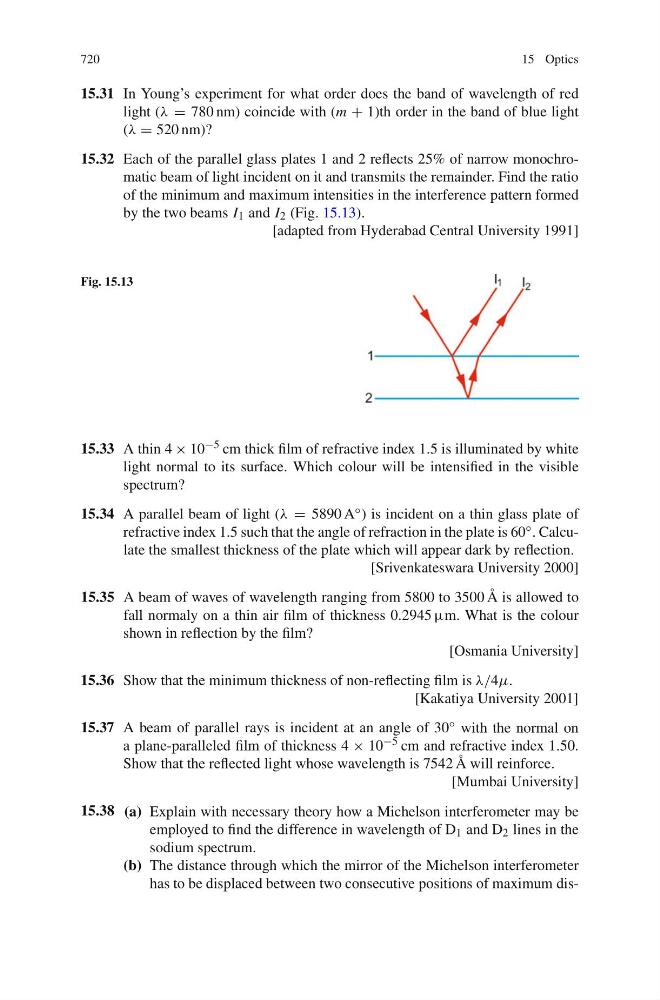
15.32 Each of the parallel glass plates 1 and 2 reflects 25% of narrow monochromatic beam of light incident on it and transmits the remainder. Find the ratio
of the minimum and maximum intensities in the interference pattern formed
by the two beams I 1 and I 2 (Fig. 15.13).
[adapted from Hyderabad Central University 1991]
Fig. 15.13
15.33 A thin 4 × 10 −5 cm thick film of refractive index 1.5 is illuminated by white
light normal to its surface. Which colour will be intensified in the visible
spectrum?
15.34 A parallel beam of light (λ = 5890 A ◦ ) is incident on a thin glass plate of
refractive index 1.5 such that the angle of refraction in the plate is 60 ◦ . Calculate the smallest thickness of the plate which will appear dark by reflection.
[Srivenkateswara University 2000]
15.35 A beam of waves of wavelength ranging from 5800 to 3500 Å is allowed to
fall normaly on a thin air film of thickness 0.2945 μm. What is the colour
shown in reflection by the film?
[Osmania University]
15.36 Show that the minimum thickness of non-reflecting film is λ/4μ.
[Kakatiya University 2001]
15.37 A beam of parallel rays is incident at an angle of 30 ◦ with the normal on
a plane-paralleled film of thickness 4 × 10 −5 cm and refractive index 1.50.
Show that the reflected light whose wavelength is 7542 Å will reinforce.
[Mumbai University]
15.38 (a) Explain with necessary theory how a Michelson interferometer may be
employed to find the difference in wavelength of D 1 and D 2 lines in the
sodium spectrum.
(b) The distance through which the mirror of the Michelson interferometer
has to be displaced between two consecutive positions of maximum dis-