

15.2 Problems
719
15.25 The inclined faces of a biprism of refractive index 1.50 make an angle of
2 ◦ with the base. A slit illuminated by monochromatic light is placed at a
distance of 10 cm from the biprism. If the distance between two dark fringes
observed at a distance of 1 m from the prism is 0.18 mm, find the wavelength
of light used.
[University of Delhi]
15.26 A beam of monochromatic light of wavelength 5.82 × 10 −7 m falls normally
on a glass wedge with the wedge angle of 20 s of an arc. If the refractive
index of glass is 1.5, find the number of interference fringes per centimetre
of the wedge length.
[Indian Administration Services]
15.27 Light of wavelength 6000 Å falls normally on a thin wedge film of refractive
index 1.4, forming fringes that are 2 mm apart. Find the angle of the wedge.
[Delhi University]
15.28 In Newton’s rings apparatus, the radii of the nth and (n + 20)th dark rings
are found to be 0.162 and 0.368 cm, respectively, when light of wavelength
546 nm is used. Calculate the radius of curvature, R, of the lower surface of
the lens.
[University of Manchester 2007]
15.29 The radius of the 10th dark ring in Newton’s rings apparatus changes from
60 to 50 mm when a liquid is introduced between the lens and the plate.
Calculate the refraction index of the liquid.
[Nagarjuna University 2003]
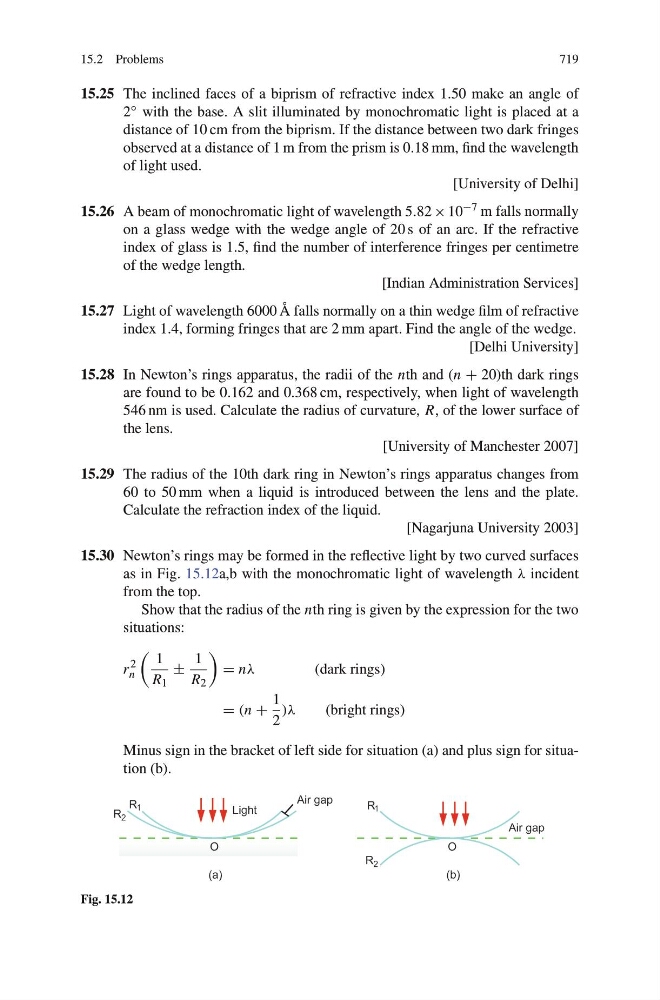
15.30 Newton’s rings may be formed in the reflective light by two curved surfaces
as in Fig. 15.12a,b with the monochromatic light of wavelength λ incident
from the top.
Show that the radius of the nth ring is given by the expression for the two
situations:
r
2
n
1
R 1
±
1
R 2
= nλ
(dark rings)
= (n +
1
2
)λ
(bright rings)
Minus sign in the bracket of left side for situation (a) and plus sign for situation (b).
Fig. 15.12