

15.1 Basic Concepts and Formulae
707
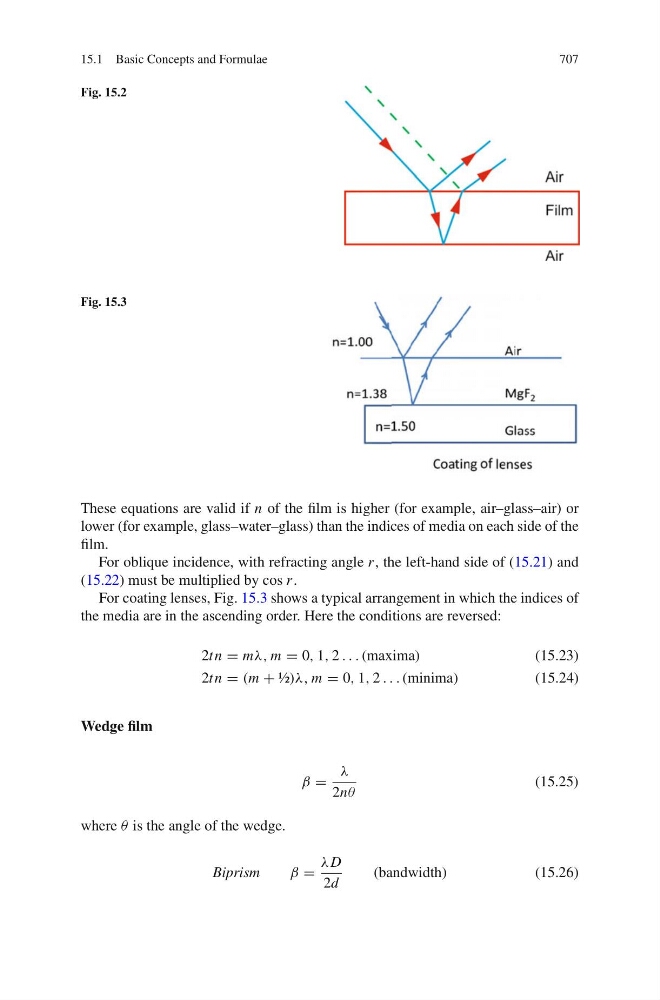
Fig. 15.2
Fig. 15.3
These equations are valid if n of the film is higher (for example, air–glass–air) or
lower (for example, glass–water–glass) than the indices of media on each side of the
film.
For oblique incidence, with refracting angle r , the left-hand side of (15.21) and
(15.22) must be multiplied by cos r .
For coating lenses, Fig. 15.3 shows a typical arrangement in which the indices of
the media are in the ascending order. Here the conditions are reversed:
2tn = mλ, m = 0, 1, 2 . . . (maxima)
(15.23)
2tn = (m + ½)λ, m = 0, 1, 2 . . . (minima)
(15.24)
Wedge film
β =
λ
2nθ
(15.25)
where θ is the angle of the wedge.
Biprism
β =
λD
2d
(bandwidth)
(15.26)