

678
14 Electromagnetism II
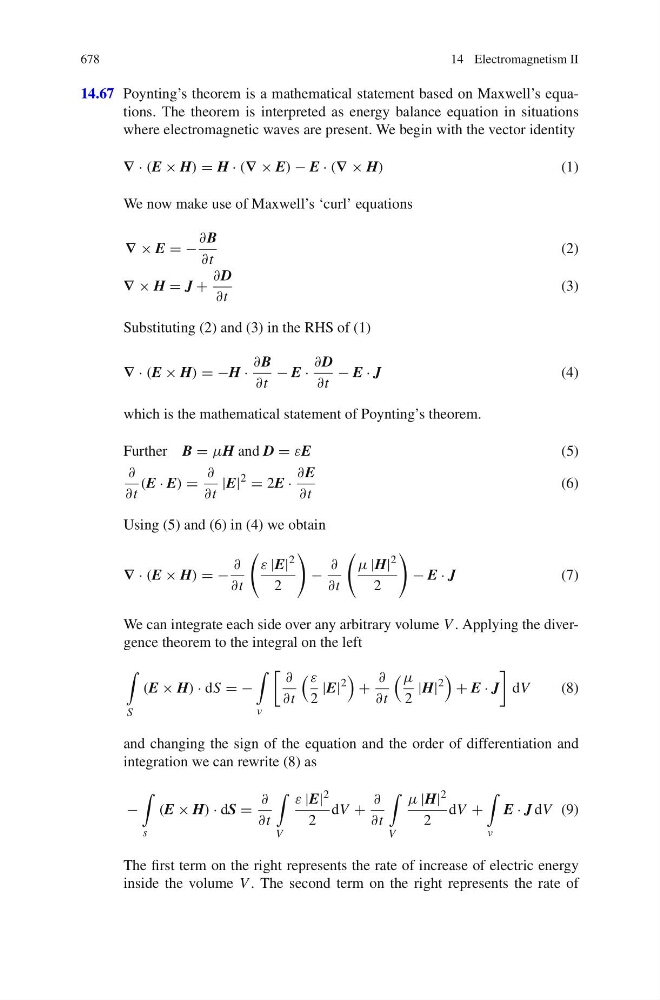
14.67 Poynting’s theorem is a mathematical statement based on Maxwell’s equations. The theorem is interpreted as energy balance equation in situations
where electromagnetic waves are present. We begin with the vector identity
∇ · (E × H) = H · (∇ × E) − E · (∇ × H)
(1)
We now make use of Maxwell’s ‘curl’ equations
∇ × E = −
∂B
∂t
(2)
∇ × H = J +
∂D
∂t
(3)
Substituting (2) and (3) in the RHS of (1)
∇ · (E × H) = −H ·
∂B
∂t
− E ·
∂D
∂t
− E · J
(4)
which is the mathematical statement of Poynting’s theorem.
Further B = μH and D = εE
(5)
∂
∂t
(E · E) =
∂
∂t
|E|
2
= 2E ·
∂E
∂t
(6)
Using (5) and (6) in (4) we obtain
∇ · (E × H) = −
∂
∂t
ε |E|
2
2
−
∂
∂t
μ |H|
2
2
− E · J
(7)
We can integrate each side over any arbitrary volume V . Applying the divergence theorem to the integral on the left
S
(E × H) · dS = −
ν
∂
∂t
ε
2
|E|
2
+
∂
∂t
μ
2
|H|
2
+ E · J
dV
(8)
and changing the sign of the equation and the order of differentiation and
integration we can rewrite (8) as
−
s
(E × H) · dS =
∂
∂t
V
ε |E| 2
2
dV +
∂
∂t
V
μ |H| 2
2
dV +
ν
E · J dV (9)
The first term on the right represents the rate of increase of electric energy
inside the volume V . The second term on the right represents the rate of