

14.3 Solutions
677
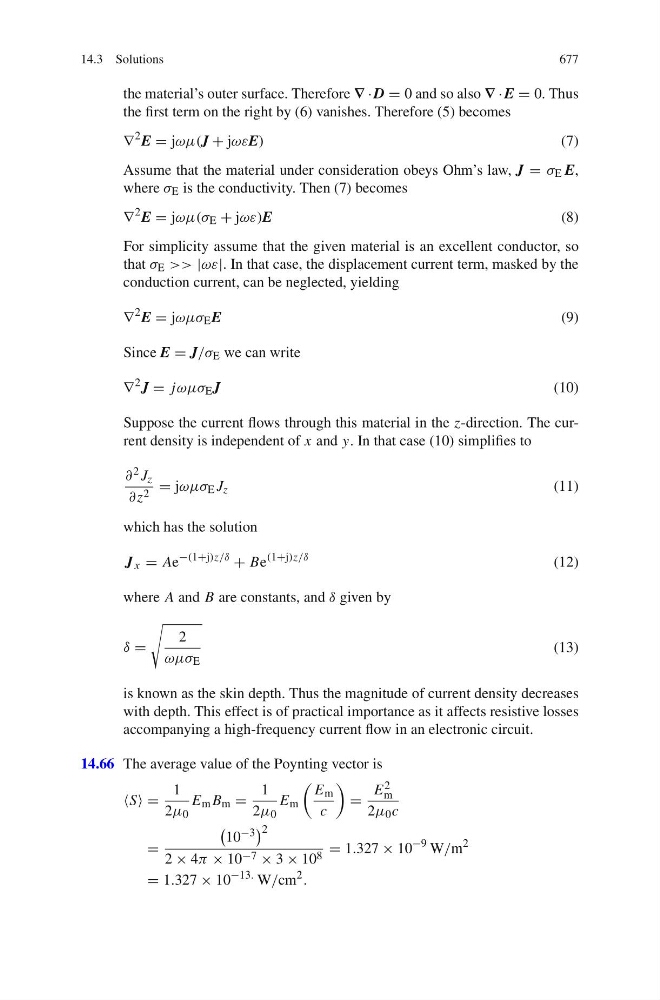
the material’s outer surface. Therefore ∇ · D = 0 and so also ∇ · E = 0. Thus
the first term on the right by (6) vanishes. Therefore (5) becomes
∇
2 E = jωμ(J + jωεE)
(7)
Assume that the material under consideration obeys Ohm’s law, J = σ E E,
where σ E is the conductivity. Then (7) becomes
∇
2 E = jωμ(σ E + jωε)E
(8)
For simplicity assume that the given material is an excellent conductor, so
that σ E >> |ωε|. In that case, the displacement current term, masked by the
conduction current, can be neglected, yielding
∇
2 E = jωμσ E E
(9)
Since E = J/σ E we can write
∇
2 J = jωμσ E J
(10)
Suppose the current flows through this material in the z-direction. The current density is independent of x and y. In that case (10) simplifies to
∂ 2 J z
∂z 2 = jωμσ E J z
(11)
which has the solution
J x = Ae
−(1+j)z/δ
+ Be
(1+j)z/δ
(12)
where A and B are constants, and δ given by
δ =
2
ωμσ E
(13)
is known as the skin depth. Thus the magnitude of current density decreases
with depth. This effect is of practical importance as it affects resistive losses
accompanying a high-frequency current flow in an electronic circuit.
14.66 The average value of the Poynting vector is
S =
1
2μ 0
E m B m =
1
2μ 0
E m
E m
c
=
E 2
m
2μ 0 c
=
10 −3 2
2 × 4π × 10 −7 × 3 × 10 8 = 1.327 × 10
−9 W/m
2
= 1.327 × 10
−13. W/cm
2
.